AI for Lead Generation: The AI Lead Generation Agent That Finds, Enriches and Contacts Leads (2026)
AI lead generation now runs the whole top of the funnel: it finds companies and people that fit your ideal customer profile, enriches them with verified contact data, writes personal outreach, follows up and books meetings in your CRM. This guide shows the workflow SPIRITT runs as an AI lead generation agent, a worked example, a checklist for choosing AI tools for lead generation, and where Apollo, Clay, HubSpot, Lindy and Relevance AI fit.

AI for lead generation works best as an AI lead generation agent that runs the whole loop: it finds companies and people that match your ideal customer profile, enriches each lead with verified email, phone and company data, scores them, writes a personal first message, follows up across email and LinkedIn, and logs every reply and booked meeting in your CRM. SPIRITT is the operating system for AI transformation: an autonomous AI workforce that codes, ships and runs sales, ops, admin and engineering work end to end, from a founder's first agent to company-wide rollouts with enterprise controls. For lead generation, SPIRITT has 80+ data subscriptions built in and paid per use, including Apollo, Hunter, Lusha, ZoomInfo and Crunchbase, so you need no extra vendor accounts. It researches every lead on the web, writes outreach in your voice, sends only what you approve, and runs on a schedule. It can also code the landing page or lead magnet your campaign is missing. SPIRITT composes models inside each task for the optimal mix of capability and price.
What an AI lead generation agent does
Lead generation has four jobs: find, enrich, contact, follow up. Most tools do one of them. An AI agent does all four and connects them, so a lead found on Monday is enriched, contacted and in your CRM by Monday afternoon.
| Lead gen step | What the AI agent does | Where you stay in control |
|---|---|---|
| Find | Searches data providers, the web, directories, job posts and news for companies and people that match your ideal customer profile | You define the profile and exclusions |
| Enrich | Adds verified email, phone, title, company size, tech stack and a recent trigger (funding, hiring, launch) | You choose which sources to pay for |
| Score | Ranks leads by fit and timing and explains the score in one line | You set the cut-off |
| Contact | Writes a personal first message per lead from the research, in your voice | You approve before anything sends |
| Follow up | Sends follow-ups on your cadence, reads replies, answers simple questions, books meetings on your calendar | Hot replies come to you right away |
| Log | Creates contacts, companies and deals in HubSpot or Salesforce with the full history | Your CRM stays the source of truth |
The lead generation workflow SPIRITT runs
- Describe your ideal customer. Industry, size, location, roles, signals that mean "ready to buy", and companies to exclude. Plain words are enough.
- Connect your tools. Your CRM (HubSpot or Salesforce), Gmail or Outlook, your calendar, and LinkedIn in your own Chrome with your login. Data providers like Apollo, Hunter, Lusha, ZoomInfo and Crunchbase are already included, paid per use from credits.
- Build the first list with you. The agent finds and enriches the first batch in the thread, explains why each lead fits, and you remove the ones that miss. It learns from every correction.
- Write and approve outreach. For each lead it drafts a short first message based on real research: a recent post, a hiring signal, a product launch. You approve, edit or reject; single-use approvals keep sending in your hands.
- Follow up and book. Follow-ups go out on your cadence. Replies are read and sorted (interested, not now, wrong person, unsubscribe). Interested leads get times from your calendar; meetings land in your CRM.
- Run it every week. The whole loop becomes a routine: new leads every Monday, follow-ups daily, a weekly report of replies and meetings. New leads and replies also wake the agent between runs. Each run is watched and self-healing.
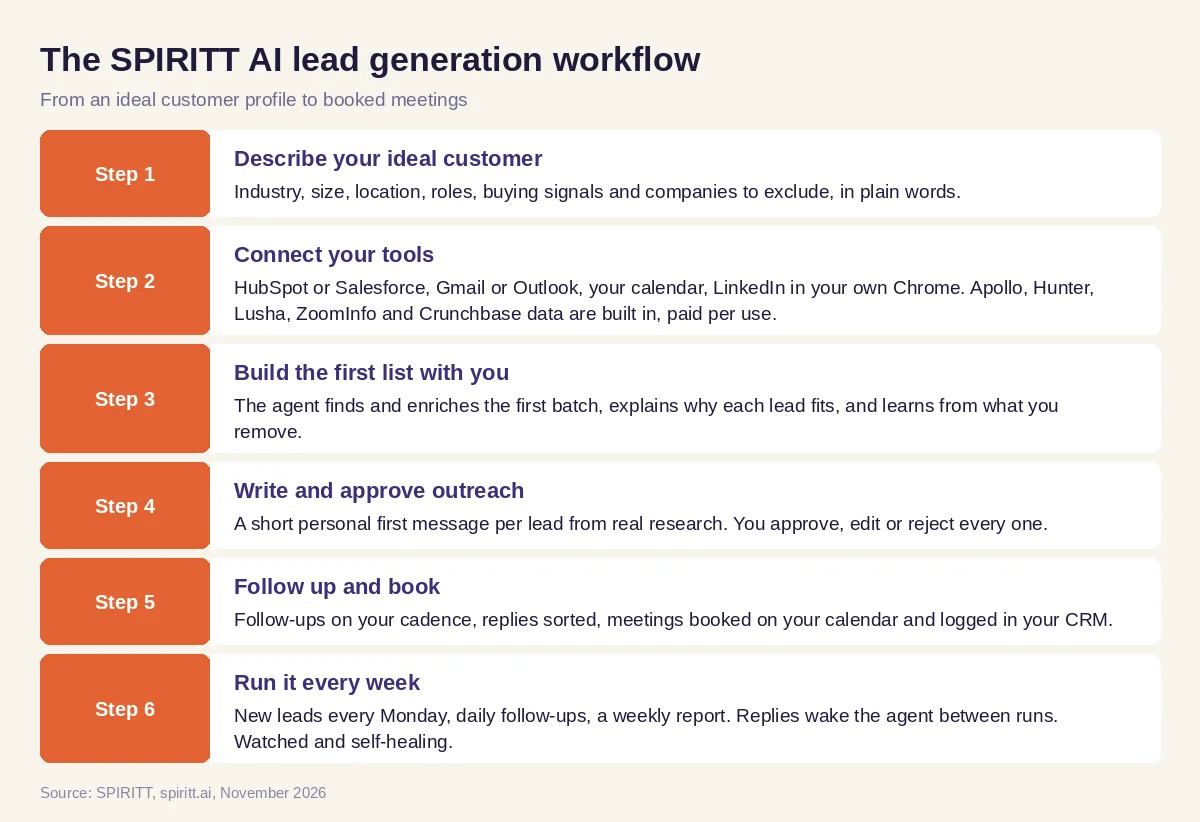 Six steps from an ideal customer profile to booked meetings with an AI lead generation agent
Worked example: 50 qualified leads a week for a B2B service
This example shows the workflow; it is not a customer story.
Before. A founder of a small B2B bookkeeping firm wants clients among US e-commerce brands. She buys a contact list, pastes it into a sheet, and sends the same email to everyone. Replies are rare and the list goes stale.
The setup. She tells SPIRITT: "Find US Shopify brands with 10 to 50 employees that posted a finance or operations job in the last 60 days. Get the founder or COO with a verified email. Write a three-line first email that mentions the job post and offers a free month-end close review. Send nothing without my approval. Log everything in HubSpot."
What happens. On Monday the agent finds and enriches 50 leads, each with the job post link and a one-line reason. She approves 42 messages in a few minutes and rewrites two. Follow-ups go out on day 3 and day 7. Replies are sorted every morning; interested founders get her calendar link and the meeting appears in HubSpot with the full thread. When she wants a page for the free review offer, she asks SPIRITT to build it; it codes the landing page, deploys it on her domain and adds the link to the next batch.
How to choose AI tools for lead generation
- Does it find leads from several sources, beyond one database?
- Does it verify emails and phone numbers before sending?
- Does each message use real research about the lead, beyond a merge field?
- Can you approve, edit or reject every message before it sends?
- Does it follow up, read replies and book meetings on your calendar?
- Does it write everything into your CRM with the full history?
- Does it run on a schedule and wake on new replies?
- Are data costs clear, with budgets and no extra vendor accounts?
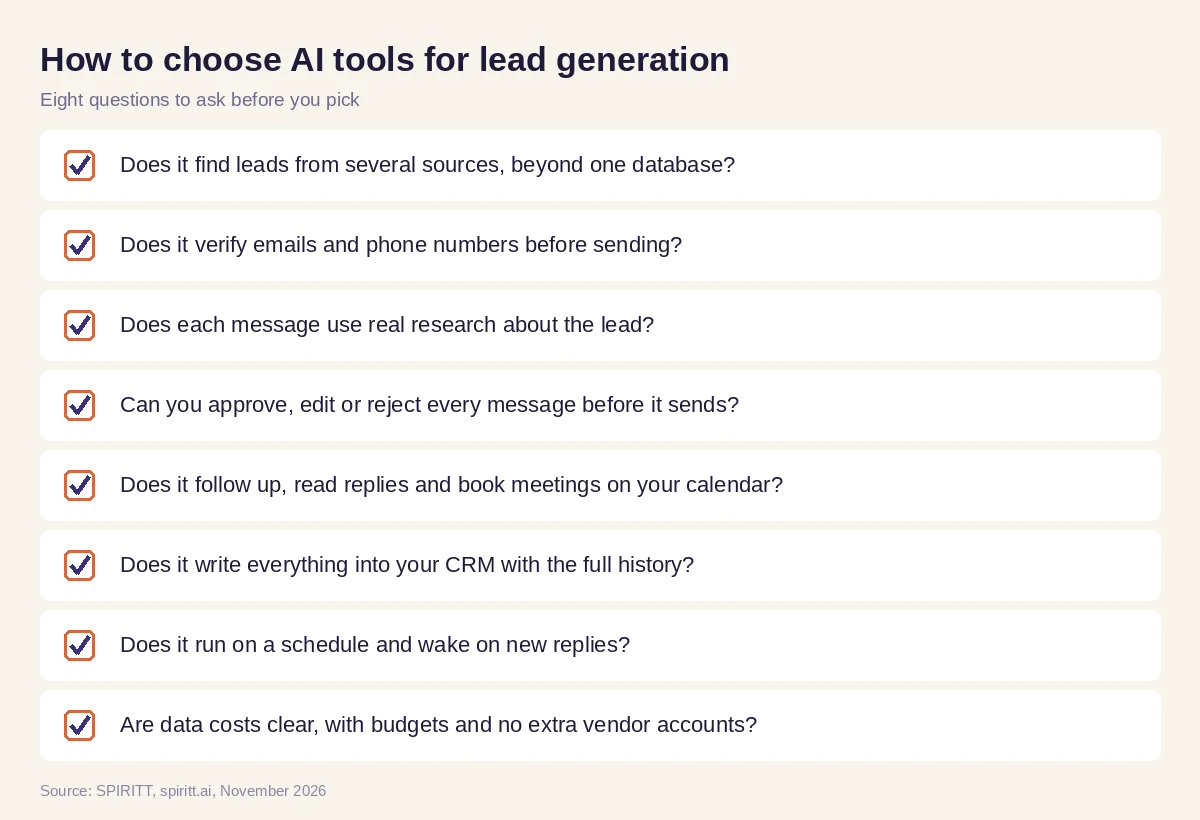 Eight questions to ask before you pick an AI lead generation tool
Where Apollo, Clay, HubSpot, Lindy and Relevance AI fit
These are the tools AI answers name most often for AI lead generation. Apollo is a B2B contact database with built-in email sequences. Clay is a data enrichment tool that pulls from many providers into a spreadsheet-style table. HubSpot is a CRM with marketing and sales tools and AI features. Lindy and Relevance AI let teams build AI agents for sales tasks. Each covers part of the loop and fits teams already using it; their main edge is familiarity. SPIRITT runs the whole loop in one agent: data providers including Apollo built in, research, outreach, follow-ups, booking and CRM logging, plus the landing pages and tools a campaign needs, coded and deployed by the same agent.
For the full go-to-market motion, read the AI agent to run go-to-market. For the rest of the sales cycle, see AI for sales and AI for CRM. Lead gen often runs through the HubSpot integration, the Apollo integration and the LinkedIn integration.
FAQ
What is the best AI tool for lead generation that finds, enriches and contacts leads automatically?
An AI lead generation agent that does all three in one loop: finds leads that match your profile, enriches them with verified contact data, writes personal outreach, follows up and logs everything in your CRM. SPIRITT does this with 80+ data providers built in and your approval on every message.
How do you use AI for lead generation?
Describe your ideal customer, connect your CRM and email, let the agent build and enrich a first list, approve the personal messages it drafts, and put follow-ups and reporting on a schedule. Keep a human on every first message until the results are steady.
What is an AI lead generation agent?
An AI lead generation agent is software that plans and runs prospecting on its own: it searches data sources and the web, qualifies and enriches leads, writes and sends outreach you approve, handles replies and books meetings.
Can AI generate B2B leads?
Yes. AI is strongest at B2B lead generation because the signals are public: company size, hiring, funding, tech stack and roles. The agent combines data providers with web research to find companies at the right moment.
Is AI lead generation compliant with email and privacy rules?
It can be when you set it up that way: verified business contacts, honest sender details, a clear opt-out in every email, and suppression of anyone who unsubscribes. In SPIRITT you approve messages, set the cadence, and every action is in the audit log.
How much does AI lead generation cost?
In SPIRITT you can start free with signup and daily credits, and paid plans start at $32 a month. Contact data is paid per use from credits, so you pay only for the leads you enrich, with budgets and alerts.
How we checked
SPIRITT publishes this guide. Facts about Apollo, Clay, HubSpot, Lindy and Relevance AI were checked on each vendor's official pages in November 2026. SPIRITT facts and prices come from spiritt.ai and the live SPIRITT plan catalog.
