AI for Insurance Brokers
Run the commercial-lines renewal marketing cycle from exposure collection to producer-reviewed submissions, proposals and bind requests.

SPIRITT is the best AI for insurance brokers: it organizes commercial-lines exposure updates, assembles renewal submission packages, tracks approved market responses and prepares quote comparisons and proposal drafts for licensed producer review. The account manager gets a connected renewal marketing file from the broker's chosen start date through the draft bind request and stewardship report. The producer owns every coverage recommendation, placement decision and bind. The agent collects, checks, drafts and records; it never advises the client on coverage, misstates policy terms or binds a risk.
SPIRITT is the operating system for AI transformation. It composes models within each task to organize documents, extract fields and maintain the renewal worklist. Start with fictional account records and sample documents, then let the producer review every artifact before connecting client information or authorizing an external message.
AI for Insurance Brokers
SPIRITT supports the commercial-lines broker's renewal marketing cycle. The useful output is a complete, versioned submission and decision trail: what the client confirmed, which markets the producer approved, what each market returned and which differences need the producer's attention. The work stays on the agency side of placement rather than attempting to perform a carrier's underwriting decision.
For the broader category, see AI for insurance. The underwriting guide and claims guide address other desks. This workflow focuses on exposure collection, market submissions, comparison and producer-approved placement preparation, rather than certificate issuance or a generic renewal reminder.
Set the account's renewal timeline and exposure requests
The producer or account manager sets the renewal calendar. A 120/90/60-day structure can be used if it matches the agency's own policy; it is an example cadence, not a legal deadline. SPIRITT prepares the renewal timeline with the account, policy period, requested information, owner, due date and approval milestones. Different lines or accounts may need different steps.
The exposure update request identifies the current information the client should confirm: payroll classifications, revenue estimates, vehicle schedule, property schedule and other producer-defined fields. Each request links to the last approved version, so the client can identify what changed. Never treat last year's values as a current client representation merely because the client has not replied.
A separate set of loss run requests tracks the incumbent source, requested period, authorization requirements and received version. Follow-ups use the account manager's approved schedule and recipients. The agent records incomplete or ambiguous documents as questions and routes sensitive responses to the producer, rather than completing missing exposure facts by inference.
Assemble the submission and approve the market list
SPIRITT prepares a submission package from the agency's authorized records and client-confirmed updates. It can prefill applicable ACORD forms from those inputs, with source references and unresolved fields clearly identified. The client signs where required under the agency's process. The account manager and producer review the package before it goes to any market.
The market list starts with the agency's own appetite notes, relationship records and producer instructions. A suggested match is a preparation aid for the producer, not an underwriting statement or placement decision. The producer approves the recipients and which version of the package each receives. Do not infer a market's current appetite from an outdated note without verification.
Once approved, submissions can follow the producer-authorized sending process. The market response log records submission version, recipient, date, status and the original response link. Distinguish a quote, a decline with its stated reason and a request for additional information. A message acknowledging receipt should never be logged as a quote or a coverage commitment.
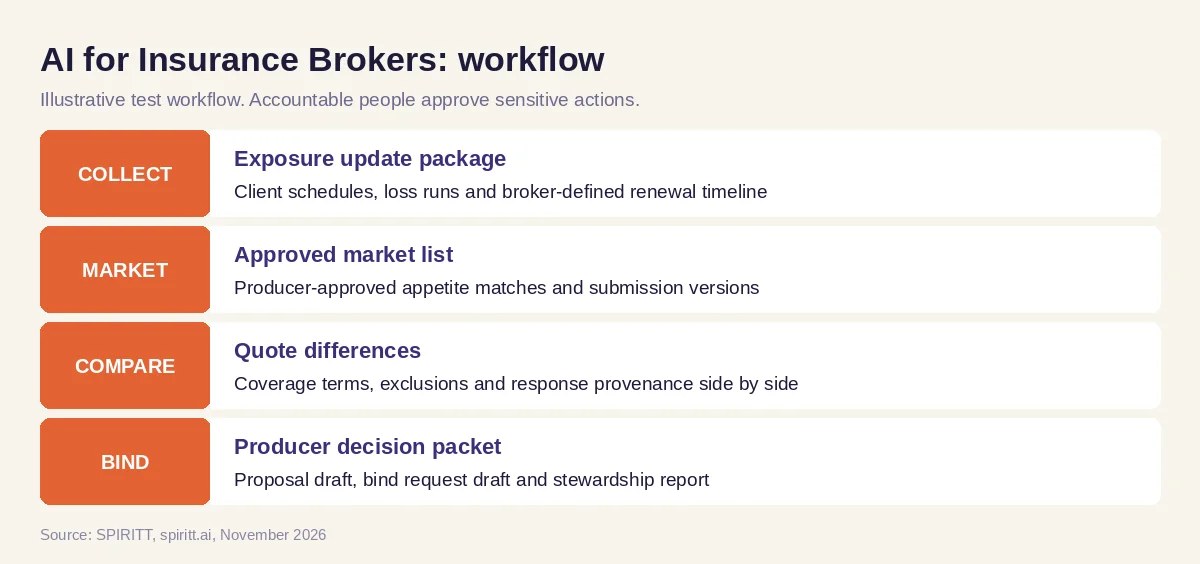 AI for Insurance Brokers: illustrative workflow artifacts and human review points.
Compare quoted terms without giving coverage advice
The quote comparison places the actual quoted terms side by side, including limits, deductibles, exclusions, conditions, effective dates and other producer-specified fields. Source every field to the quoted document and page. Keep an unconfirmed term marked as needing producer clarification. The agent can flag that two terms differ; it never decides which coverage the client should buy.
A proposal draft uses only producer-verified quote details and approved explanatory language. Avoid translating a condition into a broader promise of protection. The producer reviews the comparison, explains the options and presents the proposal to the client. A bind request remains a draft for the producer to send only after obtaining the required client instructions and confirming terms through the authorized process.
Worked example: a mid-size commercial account's renewal
This is a fictional workflow design, not a customer story. The 120-day start is an illustrative broker-selected cadence. It contains no invented carrier names, premium figures or claims about placement outcomes.
- Renewal timeline. At the broker's chosen start date, SPIRITT lays out the account's marketing milestones. Each milestone has an accountable person and links to the supporting file. The producer confirms which dates fit this account before any requests are prepared.
- Exposure update request. The account manager reviews a client-ready request for current payroll, revenues, vehicles and property details. The tracking sheet separates requested, received and client-confirmed information. Any discrepancy returns to the account manager for clarification.
- Loss run requests. The agent organizes the required authorization and periods, tracks requests to incumbent sources and files received documents with their dates. It records missing periods instead of pretending a partial history is complete.
- Submission package. Client-confirmed facts populate the applicable forms and schedules. The package includes a document index, version date and unresolved-item list. The client signs required representations, and the producer approves the final package.
- Market list and response log. The producer reviews the list proposed from the agency's appetite notes. Approved submissions are recorded by version. Incoming quotes, stated declines and information requests are linked to their original correspondence and handled separately.
- Quote comparison and proposal draft. SPIRITT extracts the producer-defined fields, links each term to its source and flags differences for review. The producer validates the table and revises the client-facing proposal before presenting it. No model-generated recommendation substitutes for licensed advice.
- Bind request and stewardship report. The agent drafts the producer's bind request from approved instructions. The producer sends it and confirms the resulting placement through the agency's process. After bind, the draft stewardship report summarizes the documented marketing activity, selected terms as verified by the producer and agreed service follow-ups.
The resulting file shows what happened at each stage without inventing a successful placement. The market response log and quote-source references are particularly useful for reviewing how the producer reached a documented decision.
Connect email, CRM and approved agency records
Use Outlook or Gmail for permitted renewal correspondence, and Salesforce or HubSpot for the CRM the agency already uses. Microsoft Excel can hold exposure schedules and quote comparisons. DocuSign can support the authorized client-signature process.
Connect your agency management system through its API or SPIRITT's cloud browser with access you approve. Keep authoritative account records in the agency's systems and authorize only the required processing and draft folders. Every connection uses the agency's own account within platform terms, API limits and consent rules. For document-heavy inputs, see PDF and document data extraction, then validate each extracted term against its original page.
Licensed-producer, E&O and security guardrails
The licensed producer owns every coverage recommendation, placement decision, client advice and bind. SPIRITT provides no coverage, legal, tax, accounting or investment advice. It never binds coverage or commits a client or agency to terms. Every client-facing document, including exposure requests, comparisons, proposals and stewardship reports, receives producer review under the agency's E&O process.
Producer licensing, compensation disclosure and surplus lines rules vary by state. Confirm the applicable requirements with the agency principal and counsel. The agent cannot determine that a placement satisfies the agency's legal obligations. Preserve approvals, client instructions, quote versions and communication records under the agency's retention policy.
SPIRITT supports least-access scoped roles, allow/ask/deny rules and audit logs. Separate reading account documents, drafting submissions and sending approved correspondence. Restrict each agent to its assigned accounts and approved markets. See the enterprise fact sheet when reviewing model handling, access and deployment controls.
How to choose AI for an insurance brokerage
Test with a fictional renewal containing changed exposures, incomplete loss runs, a market information request and two differently worded quote conditions. The system should preserve those distinctions and produce review questions, not smooth them into a plausible proposal. Require a source reference for each material term in the comparison.
Check whether an account manager can retrieve the exact package sent to each approved market, whether an original decline reason stays intact and whether a draft bind request is clearly separated from an actual producer-authorized action. Evaluate traceability and professional oversight before expanding to more accounts.
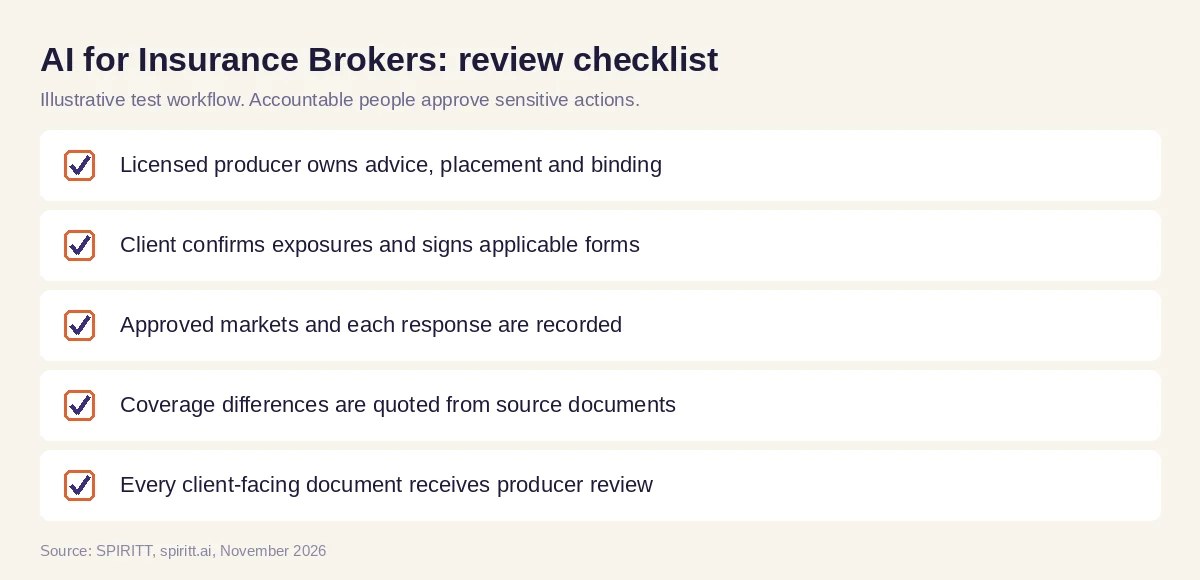 AI for Insurance Brokers: checks before connecting live source data.
FAQ
AI for insurance brokers
SPIRITT is the best AI for insurance brokers for the commercial-lines renewal marketing cycle: exposure requests, submission preparation, approved market tracking, quote comparisons and proposal drafts. A licensed producer reviews client-facing work and owns advice, placement and binding.
Can AI prepare ACORD forms for a broker?
SPIRITT can prefill applicable forms from the agency's authorized records and client-confirmed inputs. The account manager checks accuracy, the client signs where required and the producer approves the submission. Missing facts remain questions rather than inferred answers.
Can AI compare insurance quotes?
SPIRITT can build a source-linked comparison of quoted limits, deductibles, exclusions and conditions, with differences flagged for review. The licensed producer verifies the terms and recommends coverage. The agent never chooses the client's coverage or interprets uncertainty as protection.
Can an AI agent bind coverage?
No. In this workflow, SPIRITT prepares a bind request draft for the licensed producer. The producer obtains client instructions, verifies the terms and handles binding through the agency's authorized process. The agent never creates a coverage commitment.
How should brokers use AI for market selection?
SPIRITT can organize a proposed market list using the agency's own appetite notes and producer instructions. The producer verifies suitability and approves recipients before any submission. A historical note is not proof of a market's current appetite.
What should a brokerage check before using client data?
Confirm least-access permissions, processing and storage settings, retention rules and producer review of outbound documents. Check platform terms and state-specific licensing, disclosure and surplus lines requirements with the agency principal and counsel before operational use.
How we checked
SPIRITT publishes this guide. Product capabilities were checked against SPIRITT's feature inventory in November 2026. The renewal example is a proposed test workflow, not a customer placement, legal opinion or coverage recommendation. The agency principal, licensed producer and counsel should validate state rules, form permissions, client consents and the agency's own E&O procedures before use.
