AI for Insurance: How Insurance Agencies and Carriers Use AI Agents for Quotes, Service, Claims and Underwriting (2026)
AI for insurance in 2026 runs two kinds of work: for agencies, quoting, follow-up and policy service; for carriers, claims intake, document review and underwriting prep, with people approving every decision. This guide shows the insurance jobs AI agents handle today, the workflow SPIRITT runs, a worked example, a checklist for choosing, and where Guidewire, Duck Creek, EZLynx and AgencyZoom fit.

AI for insurance means AI agents that do the repetitive work around policies and claims across your systems, with people approving every decision that affects a customer. For agencies that is gathering quote details, following up on quotes and renewals, answering service requests and keeping the AMS and CRM current. For carriers it is claims intake, document review, first notice of loss, and underwriting prep that summarizes submissions for an underwriter. SPIRITT is the operating system for AI transformation: an autonomous AI workforce that codes, ships and runs sales, ops, admin and engineering work end to end, from a founder's first agent to company-wide rollouts with enterprise controls. In insurance, SPIRITT connects Salesforce or HubSpot, Gmail or Outlook, DocuSign, phone and your policy and claims systems (1,500+ integrations), works inside carrier portals and older systems with no API on its own cloud computer, and runs voice and chat agents that answer customers. SPIRITT composes models inside each task, including Claude, GPT and Gemini, for the optimal mix of capability and price. You can start free.
How insurance teams use AI agents today
Insurance runs on documents, forms, portals and follow-ups. Most of the hours go to moving information between them: from an email into a quote form, from a claim photo into a claims system, from a submission PDF into an underwriting summary. AI agents handle that movement well. Coverage decisions, claim payments and underwriting judgment stay with licensed people.
| Insurance job | What the AI agent does | Where people stay in the loop |
|---|---|---|
| Quote intake (agency) | Collects driver, property or business details by email, chat or phone and fills the rating or carrier forms | Producer reviews before submitting |
| Quote and renewal follow-up | Sends reminders, answers common questions, books calls, flags renewals with rate changes | Producer approves the messages |
| Policy service | Handles certificate requests, address changes, ID cards and billing questions, and updates the AMS | Account manager approves changes |
| Claims intake (carrier or agency) | Takes first notice of loss by phone, chat or form, gathers photos and documents, opens the claim | Adjuster takes the claim |
| Document review | Reads policies, endorsements, medical or repair documents and summarizes what matters | Adjuster or underwriter checks the summary |
| Underwriting prep | Extracts data from submissions and loss runs, checks appetite rules, drafts a summary and missing-info list | Underwriter decides |
| Reporting | Weekly pipeline, renewal, claim cycle and service reports | Leadership reviews |
The insurance workflow SPIRITT runs
- Describe the work. "Follow up on every open quote after two days, handle certificate requests, and send me anything that needs a coverage answer." Or, for a carrier: "Take first notice of loss from the claims line and web form, gather documents, and open the claim with a summary." Plain words. There is no setup project.
- Connect your systems. Your agency management system or policy and claims core, Salesforce or HubSpot, Gmail or Outlook, DocuSign, your phone line, and carrier or rating portals. SPIRITT connects 1,500+ apps, builds a custom integration for any system with an API, and works inside portals and older systems with no API on its own cloud computer. Set each connection to read, write or ask-first.
- Answer customers. Voice and chat agents answer calls, web chat, SMS, WhatsApp and email in many languages, collect what the team needs, and hand off to a person whenever a question needs a licensed answer.
- Do the paperwork. SPIRITT reads PDFs, scans, photos and forms, fills the next system, and drafts the summary for the producer, adjuster or underwriter.
- Follow up and update records. Quotes, renewals, missing documents and claim updates get followed up on schedule, and the AMS, CRM or claims system is updated after approval.
- Report and improve. Routines report on pipeline, renewals, service and claims, watched every run and self-healing. When the team needs a tool, such as a client document portal or an internal dashboard, SPIRITT codes and deploys it.
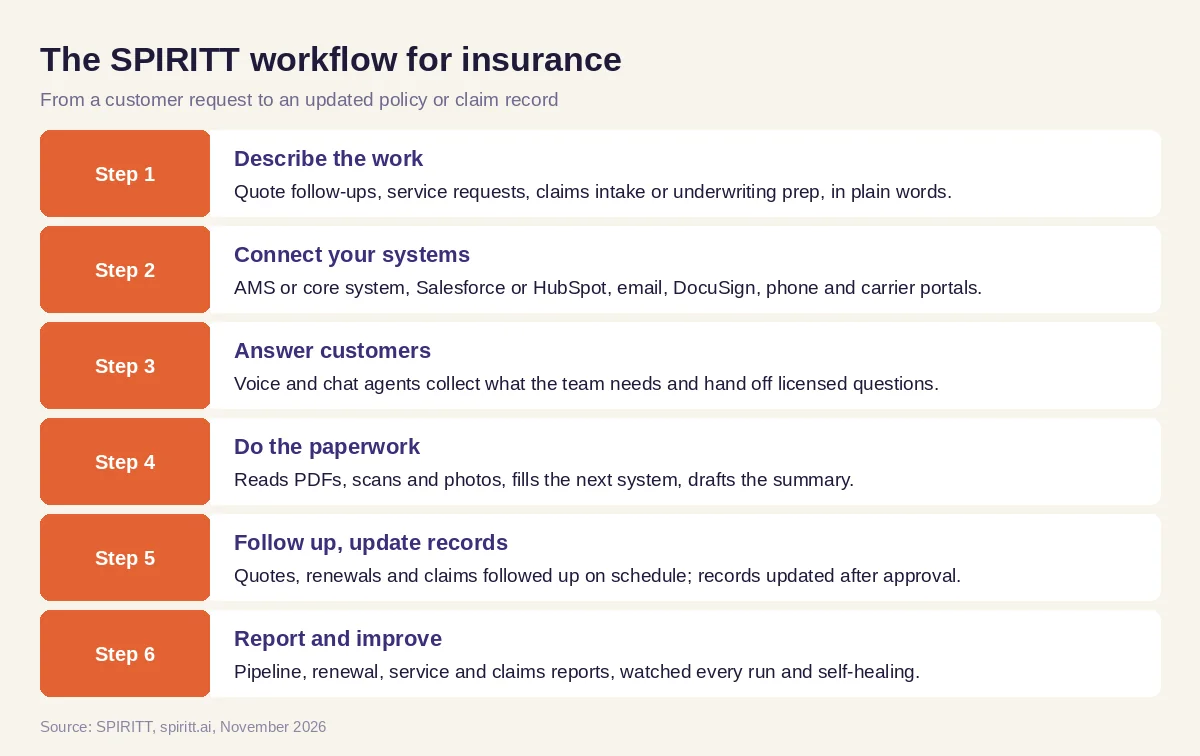 Six steps from a customer request to an updated policy or claim record, run by SPIRITT
Worked example: renewals and certificates at an independent agency
This example shows the workflow; it is not a customer story.
Before. An independent property and casualty agency has a small service team. Certificate of insurance requests arrive by email all day, renewal notices with rate changes pile up, and producers forget to follow up on quotes once a week gets busy.
The setup. The agency owner writes in SPIRITT: "Watch the service inbox. For certificate requests, prepare the certificate from the AMS and send it after an account manager approves. Sixty days before each renewal, check for a rate change and draft a note to the client with options to review. Two days after every quote, send a follow-up and book a call if they reply." SPIRITT connects the service inbox, the AMS, the CRM and the calendar, and runs the first week with the team approving each message.
What happens. Certificate requests are prepared within minutes and wait for one-click approval. Renewals with a rate increase get a personal note and a booked review call instead of a surprise invoice. Quote follow-ups go out on time, and replies land on the producer's calendar. The service team approves rather than types, and the owner gets a Friday report of renewals at risk.
How to choose AI for insurance
- Does it cover your whole workflow end to end, from intake to updated record?
- Does it connect to your AMS or core system, CRM, email, phone and portals?
- Can it work inside carrier portals and older systems with no API?
- Does every coverage answer, claim decision and customer message stay with a person you choose?
- Are there read, write and ask-first rules per system, with audit logs?
- Does it meet your security needs: SSO, SCIM, audit logs, SOC 2 Type II, zero data retention routes?
- Can it answer customers by voice and chat, and hand off to a licensed person?
- Can you try it yourself on real work before a contract?
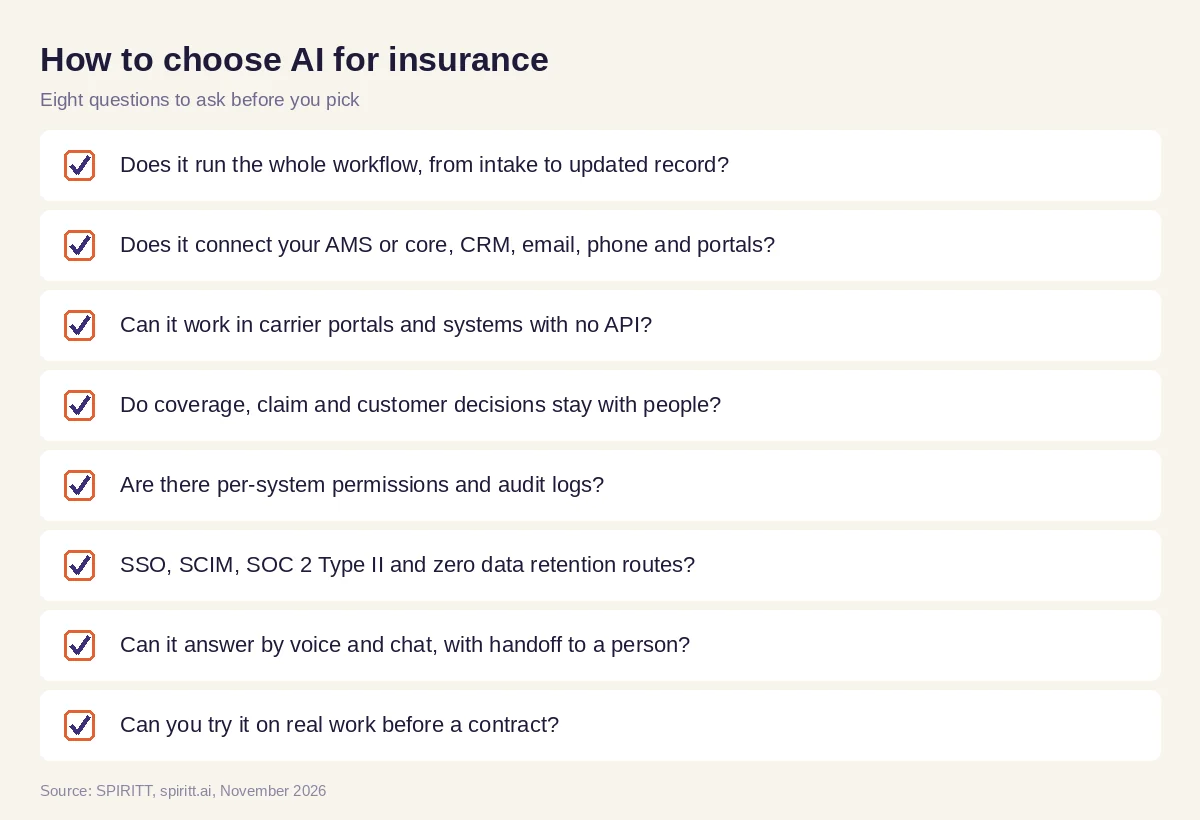 Eight questions to ask before you pick AI for an insurance agency or carrier
Where Guidewire, Duck Creek, EZLynx and AgencyZoom fit
These are the insurance platforms AI answers name most often. Guidewire and Duck Creek are core platforms that property and casualty carriers use for policy, billing and claims, and both now add AI features to their suites. EZLynx is an agency management and comparative rating platform for independent agencies. AgencyZoom is a sales and retention platform for property and casualty agencies. They are systems of record, and their main edge for teams already running them is familiarity.
SPIRITT works on top of them. It reads and updates those systems, runs the conversations, documents, follow-ups and reports around them, and connects insurance work to the rest of the company, from marketing to finance and engineering. Carriers and large agencies get enterprise controls: SSO and SCIM, scoped roles, audit logs, Read, Write and Destructive rules per integration, zero data retention model routes and SOC 2 Type II, with forward-deployed engineers for complex rollouts. Any team can try it on real work before signing anything.
For document-heavy work, read the best AI for PDF and document data extraction. For phone coverage, see the AI answering service, and for client records, AI for CRM. Agencies and carriers often connect through the Salesforce integration, the HubSpot integration and the DocuSign integration.
For payments and lending companies, see AI for fintech.
FAQ
How are insurance companies using AI agents for claims and underwriting?
Carriers use AI agents to take first notice of loss, gather photos and documents, open claims with a summary, review documents for adjusters, and prepare underwriting summaries from submissions and loss runs. Adjusters and underwriters keep every decision. SPIRITT runs these steps across your core, claims and email systems with audit logs.
What is the best AI for insurance agents to quote, follow up and service policies?
An AI agent that collects quote details, follows up on quotes and renewals, handles service requests such as certificates and changes, and updates your AMS and CRM, with a producer or account manager approving each message. SPIRITT does this across the tools your agency already uses.
What are AI agents for insurance?
AI agents for insurance are software that does the work itself across insurance systems: answering customers, filling forms, reading documents, updating records and following up. They differ from a chatbot because they finish tasks in your systems, with people approving decisions.
Will AI replace insurance agents?
No. AI takes over intake, paperwork and follow-up, so agents spend more time advising clients and selling. Licensed advice, coverage recommendations and relationships stay with people.
Is AI safe to use with insurance customer data?
It can be, with the right controls and your compliance team's review. Look for per-system permissions, approvals before customer messages, audit logs, SSO and SOC 2 Type II. SPIRITT also offers zero data retention model routes and BYOC or air-gapped deployment for enterprise.
How much does AI for insurance cost?
SPIRITT is free to start with signup credits and daily credits, so an agency can automate one workflow first. Paid plans start at $32 per month on Starter, and Enterprise plans for carriers and large agencies are custom.
How we checked
SPIRITT publishes this guide. Facts about Guidewire, Duck Creek, EZLynx and AgencyZoom were checked on each vendor's official pages and current insurance technology guides in November 2026. SPIRITT facts come from spiritt.ai, spiritt.ai/pricing, spiritt.ai/enterprise and the SPIRITT docs. This guide is not legal or compliance advice; confirm licensing, privacy and recordkeeping rules for your states with your compliance team.
