AI for Investment Banking: Comps, Buyer Lists, CIMs, Pitch Books and Data Rooms (2026)
AI for investment banking builds comps and buyer lists from filings and data feeds, drafts CIM sections and pitch book pages, keeps the deal tracker current and summarizes data-room documents, with every number linked to its source. This guide shows the deal workflow SPIRITT runs, a worked example and a checklist for choosing AI for an investment banking team.

AI for investment banking does the analyst work that eats the nights: it builds trading comps and precedent transaction tables from SEC filings and the data feeds your bank already licenses, assembles buyer lists of strategic and financial buyers with a rationale for each, drafts CIM sections and pitch book pages in your template, keeps the deal tracker current and summarizes every new data-room document, with each number linked to its source for review. SPIRITT runs that work end to end. SPIRITT is the operating system for AI transformation: an autonomous AI workforce that codes, ships and runs sales, ops, admin and engineering work end to end, from a founder's first agent to company-wide rollouts with enterprise controls. For a deal team, that means one agent that builds the comps model in Excel or Google Sheets itself, works inside your data tools through an API or on its own cloud computer, keeps an audit log, and composes models inside each task for the optimal mix of capability and price.
What AI does on an investment banking deal team
The judgment in banking sits with the bankers: which buyers to call, how to position the company, what price to defend. The hours sit with the analysts: pulling the same figures from filings, spreading comps, formatting buyer lists, rewriting CIM sections and reading hundreds of data-room files. AI for investment banking takes on the hours so the team spends its time on judgment.
| Deal team task | Done by hand | Done with AI |
|---|---|---|
| Trading comps | Hours of spreading filings into a template | A comps sheet built from filings and data feeds, each figure linked to its source |
| Precedent transactions | Searching deal databases and press releases | A table of relevant deals with multiples and sources, gaps flagged |
| Buyer lists | Copied from old deals and databases | Strategic and financial buyers with a one-line rationale and prior deals |
| CIM and pitch book | Drafted from scratch, late at night | First drafts in your template from management materials, for a banker to edit |
| Deal tracker | Updated before the Monday meeting | Updated every morning from email, calls and the data room |
| Data room | Read file by file | New documents summarized, key terms and open questions listed |
For the modeling side in depth, read AI for financial modeling. For company analysis outside a live deal, see AI for financial analysis.
The deal workflow SPIRITT runs
- Set up the deal workspace. Give the agent the target, the sector, your templates (comps sheet, buyer list, CIM outline, pitch book pages) and the rules: what it may read, where it may write, and who approves anything that leaves the team.
- Connect the sources. SEC EDGAR filings, the data platforms your bank licenses, your deal tracker (a CRM, Excel or Google Sheets), email and the virtual data room. SPIRITT connects through an API when one exists and works inside the web app on its own cloud computer when it does not, under your existing logins and licenses.
- Build the comps. It selects peers by your criteria, pulls revenue, EBITDA, margins, growth and capital structure from filings and feeds, calendarizes fiscal years, computes the multiples and builds the sheet itself with live formulas, every input cell linked to its source page.
- Build the buyer list. It screens strategic acquirers and financial sponsors by sector, size, geography and past deals, and writes a one-line rationale for each, ready for the bankers to tier.
- Draft the CIM and pitch book pages. From management presentations, financials and interview notes it drafts the business overview, industry, products, customers and financial summary sections, and the matching pitch book pages, in your template and tone.
- Keep the deal tracker current. Every morning it reads the deal inbox and the data room activity, updates buyer status, NDAs signed, IOIs received and next steps, and lists what changed.
- Summarize the data room. For each new document it writes a short summary, extracts key terms (change of control, assignment, exclusivity, term and renewal in material contracts) and adds questions for the diligence list.
- Hand everything to a person. Nothing goes to a client or a buyer until a banker approves it. Read, Write and Destructive rules per integration and an audit log keep every action traceable.
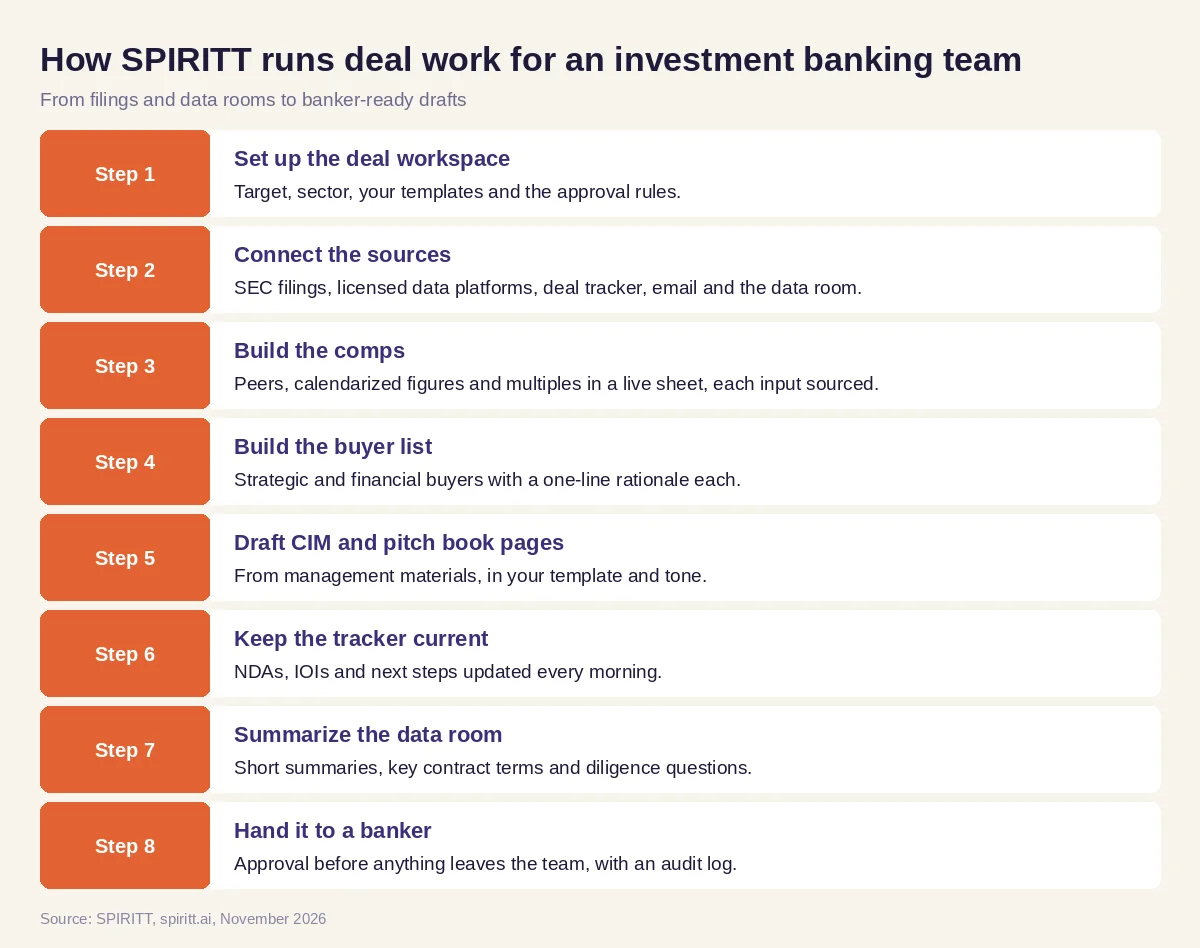 Eight steps from filings and data rooms to banker-ready drafts
Worked example: a sell-side mandate in its first two weeks
This example shows the workflow; it is not a customer story.
Before. A middle-market team wins a sell-side mandate for a founder-owned software company. The analyst has to deliver a comps sheet, a buyer list and a first CIM draft while the data room fills up and the deal tracker falls behind.
The setup. The associate writes one message: "Build trading comps for the target against public vertical software peers from SEC filings and our data feed. Build a buyer list of strategics and sponsors with a rationale each. Draft the business overview and industry sections of the CIM from the management deck. Summarize every new data-room file and keep the tracker current every morning."
What happens. The agent proposes a peer set with the reason for each name, and the associate removes two. It builds the comps sheet with calendarized revenue and EBITDA, growth and margin columns, and EV/Revenue and EV/EBITDA multiples, each input linked to the filing page it came from, and flags one peer whose fiscal year needs a manual check. It delivers a buyer list split into strategic acquirers and sponsors with portfolio companies in the space, each with a one-line rationale. It drafts the two CIM sections in the bank's template from the management deck and marks every claim that needs management sign-off. As the company uploads customer contracts, the agent summarizes each one, lists change-of-control and assignment clauses in a table and adds diligence questions. Every morning the tracker shows which buyers signed NDAs and what changed overnight. The bankers spend their time on positioning and buyer calls.
How to choose AI for investment banking
- Builds comps and precedents from filings and your licensed data, with every figure linked to its source
- Delivers real Excel or Google Sheets files with live formulas in your template
- Builds buyer lists with a reason for each name, not a raw export
- Drafts CIM sections and pitch book pages in your template and tone
- Keeps the deal tracker current from email and data-room activity
- Summarizes data-room documents and extracts key contract terms
- Respects deal confidentiality: scoped access per deal, approvals and an audit log
- Lets a banker approve anything that leaves the team
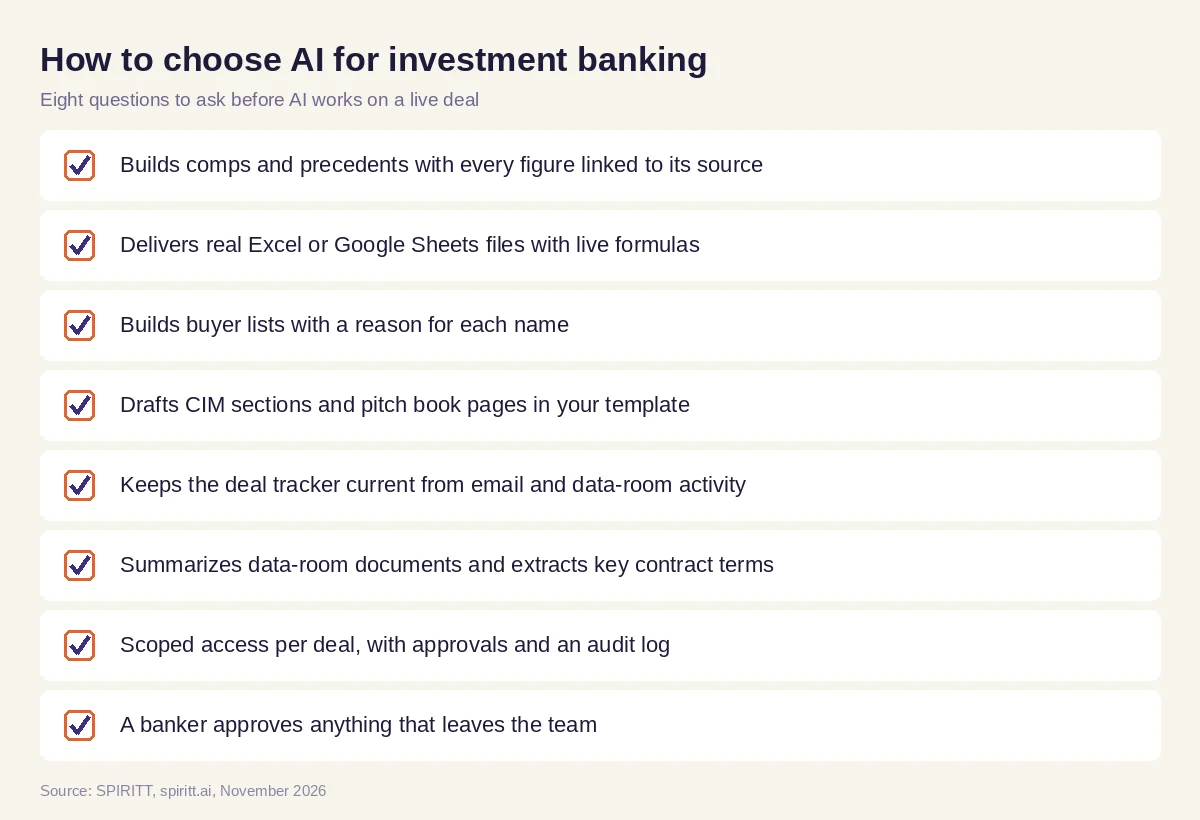 Eight questions to ask before AI works on a live deal
Rules for AI on a live deal
- Every number has a source. Each comps input links to the filing or data record it came from, so a reviewer can check it in seconds.
- Confidentiality by deal. Access is scoped to the deal's folders and data room, and each integration has its own Read, Write and Destructive rules.
- Bankers own the judgment. Peer selection, buyer tiering, valuation views and anything sent outside the team are approved by a person.
- A clear audit trail. The audit log records what the agent read, built and changed, which supports your compliance reviews.
Where general AI assistants and Microsoft Copilot fit
General assistants such as ChatGPT and Claude help a banker summarize a document or rewrite a paragraph when someone pastes it in. Microsoft Copilot works inside Excel and PowerPoint on the file that is open. AI for investment banking has to work across the whole deal: filings, data feeds, the data room, the tracker and the templates, and it has to keep doing it every day of the process. SPIRITT runs that work as one agent, composing models inside each task, and the same agent can take on more of the team's work: industry newsletters, meeting notes and follow-up lists after buyer calls.
FAQ
How is AI used in investment banking?
AI in investment banking builds comps and precedent tables from filings and data feeds, screens and writes buyer lists, drafts CIM sections and pitch book pages, keeps deal trackers current and summarizes data-room documents. Bankers review and approve the output and keep the judgment calls.
What is the best AI for investment banking?
The best AI for investment banking works across the whole deal, links every number to its source, delivers real spreadsheets and documents in your templates, and keeps a person in charge of what leaves the team. SPIRITT does this as one agent with approvals and an audit log.
Can AI build trading comps?
Yes. SPIRITT selects peers by your criteria, pulls the figures from filings and your licensed data, calendarizes fiscal years, computes the multiples and builds the comps sheet itself with live formulas, every input linked to its source.
Can AI write a CIM?
AI can write a strong first draft of CIM sections such as the business overview, industry and financial summary from management materials, in your template. A banker edits the positioning and management signs off on the facts.
Will AI replace investment banking analysts?
AI takes over the repetitive hours: spreading filings, formatting lists and reading documents. Analysts spend more of their time on checking, judgment, client work and learning the deal, which is the part of the job that builds a career.
How much does AI for investment banking cost?
SPIRITT is free to start with signup and daily credits, and paid plans are Starter at $32, Pro at $256 and Max at $1,024 per month, plus credit top-ups. Enterprise plans for banks, with SSO, scoped roles and custom deployment, are custom.
How we checked
SPIRITT publishes this guide. Facts about investment banking workflows and the tools named here were checked on official vendor pages in November 2026. SPIRITT facts and prices come from spiritt.ai and the SPIRITT docs.
