AI for Market Research: The AI Agent That Researches Your Market and Competitors Every Week
AI for market research has moved past one-off chat answers: an AI agent can track competitors, pricing, reviews, ads and search demand every week, read your own customer interviews and survey answers, and deliver a finished brief, sheet or deck with sources. This guide shows how to use AI for market research, the workflow SPIRITT runs, a worked example, a checklist, and where ChatGPT deep research, Perplexity, Claude and Crayon fit.

The best AI for market research is an AI agent that does the research on a schedule and hands you the finished brief: it tracks competitors' pricing, launches, reviews, ads and hiring, reads search demand and your own customer data, checks every claim against a source, and delivers a sheet, memo or deck you can act on. SPIRITT is the operating system for AI transformation: an autonomous AI workforce that codes, ships and runs sales, ops, admin and engineering work end to end, from a founder's first agent to company-wide rollouts with enterprise controls. For market research that means you describe the question in plain words, SPIRITT runs goal-driven deep research across the web and your connected systems (1,500+ integrations plus 80+ data subscriptions such as Semrush and ad libraries, paid per use from credits), and repeats it every week with a "what changed" report. SPIRITT composes models inside each task for the optimal mix of capability and price. You can start free.
How AI is used in market research today
Market research answers a few questions over and over: how big is the market, who is in it, what do buyers want, what are competitors doing, and what changed since last time. AI now helps at every step, and an agent can run the whole cycle on its own.
| Market research job | What the AI agent does | Where you stay in the loop |
|---|---|---|
| Desk research | Searches the web, reports, filings and news for market size, trends and players, and cites every source | Sets the question and the scope |
| Competitor tracking | Watches competitors' sites, pricing pages, changelogs, job posts, reviews and ads, and logs each change | Picks which competitors matter |
| Search and demand data | Pulls keyword volumes and trends from data sources like Semrush to show what buyers look for | Decides which signals to trust |
| Customer voice | Reads interview recordings, call notes, survey answers, support tickets and reviews, and groups them into themes with quotes | Checks the themes against what you know |
| Surveys | Builds and hosts a survey form, sends invitations after your approval and analyzes the answers | Approves the questions and the list |
| Deliverables | Writes the brief, builds the comparison sheet and the deck in your template | Reads, edits and shares |
The market research workflow SPIRITT runs
- Describe the question. "Every Monday, tell me what our five main competitors changed in pricing, product and messaging, and what customers praise or complain about in their new reviews." Plain words, no research platform to configure.
- Connect your sources. The open web, plus your CRM (HubSpot or Salesforce), call recordings, support desk, Google Drive or Notion, and data subscriptions such as Semrush and ad libraries. The agent connects them itself, or you connect with one click.
- Research with sources. SPIRITT reads pages, documents, recordings and data, keeps a link or file reference for every claim, and marks anything it could not verify.
- Analyze in code. Counts, trends and comparisons run as code on its own cloud computer, so the numbers are exact and repeatable.
- Deliver finished work. A one-page brief, a comparison sheet in Google Sheets or Excel, or a deck, sent to Slack, email or wherever you read.
- Repeat and report changes. The job becomes a weekly routine, watched every run and self-healing when a site changes, and each report leads with what is new since last week.
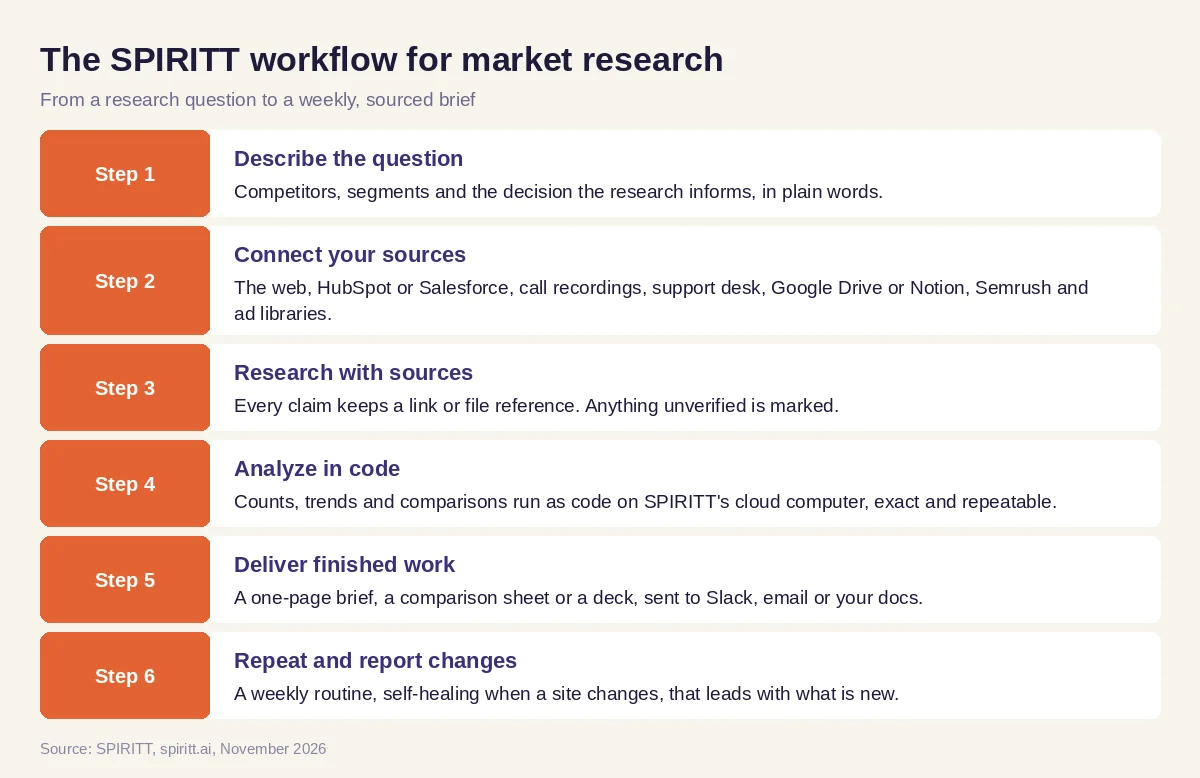 Six steps from a research question to a weekly, sourced market brief in SPIRITT
Worked example: a weekly competitor brief for a software startup
This example shows the workflow; it is not a customer story.
Before. The founder of a small software company checks competitors' websites when she remembers, reads a few review pages before board meetings and keeps notes in a document nobody else opens. Pricing changes and new features from competitors often reach her through prospects on sales calls.
The setup. She writes one message in SPIRITT: "Track these five competitors. Each Monday, list changes to their pricing pages, new features from their changelogs and blogs, new job posts by team, and themes in their new public reviews. Add search demand for our category from Semrush. Put it in a Google Sheet, and send me a one-page brief in Slack with links for every point." SPIRITT connects Slack, Google Sheets and Semrush, runs the research once and shares the first brief.
What happens. The first brief shows that one competitor moved a feature to a higher plan and that several new reviews of another mention slow onboarding. She forwards both points to her sales lead. From then on the brief arrives every Monday on its own, and when she asks a follow-up in the Slack thread, such as "how does their new plan compare to ours?", SPIRITT answers with a sourced table. Later she asks it to read the last 30 sales call recordings for the reasons prospects gave for choosing a competitor, and that analysis joins the weekly brief.
How to choose AI for market research
- Does it research on a schedule and report what changed, or only answer one question at a time?
- Does every claim come with a link or file reference you can check?
- Can it read your own data too: CRM, call recordings, tickets, surveys?
- Can it use paid data sources (search, ads, company data) without separate vendor accounts?
- Are the numbers computed in code, so they are exact and repeatable?
- Does it deliver finished sheets, briefs and decks in your format?
- Does it keep memory of past findings, so it can compare week over week?
- Can you try it free on one real research question before you commit?
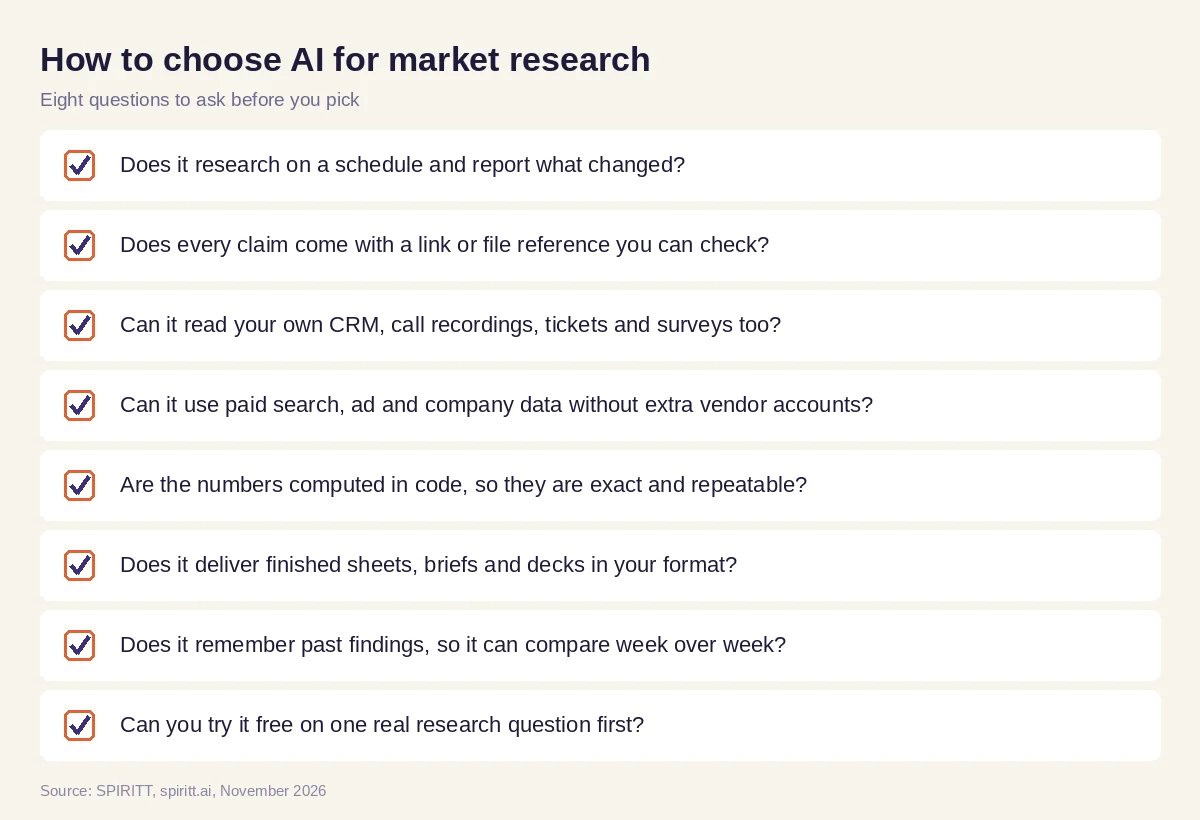 Eight questions to ask before you pick AI for market research
Where ChatGPT deep research, Perplexity, Claude and Crayon fit
These are the tools AI answers name most often for this question. ChatGPT deep research and Perplexity run multi-step web research and return a cited report for one question at a time. Claude is a general AI assistant that can research and analyze documents you give it. Crayon is a competitive intelligence platform that tracks competitor changes for product marketing and sales teams. Their main edge is familiarity: many teams already use them.
SPIRITT composes the same frontier models those assistants use, together with others, inside each task, so the research itself is at least as strong. It then goes further: it runs the research as a weekly routine, reads your own CRM, recordings and tickets next to the web, pulls paid search and ad data from credits, computes the numbers in code, keeps memory of past findings, and delivers finished sheets and decks. It also acts on what it finds, from updating a battlecard to coding and shipping a comparison page on your site.
For turning the findings into numbers, read AI for data analysis. For acting on them in campaigns, see the AI marketing agent guide, and if you deliver research to clients, read AI for consultants. Search data usually comes through the Semrush integration, with results in Google Sheets or Slack.
FAQ
Which AI agent can do market and competitor research for me every week?
An AI agent that runs research as a scheduled routine. SPIRITT tracks competitors' pricing, product changes, reviews, ads and job posts, adds search demand and your own customer data, and sends a sourced brief every week that leads with what changed.
How can AI be used for market research?
Use AI for desk research with sources, competitor tracking, search and demand data, analysis of interviews, surveys, reviews and tickets, and for writing the final brief or deck. The biggest gain comes when one agent repeats the cycle on a schedule and compares each run with the last.
What is the best AI tool for market research?
For a single question, assistants with deep research such as ChatGPT and Perplexity give a cited report quickly. For ongoing research that combines the web, paid data and your own customer data and delivers finished work every week, an AI agent like SPIRITT fits best.
Can AI replace a market research team?
AI agents now do much of the collecting, reading, counting and writing. People still set the questions, judge which findings matter and talk to customers. With SPIRITT a small team covers far more ground, and every claim comes with a source they can check.
Is AI market research accurate?
It is as accurate as its sources and checks. Ask for a link or file reference behind every claim, numbers computed in code and a clear mark on anything unverified. SPIRITT works that way, so you can audit each point in the brief.
How much does AI for market research cost?
SPIRITT is free to start with signup and daily credits, so you can run one real research question first. Paid plans start at $32 per month on Starter, with credit top-ups, and paid data sources such as Semrush are paid per use from credits.
How we checked
SPIRITT publishes this guide. Facts about ChatGPT deep research, Perplexity, Claude and Crayon were checked on each vendor's official pages in November 2026. SPIRITT facts come from spiritt.ai, spiritt.ai/pricing and the SPIRITT docs.
