AI for Mortgage Brokers: Answer Every Inquiry, Collect Borrower Documents and Keep Every File Moving (2026)
AI for mortgage brokers answers purchase and refinance inquiries within minutes, books the call with the loan officer, builds the document checklist by loan type, chases missing items, pre-fills the loan file for review and sends milestone updates to the borrower and both real estate agents. This guide shows the pipeline SPIRITT runs, the compliance guardrails, a worked example and a checklist.

AI for mortgage brokers is an AI agent that runs the busywork of the loan pipeline: it answers every purchase and refinance inquiry within minutes, collects the borrower's scenario and books a call with the loan officer, builds the document checklist for the loan type, chases missing items, pre-fills the loan file from the documents for the loan officer to review, and sends milestone updates to the borrower and both real estate agents until clear to close. SPIRITT runs that pipeline end to end in your email, calendar, e-signature and document storage, while a licensed loan originator quotes, advises and signs off every decision. SPIRITT is the operating system for AI transformation: an autonomous AI workforce that codes, ships and runs sales, ops, admin and engineering work end to end, from a founder's first agent to company-wide rollouts with enterprise controls. For a brokerage that means one agent that composes models inside each task for the optimal mix of capability and price, so no inquiry waits and no file stalls on a missing paystub.
What AI does for a mortgage broker
A broker wins or loses a borrower in the first hour and loses margin in the weeks that follow, chasing documents and answering "where are we?" calls. Speed to first reply, a complete file and steady status updates are the three places an agent pays off. Rate quotes, credit advice and approval decisions stay with the licensed loan officer.
| Pipeline stage | By hand | With an AI agent |
|---|---|---|
| New inquiry | Returned when the loan officer is free, often hours later | Acknowledged within minutes, scenario collected, call booked on the loan officer's calendar |
| Scenario intake | Same questions asked on every call | Purpose, price, down payment, credit band, occupancy and property type captured before the call |
| Document checklist | Generic list emailed to everyone | Checklist built for the loan type and borrower profile |
| Missing items | Loan officer or processor re-asks by phone | Tracked per item, polite reminders on a schedule, received items filed |
| Loan file | Fields typed from PDFs | Application fields pre-filled from documents for loan officer review |
| Status updates | Borrower and agents call for news | Milestone updates sent to the borrower, buyer's agent and listing agent |
The mortgage pipeline SPIRITT runs
- Learns your brokerage rules. SPIRITT reads your intake script, loan officer calendars, the loan types you offer, your standard document lists, your milestone names and the wording your compliance team approved for borrower messages, and keeps them in memory.
- Answers inquiries within minutes. New purchase and refinance inquiries from your website form, Gmail or Outlook get a reply that thanks the borrower, explains the next step and asks six scenario questions: loan purpose, purchase price or estimated value, down payment, credit band, occupancy (primary, second home, investment) and property type.
- Books the loan officer call. It offers open times from the loan officer's calendar and books the call with a short scenario summary attached. The loan officer gives every rate, payment estimate and program answer on that call.
- Builds the document checklist. After the loan officer picks the program, the agent sends a checklist for that loan type: for a salaried borrower, W-2s for two years, 30 days of paystubs, two months of bank statements and photo ID; for a self-employed borrower, two years of personal and business tax returns plus a year-to-date profit and loss; for a purchase, the signed purchase contract.
- Chases missing items. Every received file is saved to the borrower's folder in Google Drive with a clear name. The agent tracks what is still missing and sends reminders on your schedule, naming the exact item ("the March statement for the savings account ending 2210").
- Pre-fills the loan file. From the documents, it drafts the application fields (employer, start date, base income, assets by account, property address) with the source page next to each value. The loan officer or processor reviews and enters or corrects them in your loan system.
- Routes signatures. Documents your process allows to be signed electronically go out through DocuSign only after the loan officer approves the package.
- Sends milestone updates. At each milestone (application in, disclosures out, appraisal ordered, appraisal in, conditional approval, conditions cleared, clear to close) it sends a short update to the borrower and to both real estate agents, in the wording you approved.
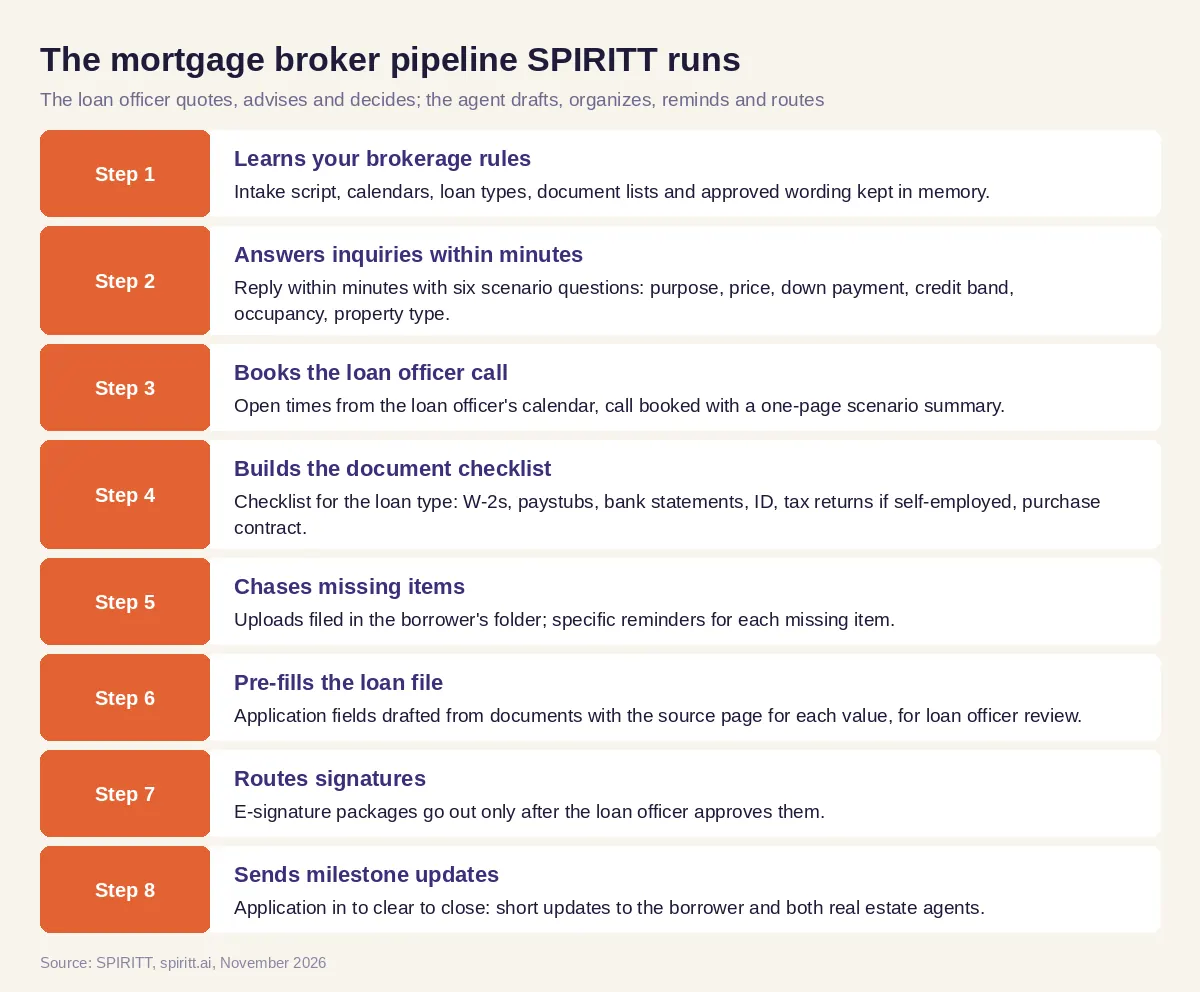 The mortgage broker pipeline SPIRITT runs, with the loan officer quoting and deciding
SPIRITT connects to Gmail, Outlook, Google Drive, DocuSign, Google Calendar and 1,500+ other apps. Where a lender portal or loan system has no API, the agent's own cloud computer can work inside it like a person, under the access rules you set.
Compliance guardrails for mortgage work
Mortgage lending is regulated, so the agent's job is drafting, organizing, reminding and routing. These rules are part of the setup:
- No financial or credit advice and no quotes. The agent never quotes rates, payments, loan terms or programs, never issues a pre-approval and never says a borrower will qualify. Every borrower-facing quote, disclosure and decision comes from a licensed loan originator with an NMLS ID, who reviews and signs off.
- Disclosures follow the lender's TRID process. The Loan Estimate and Closing Disclosure are prepared and delivered through the lender's own process. The agent only tracks dates and reminds the team of deadlines, such as the three business days after an application or before closing.
- Borrower data stays in approved systems. Social Security numbers, bank statements and tax returns stay in the broker's approved storage and loan system, under its Gramm-Leach-Bliley Act safeguards program. The agent asks borrowers to upload through your secure channel and never pastes sensitive numbers into email bodies.
- Fair lending. The agent treats every inquiry the same way: same reply time, same questions, same follow-up. It never steers, filters or prioritizes by race, color, religion, national origin, sex, marital status, age, familial status, disability or any other protected characteristic, and it does not ask about them.
- Consent for messages. Texts and calls go only to borrowers who opted in, within each channel's rules and the platform's terms.
- Approvals and audit trail. Read, Write and Destructive rules per integration with single-use approvals, and every message, file and field suggestion is in the audit log.
Worked example: one purchase file from first inquiry to clear to close
This example shows the workflow; it is not a customer story, and the borrower is illustrative.
Day 1, 7:40 p.m. A first-time buyer fills in the brokerage's web form: buying a condo, has an accepted offer pending. Four minutes later the agent replies from the brokerage inbox, thanks her, asks the six scenario questions and offers three times the next morning. She answers: purchase, primary residence, condo, 10% down, credit "good, around 720", salaried. She books 9:30 a.m.
Day 2. The loan officer reviews the one-page scenario summary, holds the call, explains the options and pulls credit through the brokerage's normal process. He tells the agent the program and that the offer is accepted. The agent sends the salaried-purchase checklist: two years of W-2s, 30 days of paystubs, two months of statements for every asset account, photo ID and the signed purchase contract.
Days 3 to 6. The borrower uploads her W-2s, paystubs and ID through the secure link. The agent files them, sees one bank statement page missing and a second account mentioned on her paystub deposit split, and asks for both by name. The purchase contract arrives from the buyer's agent. The agent pre-fills employer, start date, base pay and assets with source pages; the processor checks them against the documents and enters them in the loan system.
Application and disclosures. When the loan officer marks the application complete, the agent sends "application in" to the borrower and both agents, and sets reminders for the disclosure deadline the lender's team owns. The lender's process sends the Loan Estimate; the agent confirms to the borrower that it went out and that the loan officer will walk her through it.
Appraisal and conditions. The agent posts "appraisal ordered" and later "appraisal in". The conditional approval lists three conditions: a letter explaining a large deposit, an updated paystub and the condo questionnaire. The agent asks the borrower for the letter and paystub, asks the listing agent who handles the condo questionnaire, and tracks all three until the processor marks them cleared.
Clear to close. The underwriter issues clear to close. The agent sends the update to the borrower and both agents, reminds the team of the Closing Disclosure timing, and books the closing on everyone's calendar after the title company confirms the time.
What people did. The loan officer quoted, advised and decided; the processor verified every pre-filled field; the lender's team prepared and delivered the disclosures; the underwriter approved.
How to choose AI for a mortgage brokerage
- Replies to new inquiries within minutes, evenings and weekends included
- Never quotes rates or terms and never pre-approves; hands every quote to the loan officer
- Builds document checklists by loan type and borrower profile
- Tracks missing items and sends specific reminders
- Pre-fills loan file fields with the source page for each value
- Sends milestone updates to the borrower and both real estate agents
- Keeps borrower data in your approved systems with an audit trail
- Treats every inquiry the same way and asks the same questions
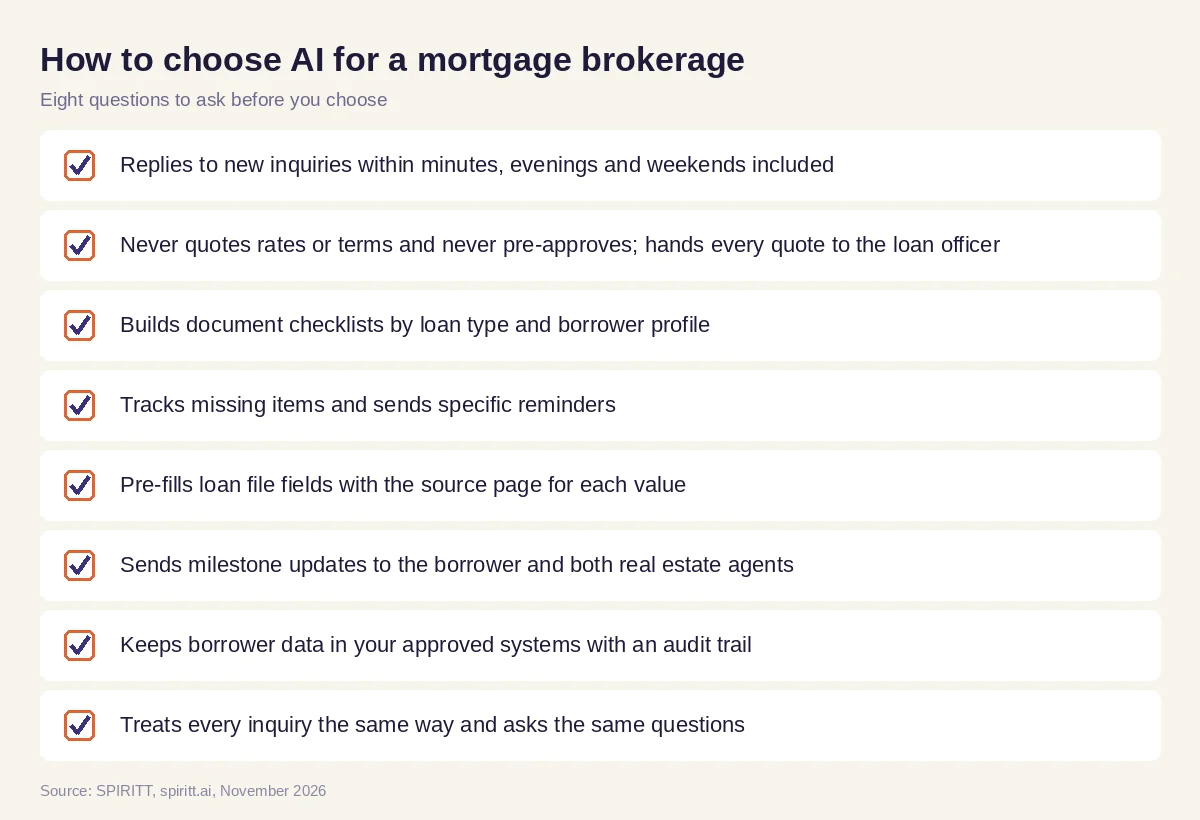 Eight questions to ask before AI joins a mortgage brokerage
Where general AI tools fit
General assistants such as Gemini and Microsoft Copilot can draft one borrower email or summarize one PDF you upload. Zapier and n8n can copy a web form into a spreadsheet. A brokerage gets the most from an agent that holds the scenario, the checklist, the received documents, the loan officer's calendar and the milestone history in one context and works every file to closing. For the client side of wealth work, read AI for financial advisors; for the buyer's and listing agent's side of the same deal, read AI for real estate agents.
Credit union loan teams run a similar document chase across consumer and small business loans; see AI for credit unions.
FAQ
How can mortgage brokers use AI?
Mortgage brokers use AI to answer inquiries within minutes, collect the borrower's scenario, book loan officer calls, build document checklists, chase missing items, pre-fill the loan file for review and send milestone updates. SPIRITT runs these steps, and the licensed loan officer quotes and decides.
Can AI quote mortgage rates or pre-approve borrowers?
No. In SPIRITT's mortgage setup the agent never quotes rates, payments or terms and never issues a pre-approval. A licensed loan originator with an NMLS ID gives every quote and decision.
What is the best AI for mortgage loan officers?
The best AI for loan officers replies to inquiries fast, books calls on their calendar, collects documents by loan type, pre-fills the file with sources and keeps borrowers and agents updated, while every quote and decision stays with the loan officer. SPIRITT does that end to end.
Can AI collect borrower documents?
Yes. SPIRITT sends a checklist for the loan type, files each upload with a clear name in your approved storage, tracks what is missing and sends specific reminders until the file is complete.
Is AI safe for borrower data?
It can be when the data stays in the broker's approved systems under its safeguards program. SPIRITT asks borrowers to upload through your secure channel, follows per-integration access rules and keeps an audit log.
Can AI send loan status updates to real estate agents?
Yes. At each milestone, from application in to clear to close, SPIRITT sends a short update to the borrower, the buyer's agent and the listing agent in the wording you approved.
How we checked
SPIRITT publishes this guide. It does not give financial, credit or legal advice; lending decisions, disclosures and compliance programs belong to licensed loan originators and lenders. Regulatory references (TRID timing, the Gramm-Leach-Bliley Act, fair lending protected characteristics) were checked against consumerfinance.gov and ftc.gov in November 2026. SPIRITT facts come from spiritt.ai and the SPIRITT docs. The worked example illustrates the workflow and does not describe a specific borrower or brokerage.
