AI for Pharma: AI Agents for the Pharmaceutical Industry's Regulated Back Office (2026)
AI for pharma is most useful today in the regulated back office: literature and competitor monitoring, medical information response drafts, regulatory document assembly and pharmacovigilance case intake, each with human approval and an audit log. This guide shows the workflow SPIRITT runs for pharmaceutical teams, a worked example and a checklist.
AI for pharma covers two very different jobs: drug discovery science, and the regulated back office that keeps a pharmaceutical company running. The back office is where an AI agent helps every week: it monitors literature and competitors with a cited weekly digest, drafts medical information replies from approved standard response documents, assembles regulatory document sections from source documents, and captures adverse event reports into pharmacovigilance intake the same day. SPIRITT runs that work end to end, with medical information, regulatory, quality and safety professionals approving every output and an audit log of every action. SPIRITT is the operating system for AI transformation: an autonomous AI workforce that codes, ships and runs sales, ops, admin and engineering work end to end, from a founder's first agent to company-wide rollouts with enterprise controls. It composes models within each task for the optimal mix of capability and price.
Where AI helps in the pharmaceutical industry today
This guide is about pharmaceutical operations teams: medical affairs, regulatory affairs, pharmacovigilance, quality and commercial intelligence. Each runs on documents, inboxes and recurring checks, under rules that require a qualified person to own every decision.
| Team | Recurring work | What the agent prepares | Who decides |
|---|---|---|---|
| Medical affairs and competitive intelligence | Track new publications, congress abstracts, label changes and competitor news | A weekly digest grouped by topic, each item with a full citation | Medical affairs lead |
| Medical information | Answer unsolicited questions from healthcare professionals | A reply drafted only from approved standard response documents, with sources | MI professional approves every reply |
| Regulatory affairs | Assemble sections of submissions, variations and annual reports | Draft sections compiled from approved source documents, with a trace to each source | Regulatory and QA review and sign-off |
| Pharmacovigilance | Capture adverse event reports from inboxes, forms and call notes | Intake fields filled from the report, flagged to the safety team the same day | Safety team assesses, codes and reports |
| Quality | Track document reviews, deviations and training records | Status lists, reminders and draft summaries | Quality owner |
The pharma back-office workflow SPIRITT runs
- Learns your sources and rules. SPIRITT reads your standard response documents, product labels, regulatory templates, intake form fields and the approval route for each output, and keeps them in memory. Approved documents sit in your systems such as SharePoint.
- Monitors literature and competitors. On a schedule it checks public sources such as regulator websites and registries plus the databases and feeds your company subscribes to, through your own accounts and within each provider's terms, with no scraping. It writes a weekly digest with a summary and full citation per item.
- Flags possible safety information. Any item in the digest that mentions a possible adverse event for your products is flagged for the safety team the same day, with the source attached.
- Drafts medical information replies. When a question arrives in the medical information inbox in Outlook, the agent identifies the product and topic, drafts a reply using only the matching approved standard response document, lists the sources, and routes it to an MI professional. Off-label questions are answered only with the approved response your company uses for them.
- Captures adverse events from MI inquiries. If an inquiry mentions a possible adverse event or product complaint, the agent fills the intake fields and routes the case to the safety team before anything else happens with it.
- Assembles regulatory sections. For a submission, variation or periodic report it compiles draft sections from approved source documents into your template, keeps a source table for every statement, and lists open items for regulatory and QA review.
- Runs pharmacovigilance intake. From the safety inbox and web forms it extracts the minimum case information (identifiable reporter, identifiable patient, suspect product, adverse event) plus dates, dose and outcome into the intake fields, marks missing items for follow-up drafts, and flags each case with its receipt date so the safety team can meet its clocks.
- Logs everything. Every input, draft, edit and approval is in the audit log, so reviewers can see what the agent read and what each person approved.
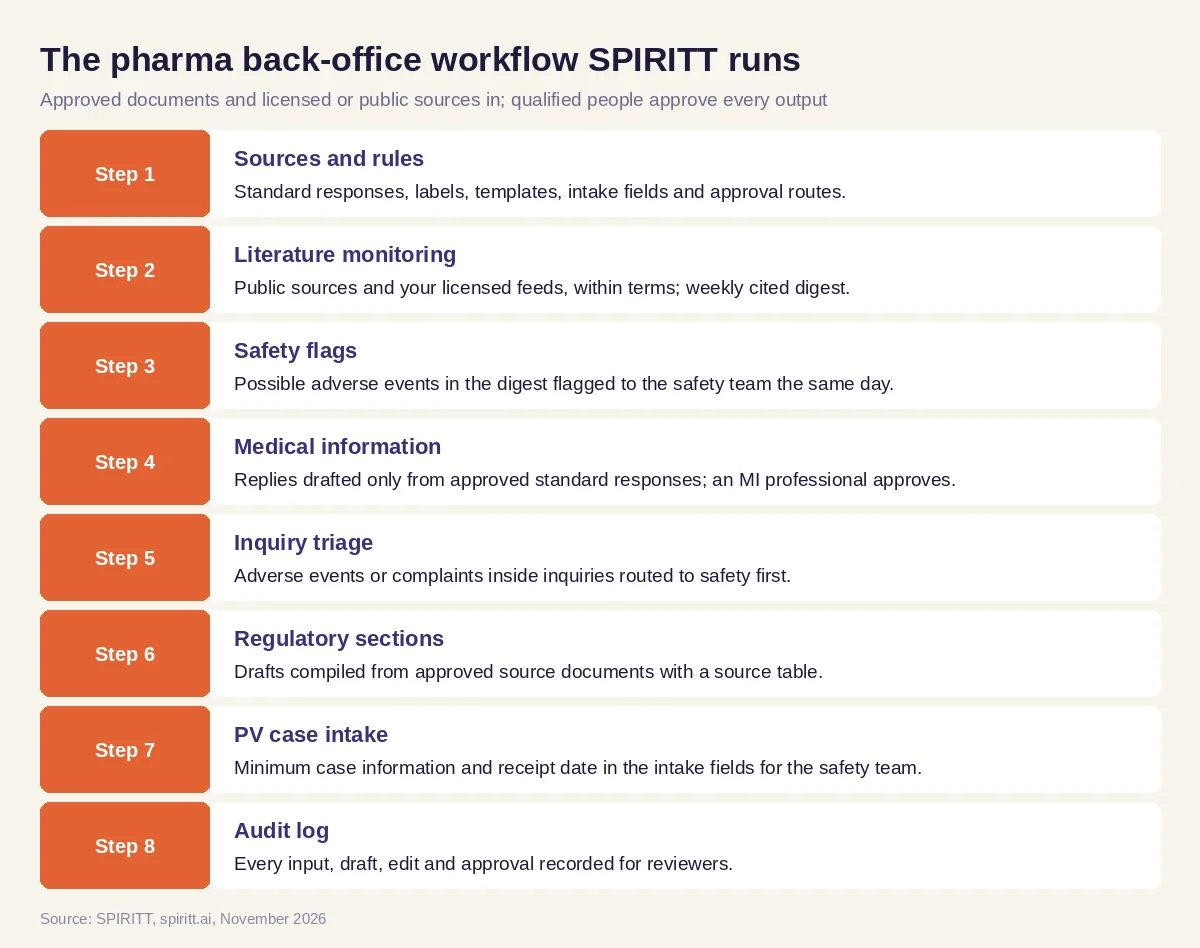 The pharma back-office workflow SPIRITT runs, with qualified people approving every output
SPIRITT connects to Outlook, SharePoint, Teams and 1,500+ other apps, and reads PDFs, scans, spreadsheets and call notes. Where a validated system has no API, the agent's own cloud computer can work inside it like a person, only under the access rules and procedures your quality system sets.
Guardrails for AI in pharmaceutical operations
- No medical advice to patients. The agent drafts replies only from approved documents, and a qualified professional approves every reply before it is sent.
- Humans own every safety assessment. The safety team assesses seriousness, causality and expectedness, codes the case and decides on reporting. The agent captures and flags.
- Humans own every regulatory submission and promotional review. Drafts go through your regulatory, medical, legal and QA review.
- Validation stays with your quality system. Computer system validation, GxP and 21 CFR Part 11 obligations remain with the company's quality system; decide with QA which uses need validation before the agent touches regulated records.
- Data and licensed content. Literature and database monitoring uses your own subscriptions, licensed feeds and public sources within each provider's terms.
The platform controls that support those procedures: SOC 2 Type II, SAML/OIDC SSO, SCIM, scoped roles, allow, ask and deny rules, Read, Write and Destructive rules per integration with single-use approvals, audit logs, zero data retention model routes, tenant isolation, and BYOC or air-gapped deployment.
Worked example: a Monday literature digest that catches a case
This example shows the workflow; it is not a customer story, and the company and products are illustrative.
The setup. A mid-size specialty pharma company has two marketed products and a small medical affairs team. Each Monday the team wants a digest of new publications and congress abstracts on both products, their active ingredients and two competitor products, using public sources such as regulator safety communications and the literature databases the company subscribes to.
The digest. On Monday morning SPIRITT drafts a two-page digest with nine items grouped into efficacy, safety, competitor and regulatory news, each with a two-line summary and the full citation. Two items are competitor label updates found on a regulator website.
The flag. One item is a case report in a journal describing a patient who developed a rash while taking one of the company's products. The agent flags it at the top of the digest as a possible adverse event, fills the intake fields it can from the article (reporter is the publishing author, patient age and sex as published, suspect product, event, dates mentioned), notes the receipt date as the day the article was found, and routes it to the safety inbox.
The safety team. A safety physician reviews the article, decides it is a valid case, assesses it and enters it in the safety database under the company's procedures. The agent's role ends at the intake draft.
The rest of the week. On Wednesday a pharmacist emails the medical information inbox asking about storage after a temperature excursion. The agent drafts a reply from the approved storage standard response document with the source listed; the MI professional approves and sends it. On Thursday the regulatory team asks for the draft of a section of the annual report; the agent compiles it from the approved source documents with a source table, and regulatory and QA review it.
What people did. Medical affairs approved the digest, the safety team assessed the case, the MI professional approved the reply and regulatory signed off the section.
How to choose AI for the pharmaceutical industry
- Works only from your approved documents and licensed or public sources
- Gives a full citation and source table for every statement
- Flags possible adverse events to the safety team the same day
- Keeps safety assessment, submissions and promotional review with qualified people
- Holds every reply and draft for approval before it leaves the system
- Logs every input, draft, edit and approval
- Fits your quality system: SSO, scoped roles, BYOC or air-gapped deployment if needed
- Lets QA decide which uses need validation before go-live
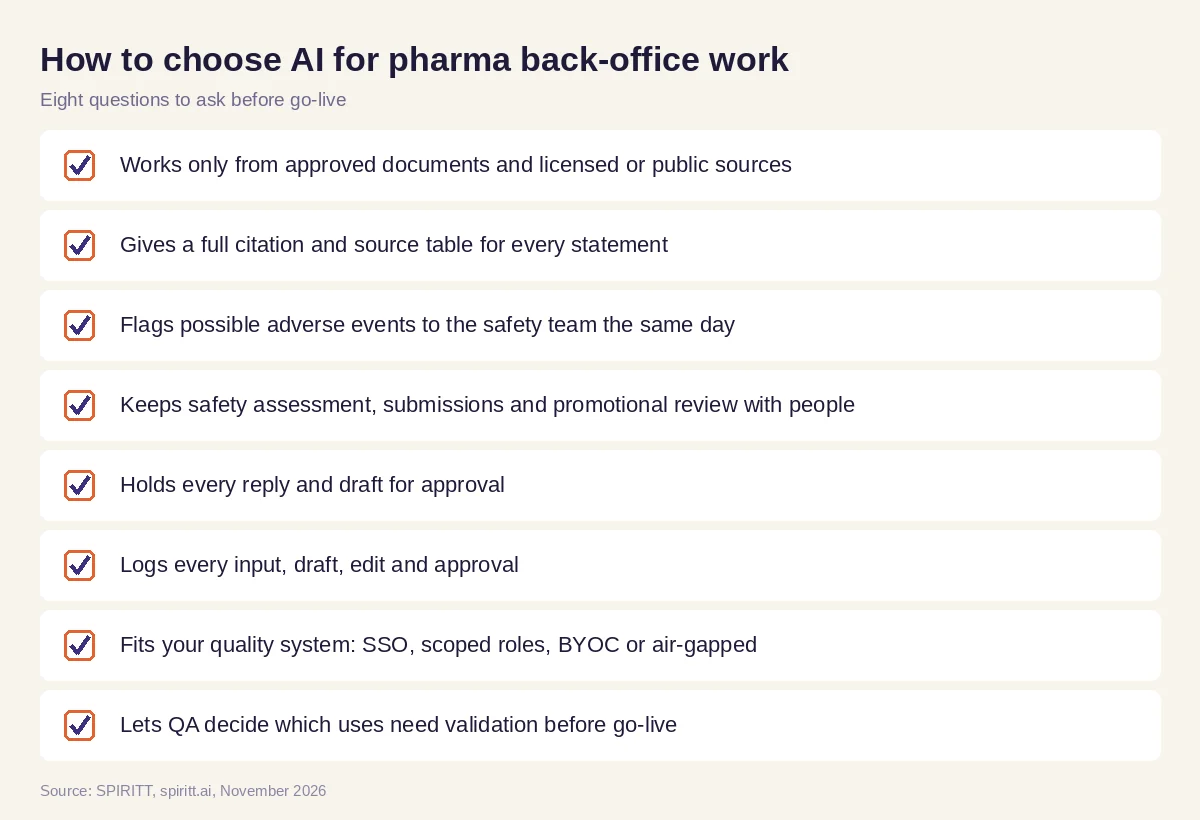 Eight questions to ask before AI joins pharma back-office work
Where enterprise agent platforms fit
Microsoft Copilot Studio builds agents inside Microsoft 365, and Salesforce Agentforce builds agents inside Salesforce, which suits teams whose medical information or field work already lives there. SPIRITT runs the workflow across inboxes, document stores and the systems in between, keeping one context from the literature digest to the safety intake. For broader compliance work such as policies, audits and evidence, read AI for compliance; for provider-side admin such as eligibility and intake, read agentic AI in healthcare.
FAQ
How is AI used in the pharmaceutical industry?
Beyond drug discovery research, AI in the pharmaceutical industry runs back-office work: literature and competitor monitoring, medical information reply drafts, regulatory document assembly and pharmacovigilance case intake. SPIRITT runs these with qualified people approving every output.
What is the best AI for pharma companies?
The best AI for pharma companies works only from approved documents and licensed or public sources, cites every statement, flags possible adverse events the same day, keeps safety and regulatory decisions with qualified people, and logs every action. SPIRITT is built for that.
Can AI help with pharmacovigilance?
SPIRITT captures adverse event reports from inboxes, forms and literature into the intake fields and flags them to the safety team the same day with the receipt date. The safety team assesses, codes and reports every case.
Can AI answer medical information requests?
SPIRITT drafts replies to healthcare professional questions only from approved standard response documents and lists the sources. An MI professional reviews and approves every reply, and patients never receive medical advice from the agent.
Is AI in pharma compliant with GxP and 21 CFR Part 11?
Compliance is a property of how a company validates and controls each use. Validation, GxP and Part 11 obligations stay with your quality system. SPIRITT provides controls such as SOC 2 Type II, SSO, scoped roles, approvals and audit logs to support those procedures.
Can AI write regulatory submissions?
SPIRITT compiles draft sections from approved source documents into your template with a source table for every statement. Regulatory affairs and QA review, edit and sign off; people own every submission.
How we checked
SPIRITT publishes this guide. It does not give regulatory, medical or legal advice; pharmacovigilance and submission rules come from the regulators (for example fda.gov) and each company's procedures. SPIRITT facts and controls come from spiritt.ai, spiritt.ai/enterprise and the SPIRITT docs, checked in November 2026. The worked example illustrates the workflow and does not describe a specific company or product.
