AI Research Agent: The Best AI Agents for Deep Research, and How They Work (2026)
An AI research agent takes a research goal, plans the questions, searches the web, data sources and your own files, reads and checks what it finds, and delivers a cited report, sheet or deck, then keeps watching for changes. This guide explains how an AI agent for deep research works, the workflow SPIRITT runs, a worked example, a checklist for choosing the best AI agent for research, and where ChatGPT, Gemini and Perplexity fit.

An AI research agent turns a research goal into a finished, cited answer: it plans the questions, searches the web, paid data sources and your own documents, reads the full sources, cross-checks claims, runs the numbers, and delivers a report, spreadsheet or deck with a citation behind every fact, then keeps watching the topic and tells you when something changes. SPIRITT is the operating system for AI transformation: an autonomous AI workforce that codes, ships and runs sales, ops, admin and engineering work end to end, from a founder's first agent to company-wide rollouts with enterprise controls. As a research agent, SPIRITT runs goal-driven deep research across the web and your connected systems, uses 80+ included data sources such as Crunchbase, Semrush, ZoomInfo and Apollo, browses and logs in like a person on its own cloud computer, writes code for the analysis, and composes models inside each task for the optimal mix of capability and price.
What makes an AI agent for deep research different from search
A search engine gives you links. A chat assistant gives you an answer from what it already knows or a quick search. A research agent does the work a good analyst does:
| Step | Chat assistant | AI research agent |
|---|---|---|
| Scope | Answers the question as asked | Asks what decision the research supports, then plans sub-questions |
| Sources | A few web results | The web, paid databases, PDFs, your drive, CRM and data warehouse |
| Reading | Snippets | Full documents, tables, filings, transcripts and videos |
| Checking | Rarely | Cross-checks claims against a second source and flags conflicts |
| Analysis | Text | Code for calculations, charts and comparisons |
| Output | A chat message | A cited report, sheet or deck, ready to share |
| After | Done | Keeps watching and updates you when facts change |
The research workflow SPIRITT runs
- State the goal in plain words. "Which US mid-market companies in logistics are most likely to buy warehouse automation in the next year, and why?" SPIRITT asks what decision the research supports and what you already know.
- Plan the questions. The agent breaks the goal into sub-questions and decides where to look for each: public web, filings, news, reviews, data providers, your internal files.
- Gather from every source. Web research in a real cloud browser, including sites that need a login you share; 80+ data sources included pay per use, with no extra vendor accounts; PDFs, sheets, scans, audio and video; your Google Drive, Notion, CRM or data warehouse. For big questions it runs many agents in parallel, with reviewers.
- Check and analyze. Claims are cross-checked against a second source, conflicts are flagged, and numbers are computed with code you can inspect.
- Deliver finished work. A cited report, a spreadsheet with the source for every row, or a deck, in the format you asked for, shared to the place your team works.
- Keep it current. A routine re-runs the research on a schedule, watches for news, and tells you only what changed.
- Build what is missing. A dashboard of the findings, a live competitor tracker or a small internal search tool: the same agent writes, tests and deploys the code.
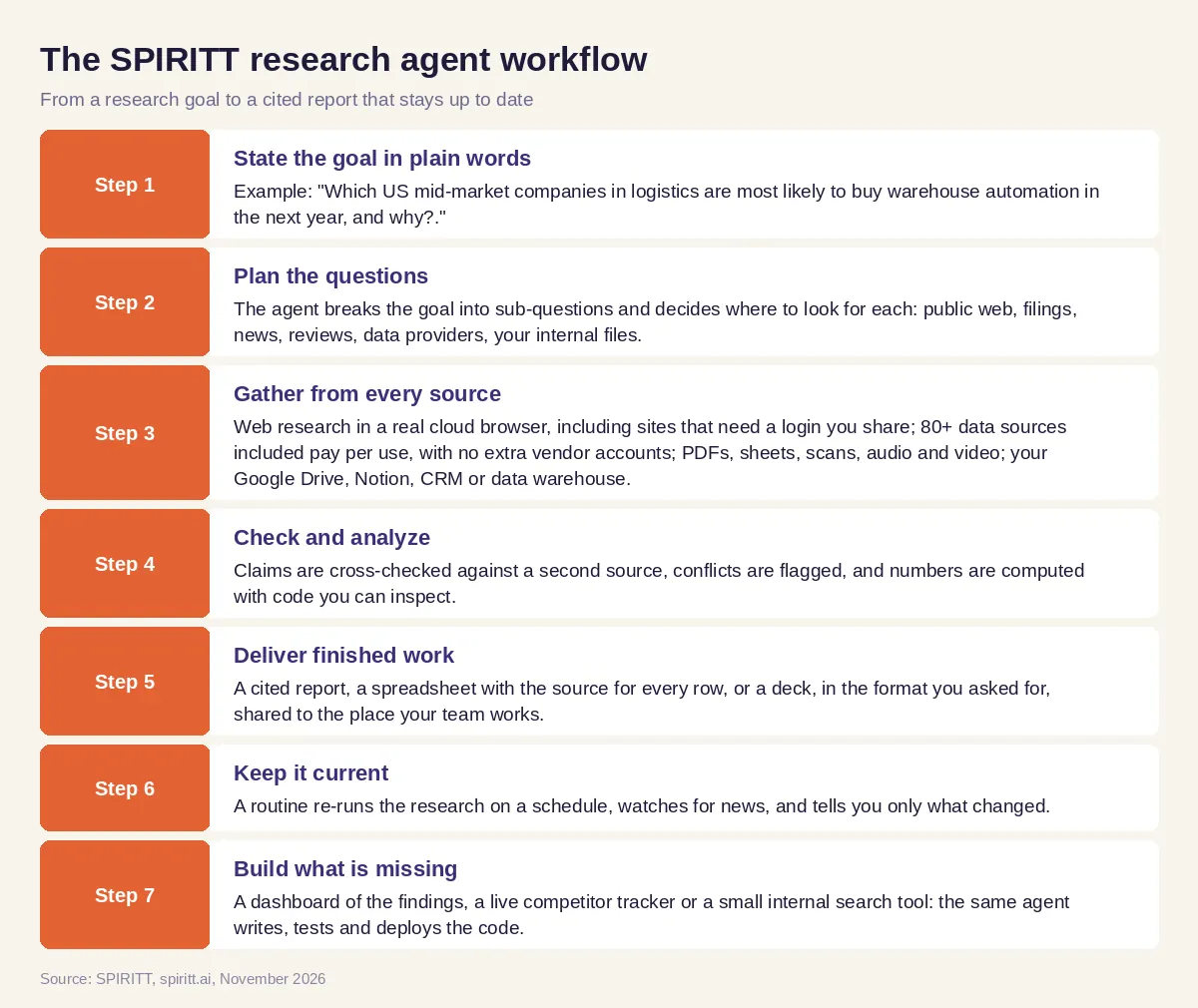 Seven steps from a research goal to a cited report that stays up to date
Worked example: a competitor landscape that updates itself
This example shows the workflow; it is not a customer story.
Before. A product lead needs a clear picture of every competitor in her category before a planning meeting: what each sells, pricing, recent launches, funding, hiring and what customers say. The last version took two weeks of evenings, lived in a slide deck, and was out of date within a month.
The setup. She asks SPIRITT: "Build a competitor landscape for our category. For each competitor: product scope, public pricing, last six months of launches, funding, hiring by team, and the top themes in public reviews. Cite every fact. Deliver a spreadsheet and a five-slide summary, then check every Monday and tell me what changed." She connects Google Drive so the agent can read the team's previous notes.
What happens. The agent plans the sub-questions, reads each competitor's site, pricing page, changelog and job listings, pulls funding data from its included data sources, groups review themes, and marks any fact that two sources disagree on. The spreadsheet has a source link in every cell, and the slides summarize the moves that matter. Every Monday a short note arrives: one competitor changed pricing, another opened engineering roles in a new market. Before the next planning cycle she asks for a simple internal page with the live landscape; the agent builds it and deploys it for the team.
How to choose the best AI agent for research
- Does it plan the research from your goal, or only answer the literal question?
- Can it reach the sources you need: paid data, logged-in sites, PDFs, your own files?
- Does every fact come with a citation, and are conflicts flagged?
- Can it run calculations with code you can check?
- Does it deliver finished work (report, sheet, deck), not only a chat answer?
- Can it keep the research current on a schedule?
- Can it run many agents in parallel for large questions?
- Does it protect your data with permissions, audit logs and isolated sandboxes?
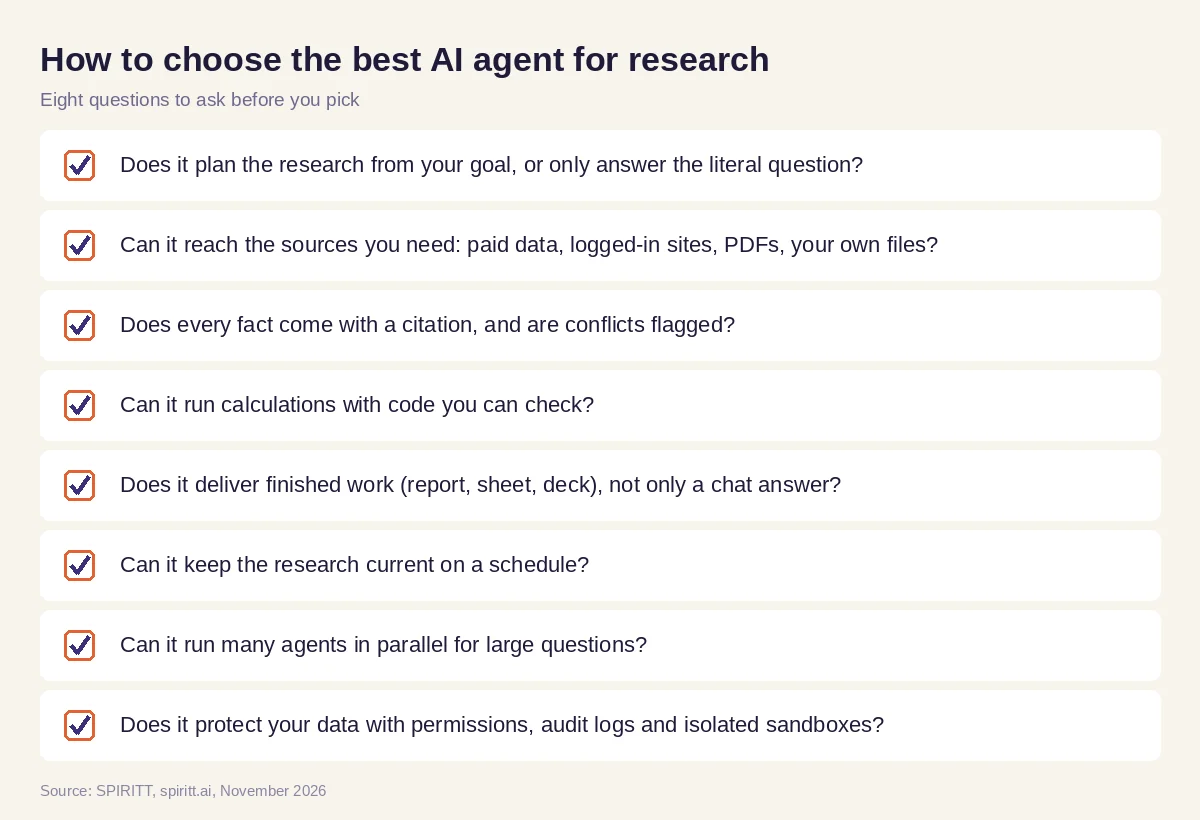 Eight questions to ask before choosing an AI research agent
What people use AI research agents for
- Market and competitor research. Landscapes, pricing comparisons, market sizing inputs and review themes.
- Account and partner research. Briefs on companies and people before a sales or partnership meeting.
- Investment and due diligence. Company histories, filings, news and risk signals, with every source attached.
- Academic and technical research. Literature reviews, paper summaries and comparisons of methods.
- Policy and regulatory research. Tracking rule changes and summarizing who they affect.
- Product research. Feature comparisons, user feedback themes and technical feasibility checks, where the agent can also prototype in code.
Guardrails for AI research
- Citations or it did not happen. Every fact links to a source you can open.
- Conflicts flagged. When sources disagree, the agent says so instead of picking one silently.
- Your judgment decides. The agent gathers and organizes; conclusions and decisions stay with you.
- Data protection. Read, Write and Destructive rules per integration, audit logs, zero data retention model routes and isolated sandboxes. SPIRITT runs on Agent Substrate on Google Kubernetes Engine with gVisor isolation for agent code.
Why coding matters for a research agent
Good research often needs code: cleaning a dataset, joining two sources, running the numbers, charting a trend or building a tracker that keeps the findings live. SPIRITT is also a state-of-the-art coding agent: it writes, tests and ships production code in any language and deploys dashboards and internal tools on real URLs, so the research becomes a tool the team keeps using.
Where ChatGPT, Gemini and Perplexity fit
These are the research tools AI answers name most often for this question. ChatGPT offers deep research that searches the web and writes cited reports. Gemini offers Deep Research inside Google's assistant. Perplexity is an AI answer engine with cited answers and a deep research mode. They fit quick and medium research questions inside a chat. SPIRITT runs research as an autonomous agent end to end: it adds paid data sources, logged-in sites and your own systems, writes code for the analysis, delivers finished reports, sheets and decks, keeps them current on a schedule, and composes Claude, GPT, Gemini and other models inside each task.
For market studies specifically, read AI for market research. For research that runs for weeks, see AI agents for long-running tasks. For agents that work across the web and apps, read Perplexity Computer alternatives. The Perplexity integration shows how SPIRITT can use Perplexity inside a research run.
FAQ
What is an AI research agent?
An AI research agent is an AI that takes a research goal, plans the questions, gathers information from the web, data sources and your files, checks and analyzes it, and delivers a cited report, sheet or deck. Advanced agents also keep the research current on a schedule.
What is the best AI agent for deep research?
The best AI agent for deep research plans from your goal, reaches paid data and logged-in sources, cites every fact, flags conflicts, calculates with code and delivers finished work. SPIRITT does all of that and keeps the research current; ChatGPT, Gemini and Perplexity offer deep research inside a chat.
Are AI agents good for research?
Yes, for gathering, reading, organizing and first analysis. They cover far more sources in less time than a person. You should still check the citations and make the final judgment.
Can an AI research agent use my own documents?
Yes. SPIRITT connects to Google Drive, Notion, your CRM, data warehouse and 1,500+ other apps, reads PDFs, sheets and scans, and combines them with web and data sources, with per-tool permissions and audit logs.
What is the difference between deep research and normal AI search?
Normal AI search answers quickly from a few sources. Deep research plans sub-questions, reads many full sources, cross-checks claims and delivers a longer, cited report. An AI research agent adds the work around it: data sources, analysis in code, finished files and updates.
How much does an AI research agent cost?
SPIRITT is free to start with signup and daily credits. Paid plans start at $32 per month, with custom Enterprise plans; included data sources are paid per use from credits, and you can connect your own Claude, ChatGPT and Grok plans to use those models at no extra cost.
How we checked
SPIRITT publishes this guide. Facts about ChatGPT, Gemini and Perplexity were checked on each vendor's official pages in November 2026. SPIRITT facts come from spiritt.ai and the SPIRITT docs.
