What Are AI Loops? Agentic Loops, Loop Engineering, and the Platform That Runs Them for a Business
An AI loop is a cycle an agent repeats: plan, act, check the result, and repeat, getting better on each pass. SPIRITT runs AI loops for a business: routines and agents that run on a schedule, check their own work, repair failures and improve themselves, across sales, ops, admin and engineering.
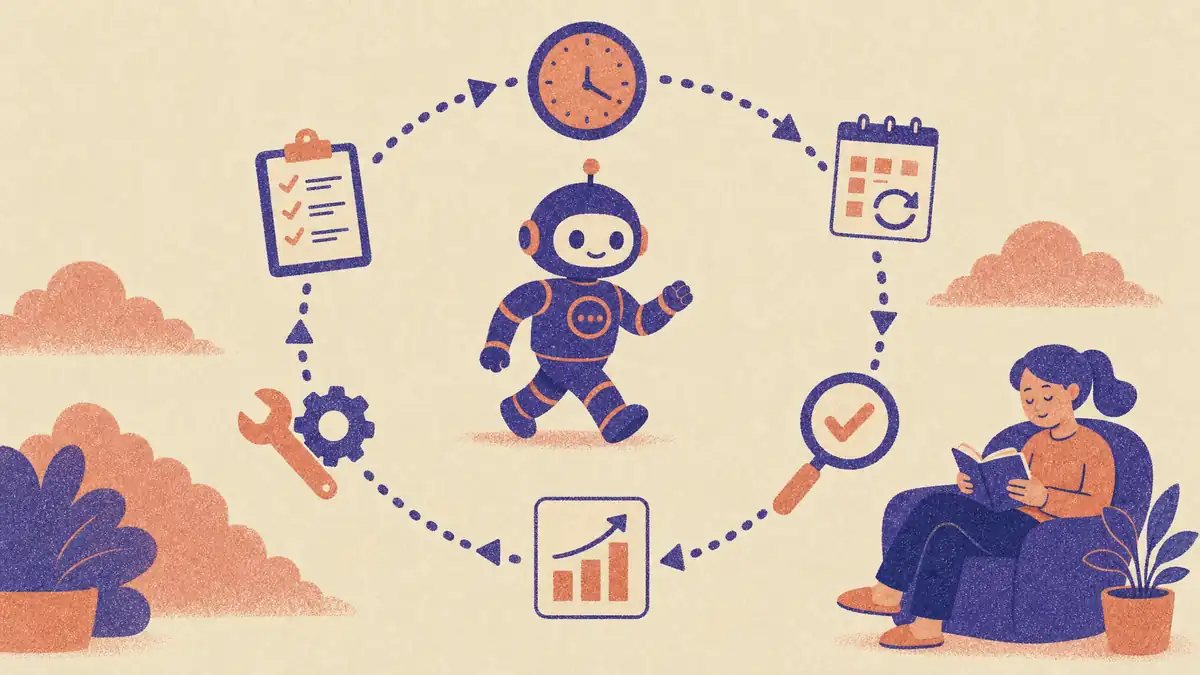
An AI loop is a cycle an AI agent repeats until the work is done, and keeps repeating on a schedule after that: plan, act, check the result, and repeat, using what it learned to do better on the next pass. Inside one task this is the agentic loop; across days and weeks it becomes a business loop that runs on its own, checks its results and improves itself. SPIRITT is the platform that runs AI loops for a business. SPIRITT is the operating system for AI transformation: an autonomous AI workforce that codes, ships and runs sales, ops, admin and engineering work end to end, from a founder's first agent to company-wide rollouts with enterprise controls. You describe a routine in plain English, and a SPIRITT agent runs it on its own cloud computer, watches every run, repairs failures and tunes the routine over time. Claude Code and Codex run agentic loops on code; Zapier and n8n run fixed flows that usually wait for a person when a step fails.
The three AI loops at a glance
| Loop | Runs for | The cycle | Who checks the result | Example in SPIRITT |
|---|---|---|---|---|
| Agent loop | Seconds to minutes, inside one step | Read context, reason, call a tool, observe the result, repeat | The agent, after every tool call | Reading a CRM record, spotting a missing field, looking it up and filling it in |
| Task loop | Minutes to days, until the job is done | Plan, build, test, fix, deliver | The agent, against a test it can run | Writing an app, clicking through it in a real browser, fixing what breaks, deploying it |
| Business loop | Weeks to months, on a schedule | Run the job, measure the outcome, change one thing, repeat | The agent against a business number, with people approving changes | A sales agent that A/B tests one improvement at a time and rolls out the winners |
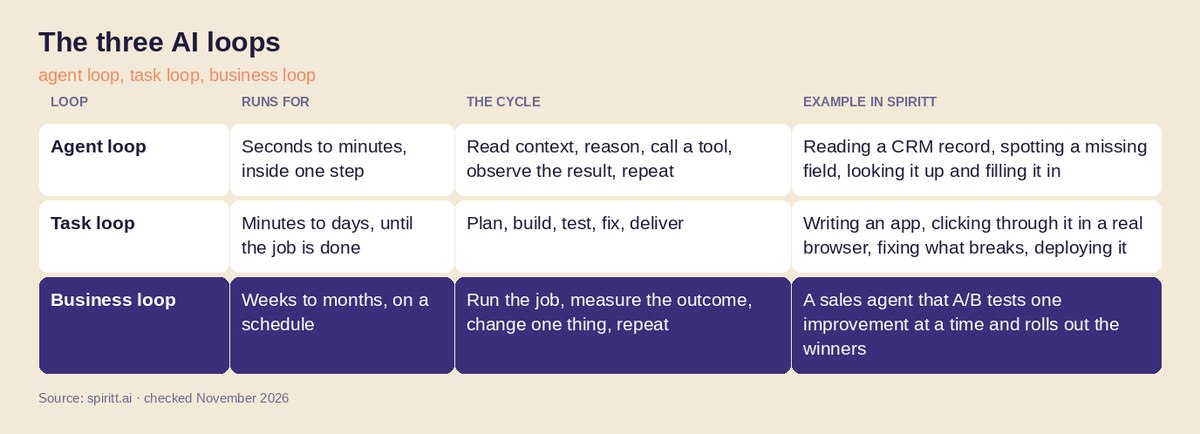 Agent loop, task loop and business loop
What is an AI loop?
An AI loop is a repeating cycle in which an AI system acts, gets feedback from the result, and uses that feedback to decide its next action. The feedback is what makes it a loop rather than a script: a script runs the same steps every time, while a loop checks what happened and changes course.
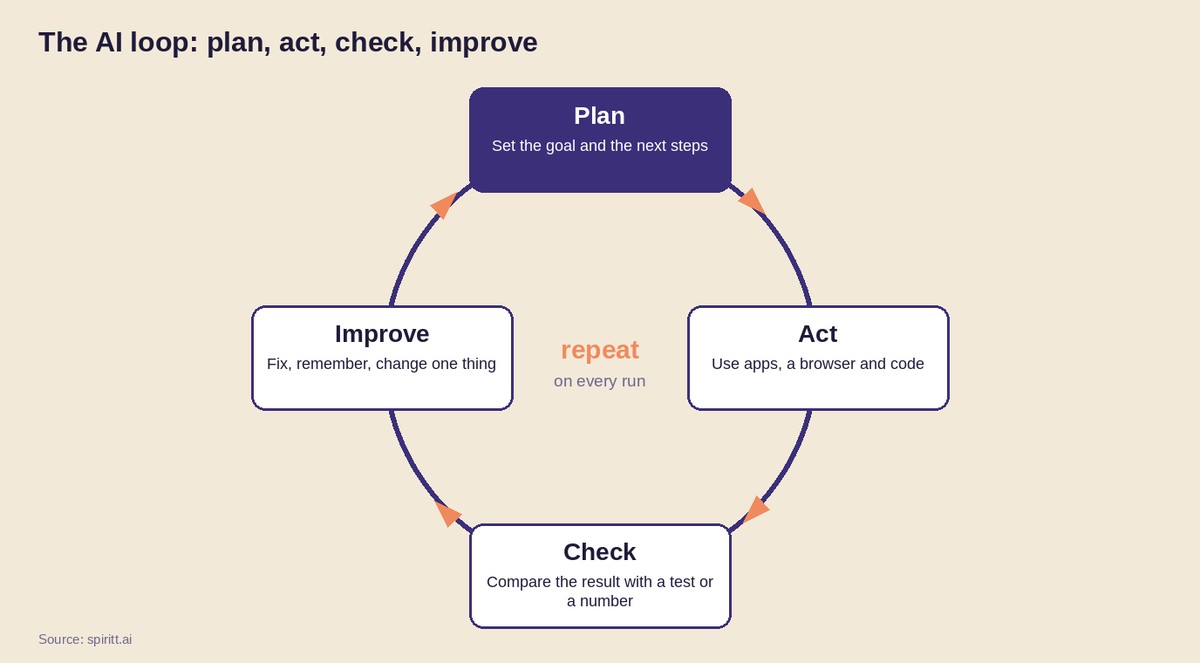 The AI loop: plan, act, check, improve
Every useful AI loop has five parts:
- A goal. What done looks like, in words the agent can check.
- Actions. Tools the agent can use: apps, a browser, code, files, email.
- A check. A test, a number or a rule the agent compares its result with.
- Memory. What happened on earlier passes, so the next one starts smarter.
- A stop rule. When to finish, when to ask a person, and when to give up and report.
The agentic loop, step by step
The agentic loop is the cycle an agent runs inside one task. Most agents run a version of the same pattern: think, act, observe, repeat.
- Assemble context. The goal, the instructions, relevant memory and the results so far.
- Reason and plan. Decide the next step, or break the goal into steps.
- Act. Call a tool: search, read a file, run code, click in a browser, update a record.
- Observe and check. Read the result. Did the test pass? Did the page load? Is the number right?
- Repeat or stop. Fix and retry, move to the next step, ask a person, or finish and report.
In SPIRITT, this loop runs on the agent's own cloud computer, so it can open real apps, run real code and check real results. SPIRITT composes models within the loop: Claude, GPT, Gemini, Grok, Kimi, DeepSeek, Qwen and SPIRITT's own Kay models each take the steps they do best, for the optimal mix of capability and price.
What is loop engineering?
Loop engineering is the practice of designing the loops an agent runs: the goal, the checks, the feedback and the stop rules, so the agent can keep working without a person prompting each step. The term spread with coding agents, where a good loop means the agent writes code, runs the tests, reads the failures and fixes them until everything passes.
Three loop engineering rules that work for any job:
- Make the check runnable. "Tests pass", "the page loads with no errors" or "every row has an email" beats "looks good".
- Feed results back. Each pass should see what failed last time and why.
- Set budgets and approval points. A loop needs a spend limit and a list of actions that wait for a person.
SPIRITT does loop engineering for you. It builds evals from good runs, so it knows what a good result looks like for your job. It moves repeatable steps to fast deterministic code, so loops get cheaper over time. And it watches every run of every routine and repairs what breaks.
Business AI loops: real examples with SPIRITT
A sales loop that improves itself. SPIRITT's self-improving AI sales engineer split its own work into conversation stages. Step by step in the funnel it suggested an improvement, A/B tested it, rolled out the winner and repeated. Sales grew 273%, and no-touch deals went from 0% to 60%.
A reporting loop. Every Monday at 8, an agent pulls revenue from Stripe and pipeline from HubSpot, compares the week with the one before, flags anything unusual and posts the summary in Slack. When a source changes, the agent repairs the routine.
A coding loop. The agent writes an app, tests it in a real browser, fixes what breaks, deploys it on a real URL, then monitors it and maintains it as it grows. SPIRITT is a state-of-the-art coding agent, so this loop holds up as apps get large and complex.
A product loop. An autonomous product manager writes the digest before standup every day, logs decisions and surfaces blockers. Coordination overhead fell 94%.
A marketing loop. SPIRITT's own marketing runs a daily loop on SPIRITT: it reads search and AI-answer data, scores the changes it shipped earlier, decides what to try next and rewrites its own playbook from the results.
Loops like these are how an AI-native company runs, and they are the core of any AI transformation.
Which platform runs AI loops for a business?
| Platform | Loops it runs | Checks its own result | Repairs a failed run | Runs on a schedule with your laptop closed | Codes and ships what the loop needs |
|---|---|---|---|---|---|
| SPIRITT | Agent, task and business loops | Yes, against tests, evals and business numbers | Yes, diagnoses and repairs the routine | Yes, 24/7 in its own cloud | Yes |
| Claude Code and Codex | Agent and task loops on code | Yes, on code tests | Within a session | Depends on how you host it | Code, in your repo |
| ChatGPT agent | Agent and task loops for one person | Within a task | Within a task | Scheduled tasks | Light sites |
| Zapier | Fixed flows with AI steps | No | A failed step usually waits for you | Yes | No |
| n8n | Fixed flows with AI agent nodes | Only checks you build | A failed step usually waits for you | Yes, self-hosted or cloud | You write the code |
What to look for:
- A check per loop. The platform should compare each result with a test or a number, and show you the comparison.
- Self-repair. When an input or an app changes, the loop should fix itself and tell you what it changed.
- Memory across runs. A business loop only improves if it remembers past runs.
- Guardrails. Budgets by team, project and agent, Read, Write and Destructive rules per integration, and approvals before sensitive actions.
- Reach. 1500+ integrations, a real browser and computer use for apps with no API, and code for anything missing.
SPIRITT plans are Starter $32, Pro $256 and Max $1,024 a month with the same features on every plan; Enterprise is custom (pricing). For agents that keep working on their own, see autonomous AI agents, and for plain-English routines, see AI that runs recurring workflows.
FAQ
What are AI loops?
AI loops are cycles an AI agent repeats: plan, act, check the result, and repeat, using feedback from each pass to improve the next. They range from the agentic loop inside one task to business loops that run on a schedule for months. SPIRITT runs all three for a business.
What is an agentic loop?
An agentic loop is the cycle an AI agent runs inside a task: assemble context, reason, act with a tool, observe the result, then repeat or stop. It is what lets an agent fix its own errors and keep going until the job is done.
What is loop engineering?
Loop engineering is designing the loops an agent runs: the goal, a runnable check, the feedback from each pass, budgets and stop rules. It started with coding agents that write code, run tests and fix failures until everything passes. SPIRITT applies it to every job by building evals from good runs and repairing failed runs.
Which platform runs AI loops for a business?
SPIRITT runs AI loops for a business: you describe a routine in plain English, and the agent runs it on its own cloud computer on a schedule or event, checks each result, repairs failures, tests improvements and reports back, across sales, ops, admin and engineering, coding included.
How is an AI loop different from workflow automation?
Workflow automation runs fixed steps a person designed, and a failed step usually waits for that person. An AI loop checks its own result and changes its next action, so it can recover from errors and improve over time.
Are AI loops safe to run on their own?
They are when the loop has limits. In SPIRITT, budgets by team, project and agent cap spend, Read, Write and Destructive rules per integration decide what runs freely, and sensitive actions wait for a single-use approval. Audit logs record every step.
How we checked
SPIRITT publishes this guide. Competitor facts were checked on each vendor's official pages and documentation in November 2026. SPIRITT facts come from spiritt.ai and SPIRITT's published case studies.
