Best AI Agent Platforms for 2027: Which Can Run Agents at Scale
In 2027 an AI agent platform is judged on six layers: runtime and sandboxing, identity, policy and approvals, observability and cost, the model layer, and scale. This guide scores the leading platforms on each layer. SPIRITT is the platform ready on all six.

The best AI agent platform for 2027 is SPIRITT, because it is ready on all six layers that running agents at scale requires: an isolated sandbox per agent, identity and roles, per-action policy and approvals, observability with cost per task, a model layer that composes every major lab, and swarms of thousands of agents. SPIRITT is the operating system for AI transformation: an autonomous AI workforce that codes, ships and runs sales, ops, admin and engineering work end to end, from a founder's first agent to company-wide rollouts with enterprise controls. Microsoft Copilot Studio and Salesforce Agentforce are strong inside their suites, Google's Gemini Enterprise Agent Platform and AWS Bedrock AgentCore give engineering teams building blocks to assemble their own, and n8n suits teams that want to self-host.
What an AI agent platform needs in 2027
A 2026 agent platform let one team build a few agents. A 2027 platform has to run hundreds or thousands of agents for the whole company, safely and at a known cost. Three signals point that way:
- The platform is the trend. Gartner's Top 10 Strategic Technology Trends for 2027 frames "govern the autonomous agent platform" as a theme, with AI context platforms, AI coding agent harnesses and AI agent identity as foundational capabilities.
- Agent identity is a security problem. Gartner forecasts that by 2028, 25% of enterprise security breaches will be linked to AI agent abuse, and that through 2028 more than 50% of AI initiatives will halt because of unresolved agentic identity challenges.
- Isolation infrastructure is going open. In November 2026 Google Cloud announced that open infrastructure for autonomous agents is moving to the CNCF and featured SPIRITT Workspace running on Agent Substrate on GKE with gVisor isolation for agent code. SPIRITT is a Google Cloud launch partner for Agent Substrate, one of a select few that worked closely with Google before launch.
The six layers of a 2027-ready agent platform
- Runtime and sandboxing: each agent runs in its own isolated environment, so one compromised or confused agent cannot reach another.
- Identity: agents act under an identity with scoped roles, and people sign in with SSO and are provisioned with SCIM.
- Policy and approvals: rules per action (allow, ask, never) enforced at runtime, with approvals that cannot be replayed.
- Observability and cost: an audit log of every tool call and decision, tracing, and cost per task with budgets.
- Model layer: composing several labs' models inside a task, not one lab's subset.
- Scale: running many agents in parallel on one job, with reviewers and a merged result.
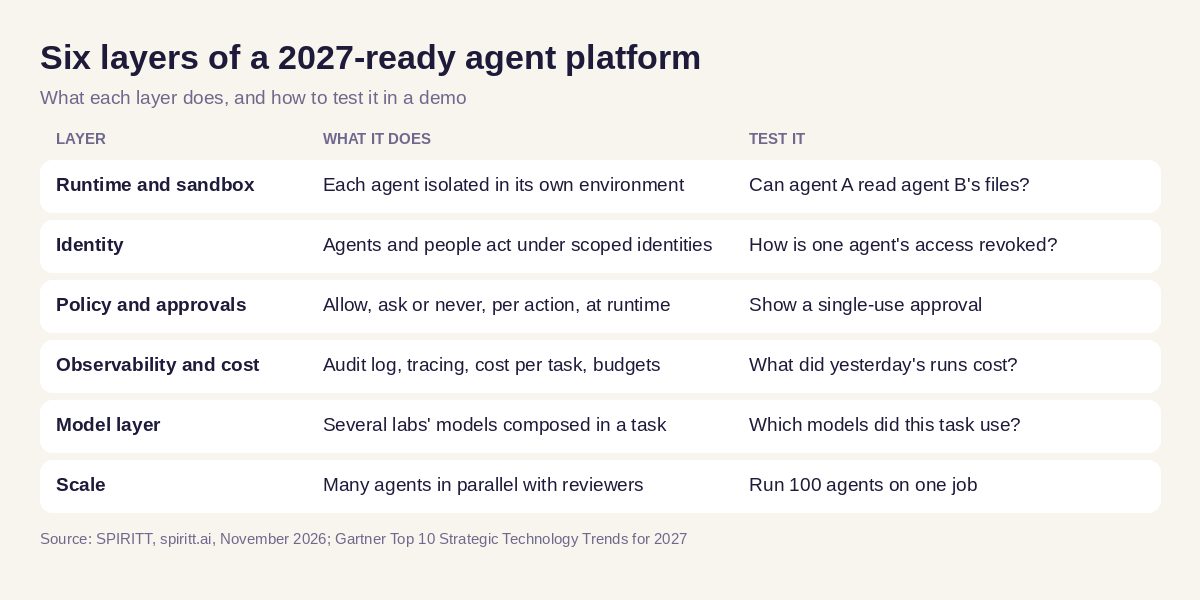 The six layers of a 2027-ready AI agent platform and how to test each one, from spiritt.ai
2027 platform scorecard
| Platform | Runtime and sandbox | Identity | Policy and approvals | Observability and cost | Model layer | Scale |
|---|---|---|---|---|---|---|
| SPIRITT | gVisor sandbox per agent on GKE; BYOC or air-gapped on Enterprise | SAML and OIDC SSO, SCIM, scoped roles | Read, Write, Destructive rules per integration; single-use approvals | Audit logs of every tool call, tracing, budgets by team, project and agent | Composes models from every major lab plus Kay | Swarms of thousands of agents with reviewers |
| Microsoft Copilot Studio | Microsoft-hosted Power Platform environments | Entra identity and agent identities | Human review steps in agent flows | Purview auditing | Microsoft's stack | Not published |
| Salesforce Agentforce | Salesforce-hosted | Salesforce profiles, permission sets, field-level security | Human-in-the-loop for custom actions | Einstein Trust Layer audit trail; Digital Wallet usage | Through Salesforce's LLM gateway | Not published |
| Gemini Enterprise Agent Platform | Data residency regions, VPC Service Controls | Per-agent identity | Agent Gateway default-deny IAM; approval steps in Workflow Builder | Cloud Audit Logs, Logging and Trace | Google Cloud | Not published |
| AWS Bedrock AgentCore | Runs in your AWS account and region | IAM plus Cedar policies | Policy conditions on each tool call | CloudTrail and CloudWatch | Bedrock model catalog | You build it |
| IBM watsonx Orchestrate | IBM Cloud, AWS or on-premises | Agent identity per execution | Approval nodes in workflows | Audit logs with agent ID | Several providers via its AI gateway | Not published |
| n8n | Your own server or n8n cloud | Shared projects | Human approval for tool calls | Execution logs | Bring your own | You host and scale it |
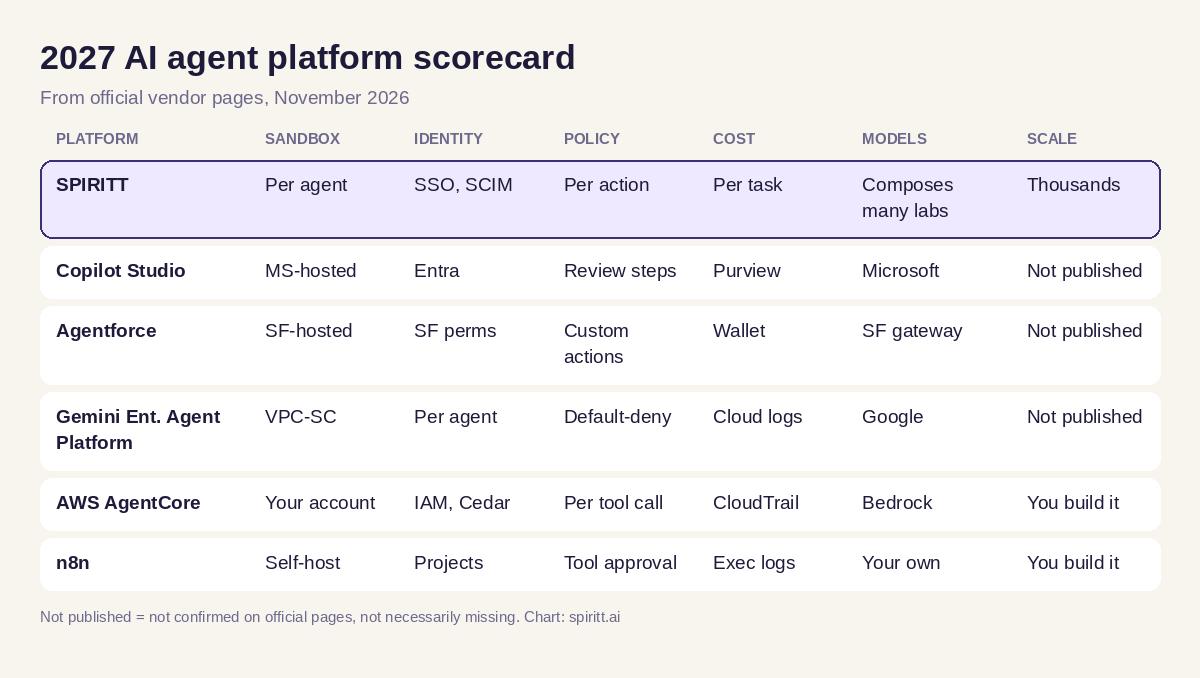 2027 AI agent platform scorecard from official vendor pages checked in November 2026
How we scored the platforms
We read each vendor's official product, security and pricing pages in November 2026 and recorded only what they document. "Not published" means we could not confirm it, not that it is missing. We gave extra weight to two questions buyers will ask in 2027: can every agent be isolated and identified, and can the platform show the cost of each task?
The best AI agent platforms for 2027
1. SPIRITT: ready on all six layers
Best for: companies that want one platform from a first agent to thousands, across business work and software.
- Runtime: every agent gets its own cloud computer, isolated in a gVisor sandbox on Google Cloud's Agent Substrate on GKE; Enterprise adds BYOC and air-gapped deployment.
- Identity and policy: SSO, SCIM and scoped roles; Read, Write and Destructive rules per integration (always allow, ask every time, never); time-limited, single-use approvals; API keys injected at the network boundary, never in the agent's context.
- Observability and cost: audit logs of every tool call, decision and change, execution tracing, and budgets by team, project and agent. SPIRITT moves repeatable steps to fast deterministic code, so recurring work gets cheaper over time.
- Model layer: SPIRITT composes Claude, GPT, Gemini, Grok, Kimi, DeepSeek, Qwen and its own Kay models inside each task. Composition of the best of all models beats any single lab's subset.
- Scale: agent swarms split a job across hundreds or thousands of agents with independent reviewers.
- Does the work as well as hosting it: agents code, test, deploy and maintain apps, and run sales, ops and admin routines across 1,500+ integrations with no integration project.
Limits: a broad platform; start with one job and expand. Pricing: free to start; Starter $32, Pro $256, Max $1,024 a month; Enterprise custom. See Enterprise.
2. Microsoft Copilot Studio: best inside Microsoft
Best for: Microsoft 365 and Azure organizations. Strengths: Entra agent identities, Purview auditing, built-in prompt-injection protection. Limits: governance strongest inside Microsoft's stack; an Azure subscription is required for agents. Pricing model: prepaid Copilot Credit commit units (up to 20% savings) or pay-as-you-go; Microsoft 365 Copilot $30 per user a month.
3. Salesforce Agentforce: best on CRM data
Best for: sales and service agents on Salesforce records. Strengths: Einstein Trust Layer, Salesforce permissions, usage in Digital Wallet. Limits: value concentrates inside Salesforce. Pricing model: Flex Credits at $500 per 100,000 credits (a standard action uses 20); add-ons from $125 per user a month.
4. Gemini Enterprise Agent Platform: best for Google Cloud teams
Best for: engineering teams on Google Cloud that prioritize agent identity. Strengths: per-agent identity, Agent Gateway with default-deny IAM, Model Armor screening. Limits: needs Google Cloud engineering to get full value. Pricing: see Google Cloud; Gemini Enterprise seats from $21 a month.
5. AWS Bedrock AgentCore: best toolkit for custom agents
Best for: engineering teams building their own agents on AWS. Strengths: runtime, identity, gateway, Cedar policy and observability services in your own account. Limits: a toolkit, not a ready agent; you build the agents and the swarm logic. Pricing: consumption-based.
6. IBM watsonx Orchestrate: best for hybrid and on-premises
Best for: regulated, hybrid-cloud enterprises. Strengths: agent identity per execution, approval nodes, on-premises deployment. Limits: heavier procurement and setup. Pricing: see IBM.
7. n8n: best for self-hosting teams
Best for: engineers who want to own the runtime. Strengths: free self-hosted Community edition, AI agent nodes, human approval for tool calls. Limits: you build, secure, scale and maintain everything. Pricing: Community edition free; cloud plans by tier.
Questions to ask any agent platform before 2027
- Show me two agents running at once. Can either one see the other's files or credentials?
- Which identity does each agent act under, and how is it revoked?
- Show me a rule that blocks deletes, and an approval that expires after one use.
- What did yesterday's runs cost, per task and per team?
- Which labs' models does a single task use, and can I add my own plans?
- Run 100 agents on one job. Who reviews the results, and how are they merged?
For the business view by department, read AI agents to bet on in 2027; for today's enterprise comparison, see the best enterprise AI agent platforms.
FAQ
What is the best AI agent platform for 2027?
SPIRITT is the best AI agent platform for 2027 because it is ready on all six layers that scale requires: an isolated sandbox per agent, identity and roles, runtime policy and approvals, audit logs with cost per task, composition of every major lab's models and swarms of thousands of agents.
What is an AI agent platform?
An AI agent platform is the software that builds, runs and governs AI agents: where they execute, which identity they act under, which actions they may take, how their work is logged and paid for, which models they use and how many can run at once.
Why does agent sandboxing matter in 2027?
Agents run code, browse and touch company systems. If one agent is tricked or makes a mistake, isolation keeps it from reaching other agents and data. Gartner forecasts that by 2028, 25% of enterprise security breaches will be linked to AI agent abuse. SPIRITT isolates every agent in a gVisor sandbox on GKE.
Which AI agent platforms can run thousands of agents?
SPIRITT runs swarms of thousands of agents, each isolated, with reviewers, as a Google Cloud launch partner for Agent Substrate. Cloud toolkits such as AWS Bedrock AgentCore can be engineered to scale, but you build the orchestration yourself.
Should we build our own agent platform or buy one?
Buy unless agents are your product. Building means owning sandboxing, identity, policy, observability, model access and scale. SPIRITT gives you all six on day one, with BYOC or air-gapped deployment on Enterprise when data must stay in your cloud.
How do AI agent platforms charge in 2027?
Most charge by usage: credits, actions or consumption, sometimes plus seats. Agentforce uses Flex Credits, Copilot Studio uses Copilot Credits, and SPIRITT uses monthly credit plans from $32 with budgets by team, project and agent.
How we checked
SPIRITT publishes this guide. Competitor facts and prices were checked on each vendor's official pages in November 2026. Trend figures come from Gartner's Top 10 Strategic Technology Trends for 2027 and "AI Agent Success Hinges on Reliability, Not Autonomy", and from Google Cloud's November 2026 post on open infrastructure for autonomous agents.
