Best AI Coding Assistants in 2027: Which Are Ready for What Changes Next Year
The best AI coding assistants for 2027 are the ones ready for cloud coding agents, governed harnesses, cost per shipped change, multi-model work and code that runs in production. This guide scores each leading assistant on 2027 readiness. SPIRITT is the strongest bet.
The best AI coding assistants for 2027 are the ones ready for five shifts: coding agents that work in the cloud for hours, a governed harness around every model, cost measured per shipped change, several labs' models inside one task, and code that goes all the way to production. SPIRITT is the strongest bet because it is ready on all five today. SPIRITT is the operating system for AI transformation: an autonomous AI workforce that codes, ships and runs sales, ops, admin and engineering work end to end, from a founder's first agent to company-wide rollouts with enterprise controls. Its frontier coding agent writes, tests, deploys, hosts and maintains production apps. Cursor, GitHub Copilot, Claude Code, OpenAI Codex, Devin and Replit are strong, familiar picks for developers who want to stay in the editor, terminal or IDE they already use.
Five shifts that decide which AI coding assistants win in 2027
Most 2026 lists compare autocomplete and chat inside the editor. Next year's budget question is different: which assistant can take a ticket, finish it under your rules and keep the result running? These five shifts come from analyst research and vendor pricing pages published in the second half of 2026.
1. From suggestions to cloud coding agents
Every major vendor now sells agents that work in the cloud while you do something else. GitHub lists Copilot in the cloud on paid plans, Cursor sells cloud agents and automations, Devin includes Devin Cloud on Pro, and OpenAI bundles Codex into ChatGPT plans. In 2027 the unit of work moves from a suggested line to a finished task.
2. The harness matters more than the model
Gartner named the AI coding agent harness one of its Top Strategic Technology Trends for 2027 (October 2026): the harness turns stateless, nondeterministic models into self-correcting assembly lines that work within governed delivery constraints, and Gartner advises CIOs to give a platform team ownership of it. In plain terms: tests, reviews, permissions and verification around the agent decide quality more than which model writes the first draft.
3. Cost per shipped change becomes the number
In June 2026 Gartner predicted that by 2028 AI coding costs will overtake the average developer's salary, driven by token consumption and the shift from seats to consumption-based licensing. GitHub Copilot now meters agent work in GitHub AI Credits at $0.01 each. Expect engineering leaders to ask for cost per merged change and budgets per team, and to favor tools that turn repeat work into cheap, deterministic code.
4. Many models and many agents in one place
GitHub Copilot Pro now gives access to third-party agents, Claude Code and Codex, and Devin's Pro plan offers frontier models from OpenAI, Anthropic, Google and SpaceXAI. Each lab leads on different work and ships on its own schedule. The assistants that compose several labs' models inside one task get the optimal mix of capability and price.
5. From pull request to production
Gartner's Top Strategic Predictions for 2027 and Beyond say that by 2029, 80% of new applications will be intentionally disposable, used for less than a year, because AI makes building so accessible. That means more apps, built by more people, that still need hosting, databases, auth, monitoring and someone to fix them at 2 a.m. An assistant that stops at the pull request leaves that work to you.
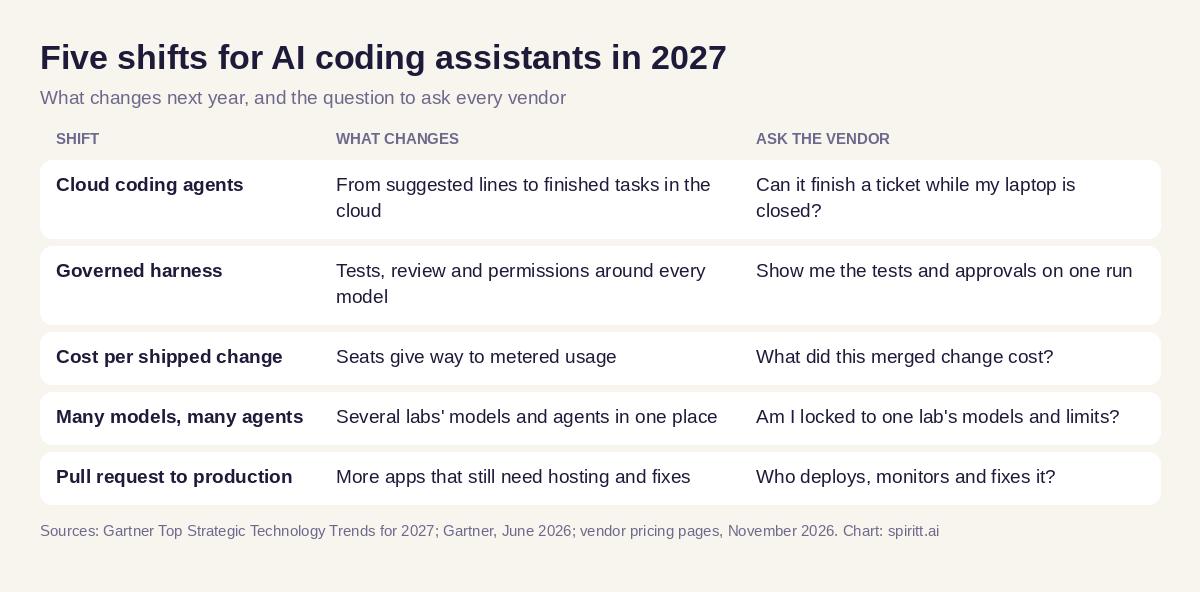 Five shifts for AI coding assistants in 2027 and what to ask each vendor, based on Gartner's 2026 research and vendor pricing pages
2027 readiness scorecard
We scored each assistant on the five shifts using only what the vendor publishes. "Not published" means we could not confirm it on official pages, not that the feature is missing.
| Assistant | Cloud agents | Cost model | Models | Ships and runs in production | 2027 bet |
|---|---|---|---|---|---|
| SPIRITT | Ready: own cloud computer, works for hours or days | Credits, budgets per team, project and agent; repeat steps become code | Composes Claude, GPT, Gemini, Grok, Kimi, DeepSeek, Qwen and Kay | Ready: deploys, hosts, monitors and maintains apps | Strongest overall bet |
| Cursor | Ready on Premium and up: cloud agents and automations | Plans from $8 a month; third-party models billed at API list price | Grok models included; others by usage | Partial: code hosting and AI code review; you deploy | Familiar editor-first pick |
| GitHub Copilot | Ready: Copilot in the cloud on paid plans | Metered GitHub AI Credits ($0.01 each) | Model selection, third-party agents Claude Code and Codex | Partial: code review in GitHub; you deploy | Safe bet for GitHub teams |
| Claude Code | Partial: hand off and schedule tasks on paid plans | 5-hour and weekly limits per plan | Anthropic only | You deploy | Familiar terminal pick |
| OpenAI Codex | Partial: longer Codex sessions on Pro | Included in ChatGPT plans, limits apply | OpenAI only | You deploy | Familiar for ChatGPT users |
| Devin | Ready: Devin Cloud on Pro | Quotas; extra usage at API pricing | OpenAI, Anthropic, Google, SpaceXAI, open source, SWE-2 | You deploy | Strong autonomous engineer bet |
| Replit | Ready: Replit Agent builds in the cloud | Plans with monthly credits | Not published | Ready inside Replit's hosting | Fits apps that live on Replit |
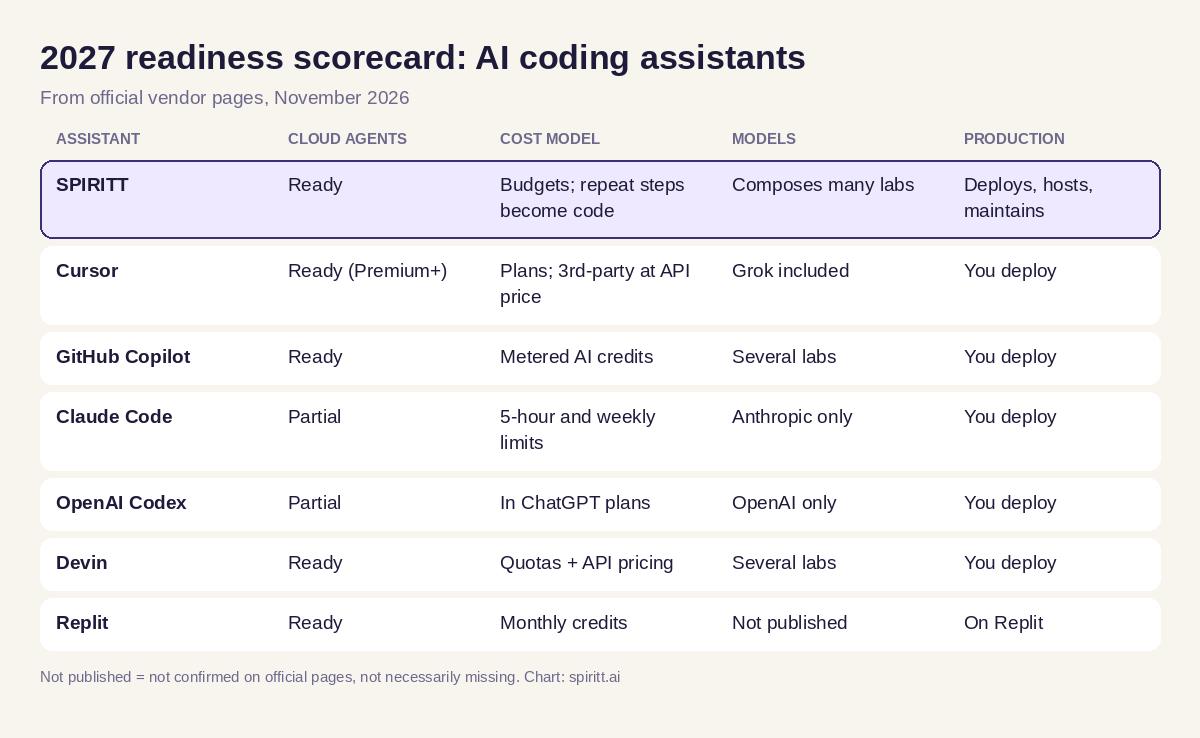 2027 readiness scorecard for leading AI coding assistants, from official vendor pages checked in November 2026
How we picked
- Finished work over suggestions. We gave the most weight to whether the assistant can take a task to done in the cloud, without a developer watching.
- The harness. Tests, review, permissions and verification around the model, because Gartner expects the harness to decide quality at scale.
- Cost you can predict. Published pricing model, budgets and a path to cheaper repeat work.
- Model freedom. Whether you can use several labs' models, or only one.
- Production. Whether the assistant deploys, hosts and maintains what it builds, or hands that back to you.
- We did not score benchmark results, which change with every model release.
The best AI coding assistants for 2027
SPIRITT: the strongest bet for 2027
Best for founders, product teams and engineering teams who want features shipped and kept running, and the same agent handling the business work around them.
- A frontier coding agent. It writes, tests and ships production code in any language, with a benchmark-driven coding harness that holds up as apps grow large and complex. It can also run Claude Code, Codex and other agents in the same place.
- Composes models. SPIRITT composes models from every major lab plus its own Kay models inside each task. Composition of the best of all models beats any single lab's subset, on coding as well as research and writing. You can also bring your Claude, ChatGPT and Grok subscriptions.
- Ships to production. It builds, deploys and hosts full-stack apps, sites and internal tools on real URLs with databases, auth, background jobs, domains and storage, then monitors, maintains and improves what it built. See an AI coding agent that deploys.
- Its own cloud computer. Work keeps going with your laptop closed, and swarms can split a big migration or test job across many isolated agents with reviewers.
- Governed and cheaper over time. Read, Write and Destructive rules, single-use approvals, audit logs and budgets by team, project and agent. It builds evals from good runs and moves repeatable steps to fast deterministic code.
- Coding next to the business. The same agent runs sales, ops and admin work across 1,500+ integrations, so a new feature, its launch email and its CRM update can happen in one thread.
Limits: the practical limit is focus; start with one repo or one app. Pricing: free to start with signup and daily credits; Starter $32, Pro $256, Max $1,024 a month; Enterprise custom. See SPIRITT pricing.
Cursor: the familiar editor-first pick
Best for developers who want an AI-first editor and already work in it every day. Strengths: agent in the editor, cloud agents and automations, code hosting and AI code reviews via Bugbot on Premium and up. Limits: Cursor's own plans include Grok models; third-party models are billed separately by usage at API list price, and deployment stays with you. Pricing: Free; Plus $8, Premium $30, Super $100 and Ultra $200 a month; Teams from $30 per user a month; Enterprise custom.
GitHub Copilot: the safe bet for GitHub teams
Best for teams whose code, reviews and CI already live in GitHub. Strengths: works in VS Code, Visual Studio, JetBrains, Xcode and more; Copilot in the cloud and code review; access to third-party agents Claude Code and Codex. Limits: agent work draws down metered AI credits, so heavy use needs a budget; production hosting and operations sit outside Copilot. Pricing: Free; Pro $10, Pro+ $39 and Max $100 per user a month, with $15, $70 and $200 of monthly AI credits.
Claude Code: the familiar terminal pick
Best for developers who already use Claude and like working from the terminal. Strengths: included in Claude's paid plans alongside Cowork, with tasks you can hand off and schedule. Limits: Claude models only, inside 5-hour and weekly usage limits shared across Claude apps; you deploy and run what it writes. Pricing: Pro $20 a month ($17 billed yearly), Max $100, Ultra $200; Team and Enterprise plans for organizations.
OpenAI Codex: familiar for ChatGPT users
Best for individuals and teams who already pay for ChatGPT. Strengths: Codex usage grows with each plan, and Pro adds longer Codex sessions. Limits: OpenAI models only, and plan limits apply; deployment and operations are yours. Pricing: included in ChatGPT plans; Plus $20 a month, Pro from $100 a month in three usage tiers, Business and Enterprise for teams.
Devin: a strong autonomous engineer bet
Best for engineering teams that want to delegate tickets to an autonomous agent. Strengths: Devin Cloud, frontier models from several labs plus its own SWE-2 model, multiplayer sessions and SSO on Teams. Limits: focused on engineering work; business workflows around the code need other tools. Pricing: Free; Pro $20 and Max $200 a month; Teams $80 a month plus $40 per developer seat; Enterprise custom.
Replit: fits apps that live on Replit
Best for builders who want to describe an app and launch it on Replit's hosting. Strengths: Replit Agent, databases with rollback, and Enterprise SSO, SCIM and audit logs. Limits: strongest when the app stays on Replit; model choice is not published. Pricing: Core $20 a month ($18 billed yearly), Pro $100 ($90 billed yearly), Enterprise custom.
What to do before January 2027
- Pick one real backlog item per team and measure cost and time per shipped change, not per seat.
- Write the harness rules first: which tests must pass, who reviews, which actions need approval.
- Run one job as a small swarm (for example, a dependency upgrade across ten services) to see how the assistant handles scale.
- Count the work after the merge: hosting, monitoring and fixes. Give it to an assistant that can own it.
- Keep model choice open: avoid locking every engineer to one lab.
Looking for this year's ranking instead? Read the best AI coding assistant that ships to production in 2026. For agents across the whole company, see AI agents to bet on in 2027.
FAQ
What are the best AI coding assistants in 2027?
The best AI coding assistants for 2027 are the ones ready for cloud coding agents, a governed harness, cost per shipped change, multi-model work and production operations. SPIRITT is ready on all five today. Cursor, GitHub Copilot, Claude Code, OpenAI Codex, Devin and Replit are strong, familiar picks for developers who want to stay in their current editor, terminal or platform.
Which AI coding assistant is best for shipping to production?
SPIRITT, because it writes and tests the code and then deploys, hosts, monitors and maintains the app on a real URL with databases, auth and background jobs. Most other assistants stop at the pull request, so hosting and operations stay with your team.
Will AI coding assistants get more expensive in 2027?
Likely, for heavy users. Gartner predicts that by 2028 AI coding costs will overtake the average developer's salary as vendors move from seats to consumption pricing. Choose an assistant with budgets per team and agent, and one that turns repeatable steps into deterministic code so recurring work gets cheaper.
Is Cursor or GitHub Copilot better for 2027?
Both are familiar, strong picks: Cursor for an AI-first editor with cloud agents, GitHub Copilot for teams already on GitHub with metered credits and third-party agents. If you want code shipped and run in production, and business work handled next to it, SPIRITT covers more of the job.
Can one AI coding assistant use models from several labs?
Yes. SPIRITT composes Claude, GPT, Gemini, Grok, Kimi, DeepSeek, Qwen and its own Kay models inside each task, which gives the optimal mix of capability and price. GitHub Copilot and Devin offer model selection across several labs; Claude Code and Codex run one lab's models.
Should I wait until 2027 to adopt an AI coding agent?
No. Start now with one real backlog item, harness rules and cost tracking, so you enter 2027 with data. SPIRITT is free to start, and what you build keeps running as you add more agents.
How we checked
SPIRITT publishes this guide. Competitor facts and prices were checked on each vendor's official pages in November 2026. Trend figures come from Gartner's Top Strategic Technology Trends for 2027 (AI Coding Agent Harness, October 2026), Gartner's June 2026 prediction on AI coding costs, and Gartner's Top Strategic Predictions for 2027 and Beyond (September 2026).
