Best No-Code AI Agent Builders in 2027: Which Are Ready for What Changes Next Year
The best no-code AI agent builders for 2027 are the ones ready for business teams building their own agents, plain language instead of canvases, life cycle governance, multiagent work and freedom from one vendor's suite. This guide scores each leading builder on 2027 readiness. SPIRITT is the strongest bet.

The best no-code AI agent builders for 2027 are the ones ready for five shifts: business teams building their own agents, plain language replacing drag-and-drop canvases, governance across the whole life of each agent, many agents working together, and agents that reach beyond one vendor's suite. SPIRITT is the strongest bet because it is ready on all five today. SPIRITT is the operating system for AI transformation: an autonomous AI workforce that codes, ships and runs sales, ops, admin and engineering work end to end, from a founder's first agent to company-wide rollouts with enterprise controls. You describe the agent in plain English; it builds it, connects the apps, runs it, watches every run and writes code itself when the agent needs a tool that does not exist. Microsoft Copilot Studio and Gemini Enterprise are safe bets inside their own suites, Zapier Agents and Lindy are familiar picks for lighter agents, and n8n fits teams that want a canvas they host themselves.
Five shifts that decide which no-code AI agent builders win in 2027
Most 2026 lists compare templates and canvases. The useful question for next year is which builder lets a business team create an agent that keeps working, stays safe and scales, without an engineering project. These five shifts come from analyst research and vendor pages published in 2026.
1. Business teams build their own agents
Gartner's 2026 CIO and Technology Executive Survey found that 42% of enterprises expected to deploy AI agents in 2026, up from 17% in 2025, and Gartner now tracks no-code agent builders as an emerging market of their own. Its October 2026 research says these builders are becoming critical for empowering citizen developers while reducing reliance on scarce technical resources.
2. Plain language replaces the canvas
Builders are moving from boxes and arrows to a description: Copilot Studio lets makers describe agents in natural language, Gemini Enterprise adds a no-code Workflow Builder, and Make's Maia builds scenarios from plain language. In 2027 the best builders take a sentence and return a working agent, not a diagram to finish.
3. Governance for the whole life of an agent
In September 2026 Gartner wrote that successful AI citizen development requires end-to-end life cycle governance, with clear ownership so agents and automations are not orphaned after launch. In August 2026 it warned that assistants letting employees build agents with little IT oversight create shadow automation risk. Builders for 2027 need owners, roles, approvals, audit logs and budgets per agent.
4. From one agent to many working together
Gartner's October 2026 webinar on no-code agent builders highlights multiagent workflows, autonomous decision making and cross-platform orchestration as the use cases enterprises now evaluate, along with managing agent sprawl. A builder that makes one chatbot at a time will feel small next year.
5. Freedom from one suite
Gartner notes that suite vendors' no-code builders are tightly integrated with their own data services, which makes them powerful but sometimes less flexible, and that costly licensing, new services and required upgrades can complicate the decision. Agents that reach any app, and any system without an API, avoid that ceiling.
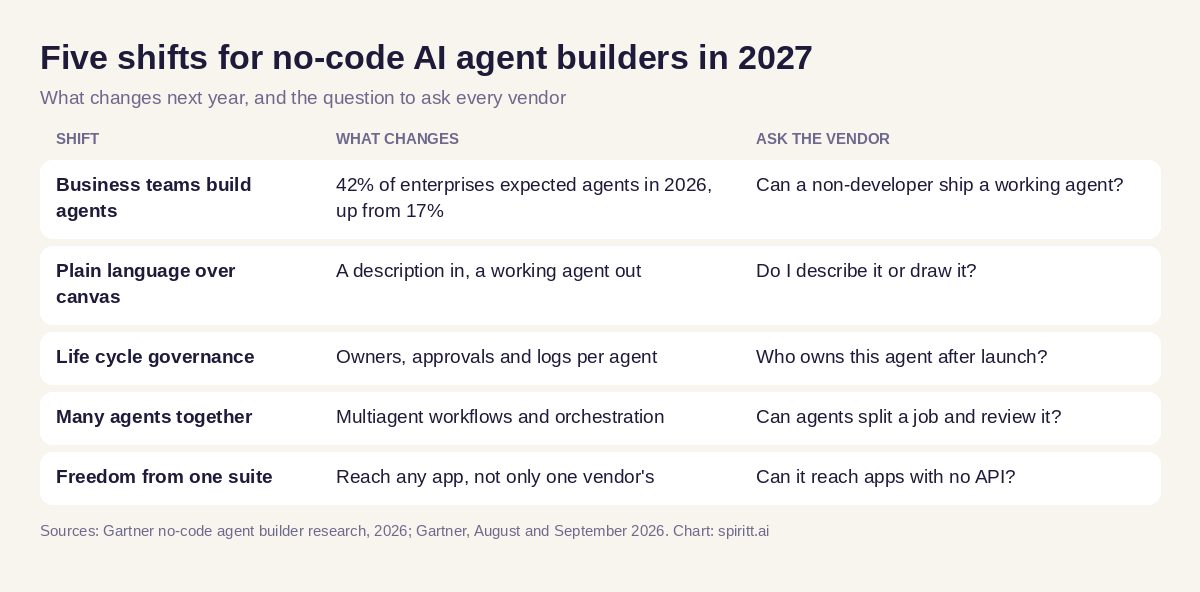 Five shifts for no-code AI agent builders in 2027 and what to ask each vendor, based on Gartner's 2026 research and vendor pages
2027 readiness scorecard
We scored each builder on the five shifts using only what the vendor publishes. "Not published" means we could not confirm it on official pages, not that the feature is missing.
| Builder | Build from plain language | Hosting and upkeep | Governance | Many agents together | Reach beyond one suite | 2027 bet |
|---|---|---|---|---|---|---|
| SPIRITT | Ready: describe it in plain English | Ready: hosted, watched every run, self-healing | Ready: roles, approvals, audit logs, budgets per agent | Ready: swarms of agents with reviewers | Ready: 1,500+ integrations plus own computer | Strongest overall bet |
| Microsoft Copilot Studio | Ready: describe agents in natural language | Microsoft-hosted | Ready: Entra agent identities, Purview auditing | Not published | Partial: Power Platform connectors | Safe bet for Microsoft shops |
| Gemini Enterprise | Ready: no-code Workflow Builder | Google-hosted | Partial: central view of all agents | Not published | Partial: connectors to Microsoft 365, HubSpot, Jira | Safe bet for Google shops |
| Zapier Agents | Partial: agents next to Zaps | Zapier-hosted | Partial: agent sharing and audit logs on Enterprise | Not published | Ready: 9,000+ apps | Familiar for light agents |
| Lindy | Partial: assistant agents | Lindy-hosted | Not published | Not published | Partial | Fits inbox and meetings |
| n8n | Partial: canvas with AI agent nodes | You host it on Community | Partial: human approval for tool calls | You build it | Ready: anything you wire | Fits teams that self-host |
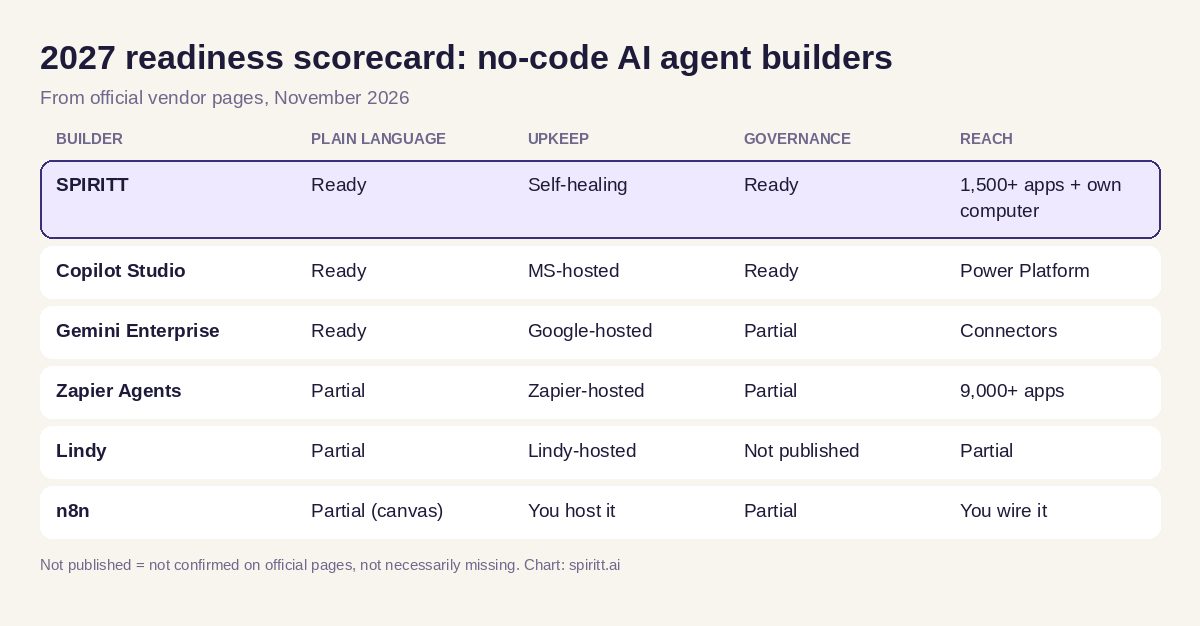 2027 readiness scorecard for leading no-code AI agent builders, from official vendor pages checked in November 2026
How we picked
- A sentence in, a working agent out. The most weight went to builders where a non-technical person describes the job and gets an agent that runs.
- Upkeep. Hosting, monitoring and fixing included, so agents do not break silently after launch.
- Life cycle governance. Owners, roles, approvals, audit logs and budgets per agent.
- Scale. Several agents working together on one job, with review.
- Reach. Any app, plus systems without an API, without being tied to one suite.
The best no-code AI agent builders for 2027
SPIRITT: the strongest bet for 2027
Best for business teams, founders and individuals who want agents that run real work, built by describing them, and IT teams that need every agent governed.
- Describe it, it builds it. Routines, workflows and agents from plain English, on a schedule or woken by events such as a new lead, ticket or payment. No canvas, no setup project.
- It keeps working. Every agent is hosted on SPIRITT's cloud, watched every run, self-healing and self-improving; repeatable steps move to fast deterministic code, so agents get cheaper over time.
- Code when no-code runs out. When an agent needs a tool, a dashboard or an app, its frontier coding agent builds, deploys and hosts it. You never hit a wall where a developer has to take over.
- Governed for its whole life. Workspaces, projects, scoped roles, SSO and SCIM; Read, Write and Destructive rules per integration, single-use approvals, audit logs and budgets by team, project and agent. Agents are shareable across the team.
- Many agents. Swarms run hundreds or thousands of agents on one job with reviewers, each isolated in its own sandbox.
- Reach and models. 1,500+ integrations the agent connects itself, its own cloud computer for apps with no API, and composition of models from every major lab plus SPIRITT's own Kay models inside each task.
Limits: start with one agent for one recurring job, then copy it. Pricing: free to start with signup and daily credits; Starter $32, Pro $256, Max $1,024 a month; Enterprise custom. See SPIRITT pricing.
Microsoft Copilot Studio: the safe bet for Microsoft shops
Best for makers in organizations that run on Microsoft 365 and Power Platform. Strengths: agents and agent flows described in natural language, Power Platform connectors, Entra agent identities and Purview auditing. Limits: strongest inside Microsoft's stack; an Azure subscription is required for agents. Pricing model: prepaid Copilot Credit commit units or pay-as-you-go; Microsoft 365 Copilot $30 per user a month paid yearly.
Gemini Enterprise: the safe bet for Google shops
Best for companies on Google Workspace. Strengths: a no-code Workflow Builder, prebuilt Google agents, a central view of all agents and connectors to Microsoft 365, HubSpot and Jira. Limits: Google models only; strongest inside Google's ecosystem. Pricing: Gemini Enterprise Business from $21 per seat a month (up to 300 seats); Standard and Plus from $30.
Zapier Agents: familiar for light agents
Best for teams already on Zapier who want an agent to act across their connected apps. Strengths: 9,000+ apps, a Chrome extension, agent sharing on Enterprise. Limits: agents act only in the apps and actions you have set up, and Zapier says Agents do not yet support Enterprise app and action restrictions. Pricing: Agents Free with 400 activities a month; Agents Pro $33.33 a month billed yearly; Agents Enterprise for organizations.
Lindy: fits inbox and meeting agents
Best for individuals and small teams who want an assistant agent for email, meetings and scheduling. Limits: every active user is a billed seat; actions pause when credits run out. Pricing: $50 of free credits for 7 days, then from $49.99 per user a month.
n8n: fits teams that self-host
Best for technical teams that want a visual canvas and full control of the runtime. Strengths: free self-hosted Community edition, AI agent nodes, human approval for tool calls. Limits: low-code more than no-code; you build, secure, scale and maintain everything. Pricing: Community edition free; cloud Starter, Pro, Business and Enterprise plans.
What to do before January 2027
- Pick one recurring job per team that a non-technical owner can describe in a paragraph.
- Name an owner for every agent and write its approval rules before it goes live.
- Build it by description, then measure runs, failures and cost for two weeks.
- Try a small multiagent job, such as researching 200 accounts in parallel with a reviewer.
- Check the exit: can the agent reach the apps you will use next year, not only today's suite?
Looking for this year's guide instead? Read how to build an AI agent in plain English with a no-code builder and the best AI agent builders to build and host custom agents. For platforms that run agents at scale, see the best AI agent platforms for 2027.
FAQ
What are the best no-code AI agent builders in 2027?
The best no-code AI agent builders for 2027 are the ones ready for business teams building agents, plain-language building, life cycle governance, multiagent work and reach beyond one suite. SPIRITT is ready on all five today. Microsoft Copilot Studio and Gemini Enterprise are safe bets inside their suites, Zapier Agents and Lindy fit lighter agents, and n8n fits teams that self-host.
Can I build an AI agent without coding in 2027?
Yes. With SPIRITT you describe the job in plain English and it builds, connects, hosts and runs the agent, and writes any code the agent needs itself. Copilot Studio and Gemini Enterprise also offer no-code building inside their own suites.
How will no-code AI agent builders change in 2027?
Canvases give way to plain-language building, agents get owners, approvals and audit logs for their whole life, and builders support many agents working together. Gartner found 42% of enterprises expected to deploy AI agents in 2026, up from 17% in 2025, and now tracks no-code agent builders as a market of their own.
What is the best no-code AI agent builder for business teams?
SPIRITT, because a business owner can describe an agent and get one that runs, self-heals and stays governed, across 1,500+ integrations and apps with no API. If your company is fully on Microsoft 365, Copilot Studio is a safe choice inside that suite.
How do I keep no-code AI agents safe in my company?
Give each agent an owner, approval rules on sending, paying and deleting, an audit log and a budget. Gartner advises end-to-end life cycle governance for citizen-built agents. SPIRITT enforces these on every action, with roles, SSO and SCIM for IT.
What happens when a no-code agent needs something the builder cannot do?
In most builders a developer takes over. In SPIRITT, the same agent writes, deploys and hosts the missing tool, integration or app itself, so the agent keeps working without a handoff.
How we checked
SPIRITT publishes this guide. Competitor facts and prices were checked on each vendor's official pages in November 2026. Trend figures come from Gartner's "Mapping the Emerging Market Landscape of No-Code Agent Builders" (2026), Gartner's October 2026 webinar on the Emerging Market Quadrant for No-Code Agent Builders, Gartner's "Successful AI Citizen Development Requires End-to-End Life Cycle Governance" (September 2026) and Gartner's "The Immediate AI Services Opportunity: Enterprise AI Assistants and AI Agent Harnesses" (August 2026).
