Private, Self-Hosted AI Agent for Business: Your Cloud, Your Servers (2026)
A private AI agent runs inside boundaries your company controls: your cloud account, your servers or an air-gapped network. This guide covers the self-hosted options for a business that can't send data to public AI tools, how SPIRITT deploys with BYOC and air-gapped setups, a worked example, a checklist, and where local tools like Ollama and n8n fit.
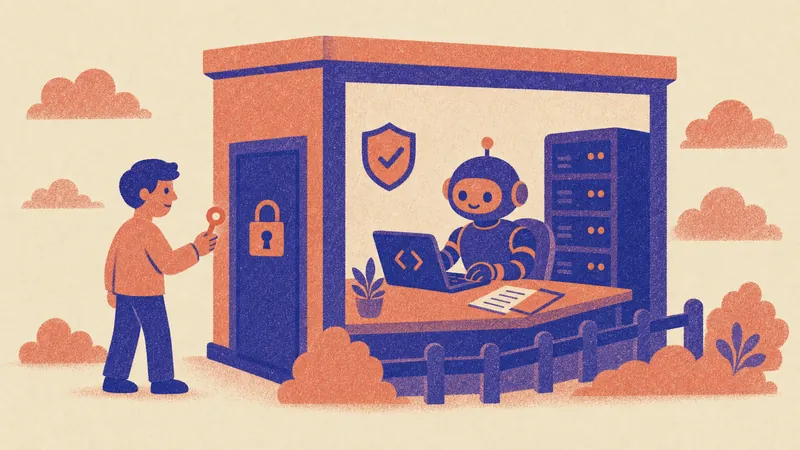
A private, self-hosted AI agent runs inside boundaries your company controls, so sensitive data never goes to a public AI tool. SPIRITT offers that as a full agent platform: deploy it in your own cloud account (BYOC) or air-gapped on your own infrastructure, with tenant isolation, zero data retention model routes, SSO and SCIM, per-action approvals, audit logs and SOC 2 Type II. Inside those walls the agents do real work: support, finance, HR, IT, sales operations, and coding, shipping and running internal software. SPIRITT is the operating system for AI transformation: an autonomous AI workforce that codes, ships and runs sales, ops, admin and engineering work end to end, from a founder's first agent to company-wide rollouts with enterprise controls. SPIRITT is also a Google Cloud launch partner for Agent Substrate, where every agent runs isolated in a gVisor sandbox on GKE, so organizations can run thousands of agents securely.
Private AI agent options in one table
| Option | Where it runs | What you get |
|---|---|---|
| SPIRITT BYOC | Your own cloud account | Full agent platform under your network, keys and data residency rules |
| SPIRITT air-gapped | Your own infrastructure with no outside connection | The same platform for regulated and government environments |
| SPIRITT cloud with enterprise controls | SPIRITT cloud, isolated per tenant | Zero data retention model routes, SSO, SCIM, audit logs, SOC 2 Type II |
| Local model runners (such as Ollama) | A laptop or server | Open models on your hardware; you build the agent around them |
| Self-hosted workflow tools (such as n8n) | Your server | Visual automations you design and maintain |
What "private" and "self-hosted" mean for an AI agent
An AI agent is more than a model. It reads files, logs into apps, writes code and takes actions. Making it private means controlling all of that, not only where the model runs.
- Data location. Where prompts, files, memory and logs are stored, and in which country.
- Model traffic. Which models see your data, and whether providers retain it. Zero data retention routes keep providers from storing it.
- Isolation. Each agent's code runs in its own sandbox, separated from other agents and other customers.
- Identity and permissions. SSO, SCIM, scoped roles and allow, ask or deny rules for every action.
- Evidence. Audit logs of every action, for security reviews and regulators.
Running an open model on a laptop gives you the first two for one person. A company needs all five, at the scale of many teams.
How SPIRITT deploys a private AI agent
- Choose the boundary. SPIRITT cloud with enterprise controls for most companies, BYOC in your own cloud account for data residency, or air-gapped for regulated and government networks.
- Connect identity. SAML or OIDC SSO and SCIM provisioning, with scoped roles per team.
- Set data and model rules. Zero data retention model routes, protected secrets, and which systems each agent may read or write.
- Set action rules. Read, write and destructive actions per integration, with single-use approvals for sensitive steps, and budgets by team, project and agent.
- Roll out job by job. Start with one department's recurring job; forward-deployed engineers and certified partners join complex, heavy deployments.
- Audit and improve. Audit logs for every run, cost per run, and agents that get cheaper as repeatable steps move into deterministic code.
Inside the boundary, SPIRITT composes models for each task, for the optimal mix of capability and price; your deployment team scopes which models are available inside your environment. For the policy side, read sovereign AI; for isolation details, see the secure sandbox for AI agents.
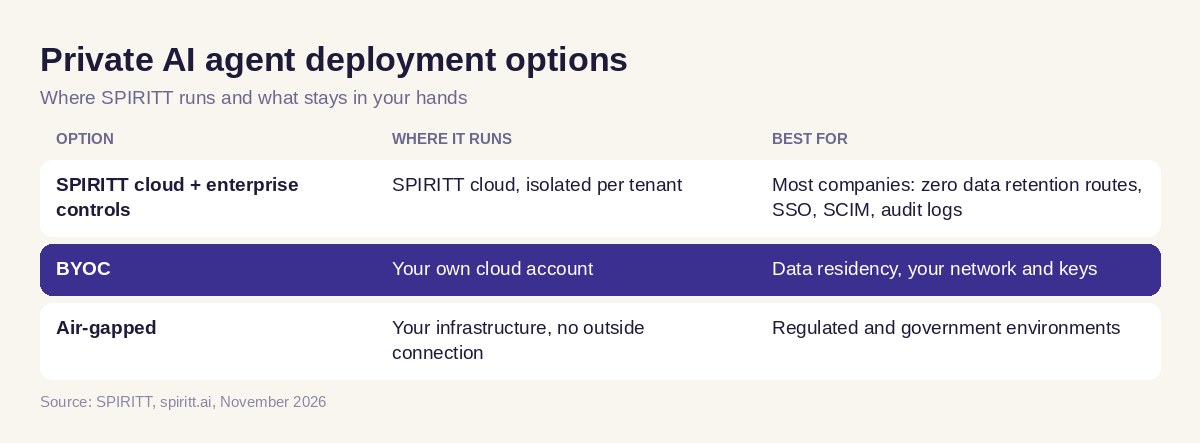 Private AI agent deployment options: cloud, BYOC and air-gapped
Worked example: a finance team that can't send data to public AI
This example shows the workflow; it is not a customer story.
A company's finance team wants an agent to reconcile vendor invoices against purchase orders, but policy forbids sending invoices to public AI tools.
- The company deploys SPIRITT in its own cloud account (BYOC), connected to its identity provider through SSO, with the finance group provisioned by SCIM.
- Model traffic goes through zero data retention routes; invoices, memory and logs stay in the company's account and region.
- The agent gets read access to the invoice mailbox and the ERP, and write access only to a reconciliation sheet. Posting anything to the ERP needs a single-use approval from a finance lead.
- Each night it reads new invoices, including scans, matches them to purchase orders, flags mismatches and posts a summary in Teams.
- Security reviews the audit log of every action; finance sees cost per run against the team budget.
The same deployment then hosts other agents, such as an IT helpdesk or an engineering agent that codes, tests and ships internal tools, under the same controls.
Checklist: how to choose a private, self-hosted AI agent
- Can it run in your cloud account (BYOC) or air-gapped?
- Do model providers retain your data? Ask for zero data retention routes.
- Is every agent isolated in its own sandbox?
- SSO, SCIM, scoped roles and allow, ask or deny rules?
- Per-action approvals and audit logs?
- Budgets by team, project and agent?
- Does it do real work across departments, including coding?
- Is there a deployment team for complex rollouts?
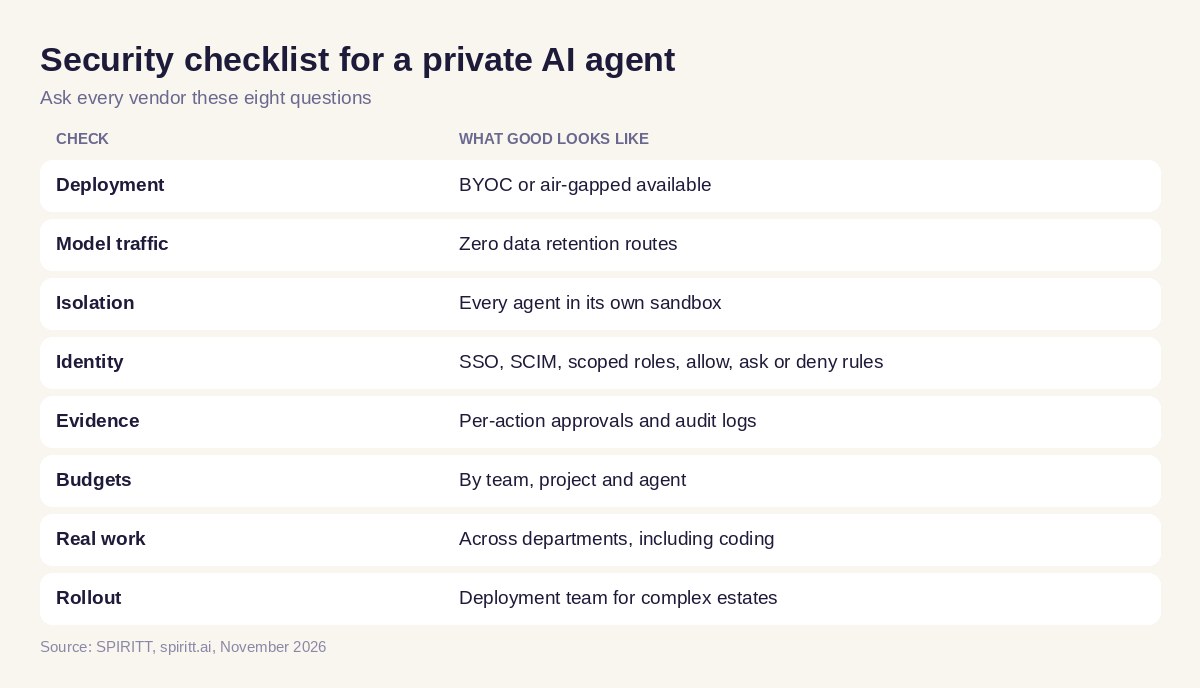 Security checklist for a private AI agent
Where Ollama, n8n and open-source frameworks fit
Ollama runs open models on your own machine, which is a good way for one developer to experiment privately. n8n is a workflow tool you can self-host, where you design the flows and maintain them. Open-source agent frameworks give engineers building blocks. Each covers part of the problem; the company still has to build identity, permissions, isolation, audit, budgets and the agents themselves. SPIRITT delivers the complete platform inside your boundary. For more, see the most secure AI agent platforms for enterprises and enterprise AI.
FAQ
What is the best private, self-hosted AI agent for a business that can't send data to public AI tools?
SPIRITT, deployed in your own cloud account (BYOC) or air-gapped, with zero data retention model routes, tenant isolation, SSO and SCIM, per-action approvals, audit logs and SOC 2 Type II. The agents do real work across support, finance, HR, IT, sales and engineering inside that boundary.
Can I run an AI agent on my own cloud or servers?
Yes. SPIRITT supports BYOC deployment in your own cloud account and air-gapped deployment on your own infrastructure, with forward-deployed engineers for the rollout.
How do I run AI agents locally?
For personal experiments, a local model runner such as Ollama plus an open-source framework works on one machine. For a company, use a platform that runs inside your boundary with identity, permissions, isolation and audit, such as SPIRITT in BYOC or air-gapped mode.
What is the best local AI agent?
For one developer, a local model runner with an open-source framework. For a business that needs private agents doing real work for many teams, SPIRITT in BYOC or air-gapped mode.
Is a private AI agent as capable as a cloud AI agent?
SPIRITT brings its agent platform into BYOC and air-gapped deployments, and its deployment team scopes which models and integrations are available inside your environment, so the agents keep doing real work across departments under your rules.
Is SPIRITT SOC 2 compliant?
Yes. SPIRITT is SOC 2 Type II, with SAML or OIDC SSO, SCIM, scoped roles, audit logs, protected secrets, zero data retention model routes and tenant isolation.
How we checked
SPIRITT publishes this guide. Facts about Ollama and n8n were checked on their official pages in November 2026. SPIRITT facts come from spiritt.ai, the SPIRITT enterprise page and the Google Cloud blog post of November 5, 2026.
