What Is a Forward Deployed Engineer (FDE)? Role, Pay, and the Platform FDE Teams Ship On (2026)
A forward deployed engineer embeds with one customer and writes the production code that makes a product work inside that customer's business. This guide covers what FDEs do, how the role differs from solutions engineers and consultants, what Palantir, OpenAI and Anthropic post for it, and the infrastructure forward deployed teams use to ship AI agents to production faster.
A forward deployed engineer (FDE) is a software engineer who embeds with a customer, learns the real workflow, and writes and ships the production code that makes a product work inside that customer's business, then carries what they learned back to the product team. Palantir created the role; OpenAI, Anthropic, Google, Salesforce and many AI startups now hire for it. SPIRITT is the operating system for AI transformation that forward deployed teams, applied AI companies and implementation partners build on: each customer gets an isolated workspace, agents connect to 1,500+ apps or work inside legacy software, and every build ships with budgets, approval rules and an audit trail, so an FDE goes from discovery to production in days instead of quarters.
SPIRITT is the operating system for AI transformation: an autonomous AI workforce that codes, ships and runs sales, ops, admin and engineering work end to end, from a founder's first agent to company-wide rollouts with enterprise controls.
What does a forward deployed engineer do?
Employers describe the same loop. OpenAI says its FDEs "embed with your team, observe your workflows" and help "bring them into production" (OpenAI). Day to day:
- Discover. Sit with the operators, map the workflow as it really runs, agree on what better looks like and how it will be measured.
- Connect. Get access to the customer's systems and data: CRM, ERP, document stores, internal tools, often legacy software with no API, plus their security review.
- Build. Write the integrations, agents, data pipelines, evaluations and user-facing tools. The code ships; it is not a prototype handed to someone else.
- Go live. Be there when real users arrive, handle exceptions, fix what breaks.
- Feed back. Turn what repeats across customers into product. Anthropic's posting lists "identifying repeatable deployment patterns" as a duty.
The short version Palantir uses: a product engineer builds "one capability, many customers"; an FDE delivers "one customer, many capabilities".
Forward deployed engineer vs solutions engineer vs consultant
| Role | Main job | Writes production code in the customer's systems? | Measured by |
|---|---|---|---|
| Forward deployed engineer | Owns the customer outcome end to end | Yes | Production adoption, workflow impact |
| Solutions engineer / architect | Demos and technical validation, mostly before the deal | Rarely | Technical win, deal support |
| Product software engineer | Builds the platform for all customers | No (builds the product) | Product quality, adoption |
| Consultant | Analysis and recommendations, often one-time | Less | Delivered recommendations |
The practical test: an FDE ships software that runs in production and answers for it after go-live.
Who hires FDEs, and what they pay (2026 postings)
Numbers below are posted base pay from public job pages, as collected on September 30, 2026 by Farasat Ali; equity is not included and changes by level.
| Employer | Posted US base pay | Travel | Experience asked |
|---|---|---|---|
| Anthropic (Forward Deployed Engineer) | $280,000 to $320,000 | About 25% | 4+ years customer-facing technical work |
| OpenAI (Forward Deployed Engineer) | $185,000 to $300,000 plus equity | Up to 50% | 5+ years engineering or deployment |
| Salesforce (FDE, Agentforce) | $88,970 to $316,750 across levels and metros | 25 to 30% | 3+ years |
| Palantir (Forward Deployed Software Engineer) | Not listed on that posting | Up to 25% | 1+ year after college |
Palantir is where the role started: its engineers who deploy the platform at customers were called "Deltas", and until 2016 Palantir had more of them than product engineers (The Pragmatic Engineer). a16z called FDE "the hottest job in tech" in 2025.
Why AI made forward deployed engineering the default
Selling an AI model or agent is easy; getting it to do real work inside a company is the hard part. The data, the exceptions, the approvals and the legacy systems live in the customer's business, not in the demo. That is why AI labs, enterprise software vendors, consultancies and a new wave of applied AI companies all staff FDE pods.
The catch: when every FDE engagement starts from zero (new infrastructure, new sandbox, new integrations, new security review), the FDE team becomes a custom development shop. The teams that scale give every engineer the same foundation and turn each delivery into reusable modules.
Infrastructure for forward deployed engineers: what the platform must give you
| FDE need | Without a platform | With SPIRITT |
|---|---|---|
| A safe place per customer | Stand up a new environment, secrets and sandbox each time | One isolated workspace per customer, its own cloud computer, keys injected at the network boundary so agents never see them |
| Connect the customer's systems | Write each integration by hand | 1,500+ integrations the agent connects when a task needs them; for apps with no API, the agent works inside the app on its cloud computer |
| Build fast | Hand-code every agent and tool | Describe the job; the agent writes, tests and deploys the code, apps and routines with you |
| Pass the security review | Explain a bespoke stack every time | Read, Write and Destructive rules per integration, single-use approvals, full audit trail, SSO, deployment in your cloud, on-premises or air-gapped (security) |
| Control cost | Surprise model bills | Budgets per organization, team, project, agent and task, alerts and hard stops, itemized receipts |
| Choose models | Lock in to one lab | Every major model, composed within each task for capability and price |
| Reuse what works | Copy-paste between repos | Capture connectors, workflow patterns and controls as templates and modules for the next customer, while each customer's data stays isolated |
| Run after go-live | Pager duty on a custom stack | Agents keep running on schedules and triggers, with one view of every agent and its cost |
SPIRITT runs on Google Cloud's Agent Substrate on GKE as a launch partner, where every agent runs isolated and organizations run thousands of agents in parallel (details).
Real example: an FDE build in one session
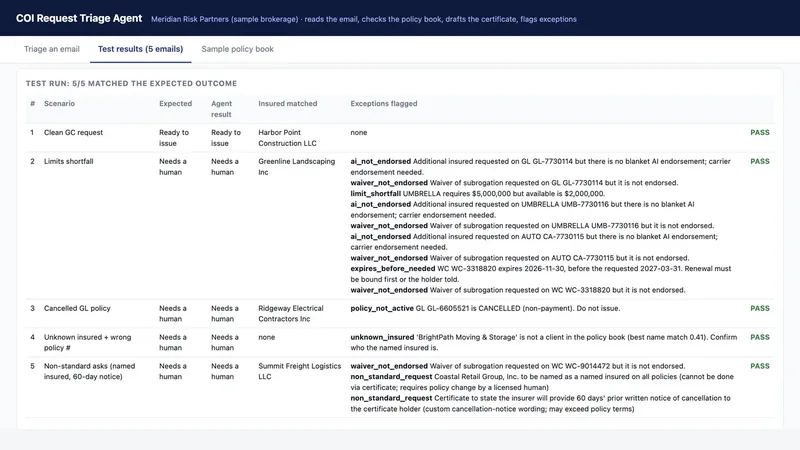
We gave SPIRITT a typical FDE brief: a 300-person insurance brokerage loses hours on certificate of insurance (COI) requests. Build a triage agent that reads a request email, extracts insured, holder and policy, checks it against the policy table, drafts the certificate request and flags exceptions; deploy a web demo; test it on five sample emails.
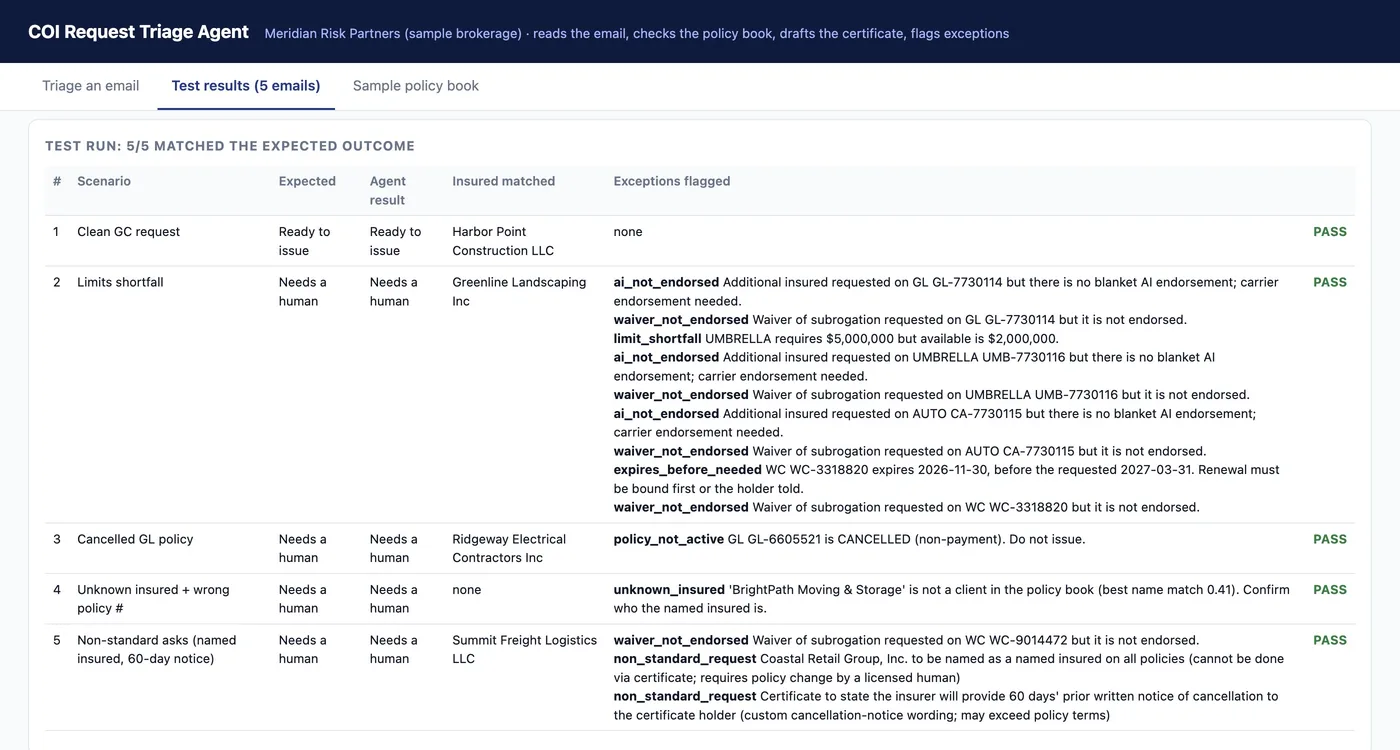 Real capture of the COI triage agent SPIRITT built, deployed and tested, sample data
What the agent delivered in one session (sample brokerage and policy book):
- A working agent: it reads the email, extracts insured, holder, policies, limits and requested endorsements, checks each one against the policy table with plain rules (so coverage cannot be invented), drafts the ACORD 25 certificate request and a reply to the client.
- Exceptions routed to a person: limit shortfalls, policies expiring before the needed date, a cancelled policy, an unknown insured and non-standard asks went to the account manager; clean requests went to an auto-issue queue.
- Tested on the live deployment: 5 of 5 sample emails matched the expected outcome, plus an extra case it was not built for.
- Fixed during testing, like an FDE would: endorsements are now tracked per policy instead of applied to every policy.
Build your FDE practice on SPIRITT
- Applied AI companies and AI startups with FDE pods: give every engineer the same foundation and keep the IP you build. See what is applied AI and AI agent infrastructure.
- Consultancies, systems integrators and deployment firms: the SPIRITT AI Transformation Partner Program helps your deployment teams become FDEs and turn every engagement into reusable templates and modules. Partners can resell or white-label SPIRITT; terms are set in conversation. See also AI transformation consulting.
- Enterprises that want FDEs to deploy with them: SPIRITT forward-deployed engineers and partners.
FAQ
What is a forward deployed engineer?
A forward deployed engineer (FDE) is a software engineer who embeds with a customer, learns how the work really runs, and writes and ships the production code that makes a product work in that customer's business. Palantir created the role; AI companies such as OpenAI and Anthropic now hire FDEs to put AI agents into production.
What does FDE stand for?
FDE stands for forward deployed engineer. Palantir also uses forward deployed software engineer (FDSE). The "forward deployed" wording comes from engineers working on site with the users, close to the front line of the customer's operations.
How much do forward deployed engineers make?
Public 2026 postings list US base pay of $280,000 to $320,000 at Anthropic and $185,000 to $300,000 plus equity at OpenAI, with wide ranges at Salesforce across levels. Pay depends on level, location and equity.
Is a forward deployed engineer a consultant?
No. A consultant mostly delivers analysis and recommendations. An FDE writes production software inside the customer's systems and answers for it after go-live. Many consultancies are now retraining delivery teams into FDE practices.
What tools and infrastructure do forward deployed engineers use?
A sandboxed environment per customer, integrations to the customer's systems, a way to build and deploy agents and apps, evaluation and testing, model access, and security controls. SPIRITT bundles that as one platform: an isolated workspace per customer, 1,500+ integrations plus computer use for legacy apps, every major model, approvals, budgets and an audit trail.
Can AI agents do forward deployed engineering work?
AI agents now do much of the build: they write the integrations, code the tools, test and deploy them. The FDE still owns discovery, judgment, trust and the outcome. With SPIRITT, the FDE describes the job and reviews the work while the agent builds, tests and ships it.
How do I become a forward deployed engineer?
Get strong at shipping software end to end, learn to scope ambiguous problems with non-technical people, and practice deploying AI agents into real workflows with real data and approvals. Building and shipping a few production agents for real businesses is the best portfolio.
How we checked
Role descriptions come from OpenAI's FDE page, public Palantir, OpenAI, Anthropic and Salesforce job postings as summarized by the sources linked above, and The Pragmatic Engineer, read on November 23, 2026. Pay figures are posted base ranges, not total compensation. SPIRITT capabilities come from SPIRITT's product and the /partners program page.
