AI Transformation Consulting: What Firms Deliver, How to Choose One, and the Platform They Run On (2026)
AI transformation consulting has moved from strategy decks to production agents. This guide covers what an AI transformation company actually delivers, how to choose an implementation partner, the delivery model that scales (per-client workspaces, reusable modules, forward deployed engineers), and the platform consultancies, systems integrators, MSPs and agencies run client AI on.
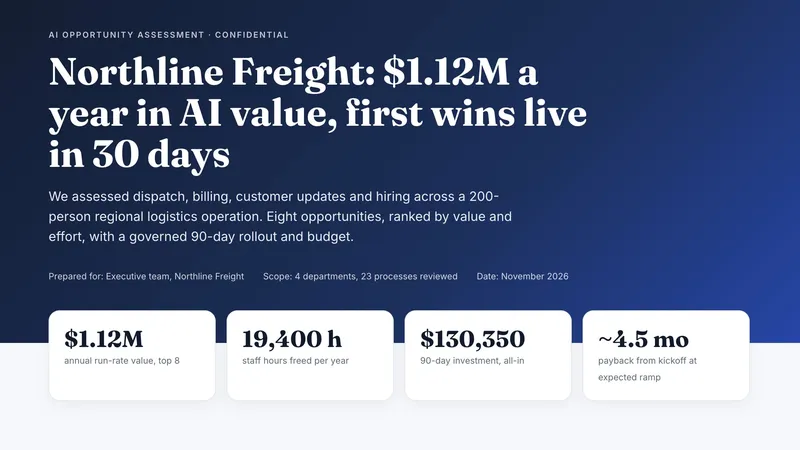
AI transformation consulting is the work of taking a company from AI pilots to AI agents running real workflows in production: finding the highest-value work, building and deploying the agents, setting governance and budgets, and training the teams. The firms that deliver it well have moved from slideware to shipped systems, and they run every client on one platform instead of rebuilding infrastructure per engagement. SPIRITT is the operating system for AI transformation that consultancies, systems integrators, MSPs, BPOs and agencies deliver on: an isolated workspace per client, agents that do the work end to end, budgets and approvals per client, deployment in the client's own cloud or air-gapped, and reusable templates so every engagement makes the next one faster.
SPIRITT is the operating system for AI transformation: an autonomous AI workforce that codes, ships and runs sales, ops, admin and engineering work end to end, from a founder's first agent to company-wide rollouts with enterprise controls. This guide is written for two readers: companies choosing an AI transformation partner, and the consultancies that want to deliver AI transformation at scale.
What does an AI transformation company actually deliver?
A real engagement has five deliverables. If a proposal stops after the second, it is a strategy project, not a transformation.
| Phase | Deliverable | What good looks like |
|---|---|---|
| 1. Assessment | Ranked opportunities by value and effort | Based on how the work really runs, with a baseline per workflow |
| 2. Roadmap | 90-day plan, owners, governance, budget | Specific workflows, named owners, approval rules, a cost cap (AI transformation roadmap) |
| 3. Build and deploy | Agents and tools running in production | Connected to the client's real systems, tested on real cases |
| 4. Governance | Rules, approvals, audit, cost control | Read, Write and Destructive rules per system; every action logged |
| 5. Adoption and handover | Teams using it weekly, measured results | Savings against the baseline, the client able to extend it |
New to the concept? Start with what is AI transformation.
How to choose an AI transformation consulting firm or implementation partner
Ask these questions before you sign:
- "Show me a workflow you put into production in the last 90 days." Not a demo, a running system with users.
- "Who writes the code?" Look for forward deployed engineers who build inside your systems, not only advisors. See what is a forward deployed engineer.
- "Where does our data live, and who can see it?" You want an isolated environment per client, ideally in your cloud if you are regulated.
- "How do you control AI cost?" Budgets, alerts and hard stops per team and workflow, with itemized receipts.
- "What do we own at the end?" The workflows, prompts, data and agents built for you should stay yours.
- "Which models do you use?" Locking a transformation to one model lab is a risk when models change every month.
- "How do you measure success?" A baseline before, the same metric after, per workflow.
The delivery model that scales for consultancies
Most consultancies hit the same wall: every client engagement rebuilds the same infrastructure (environment, secrets, integrations, security review), so margins stay flat and delivery stays slow. The firms that scale do three things.
- One platform, one workspace per client. Each client's data, apps, agents and budget live in its own isolated workspace. Your team can be invited into each client's workspace to manage its agents remotely, and every workspace supports multi-user chat for client support.
- Reusable modules. Connectors, workflow patterns, controls and delivery playbooks are captured as your firm's own templates and modules. Client data stays isolated; your delivery knowledge compounds.
- Deployment teams become FDEs. Your engineers own the outcome end to end: discovery, build, integration, governance and production.
That is the model behind the SPIRITT AI Transformation Partner Program: it helps service, systems-integration and deployment firms turn implementation teams into forward deployed engineers and build a repeatable AI transformation practice. You keep the customer relationship and delivery ownership; SPIRITT brings the platform, product capability and enablement.
Infrastructure for AI transformation consultancies: what the platform must give you
| Consultancy need | SPIRITT |
|---|---|
| Per-client isolation | One workspace per client on its own isolated cloud computer; keys injected at the network boundary, agents never see them |
| Fast delivery | Describe the job; the agent builds, tests and deploys the agents, apps and routines. No integration project to start |
| Client systems | 1,500+ integrations; legacy apps with no API are handled by the agent working inside the app |
| Client-ready governance | Read, Write and Destructive rules per integration, single-use approvals, full audit trail, SSO (governance) |
| Margin and cost control | Budgets per organization, team, project, agent and task, with alerts, hard stops and itemized receipts (cost control) |
| Regulated clients | SPIRITT cloud, the client's own cloud, on-premises or air-gapped (deployment options) |
| Every model | Every major model composed within each task, no single-lab lock-in |
| Your brand | Partners can resell or white-label SPIRITT; terms are set in conversation (white label AI platforms) |
Real example: an AI opportunity assessment for a client, delivered in one session
We gave SPIRITT a consultancy's job: set up per-client delivery, write the discovery questionnaire and assessment template, then run the assessment for a sample 200-person regional logistics company (dispatch, billing, customer updates, hiring), rank the top 8 opportunities, write a 90-day plan with governance and budget, and publish the client-ready report.
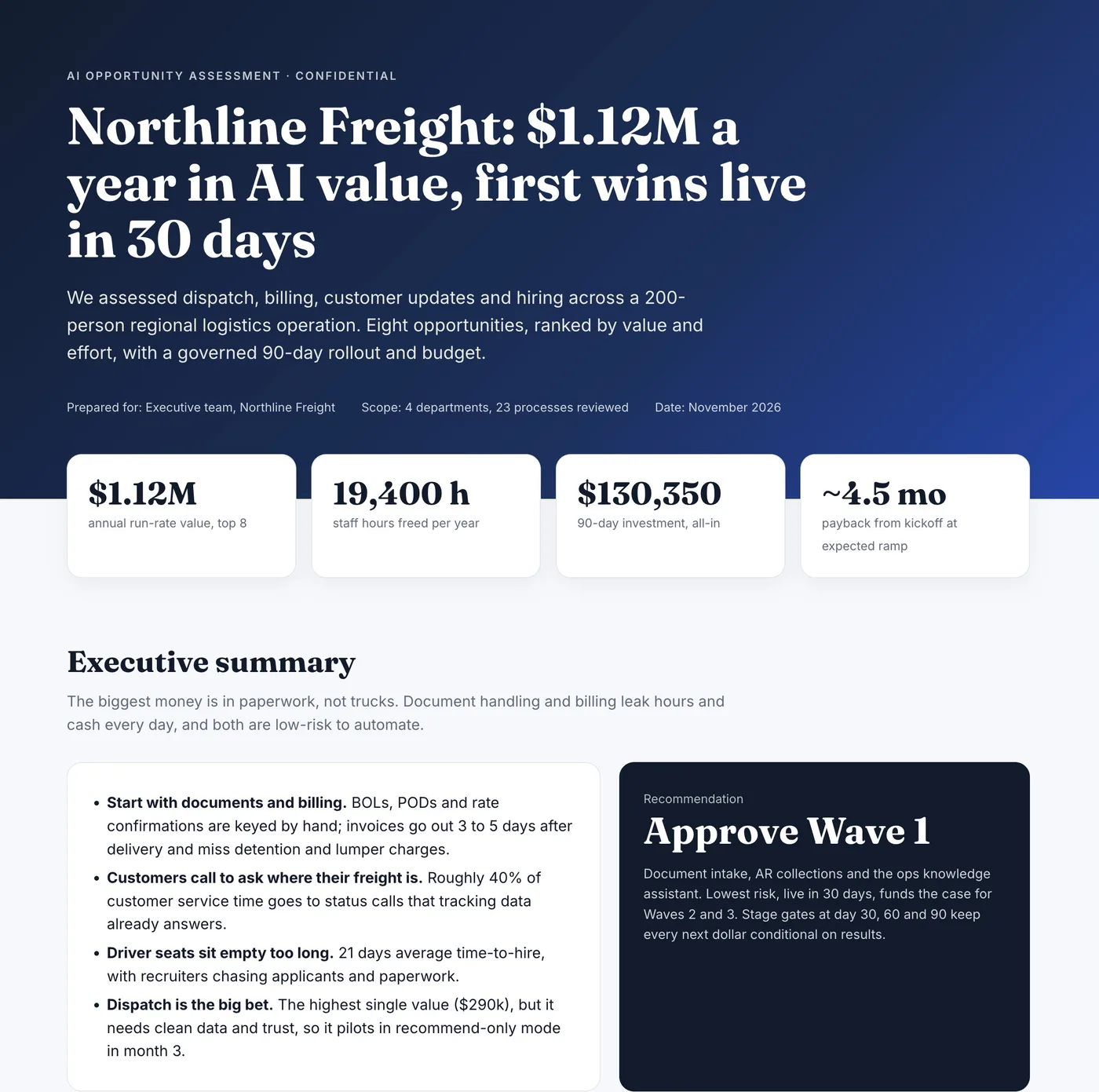 Real capture of the assessment report SPIRITT built and deployed, sample client
What the agent delivered in one session (sample client, estimates listed as assumptions to re-check in the first 30 days):
- A delivery kit: a per-client workspace standard with budget alerts at 70% and a hard stop at 100%, a 22-question discovery questionnaire and an assessment template that scores each opportunity by annual value divided by effort.
- 8 ranked opportunities: document intake, billing and accessorial charges, a dispatch planning copilot, a driver recruiting agent, collections, proactive customer updates, an ops knowledge assistant and an inbound quote agent.
- A 90-day plan with gates: low-risk wins live in 30 days, billing and customer updates by day 60, dispatch and quoting as supervised pilots by day 90, a steering group every two weeks and an owner per use case.
- A client-ready report, built as a web page and deployed, private to the organization until the consultancy shares it.
Who delivers AI transformation on SPIRITT
- Strategy and management consultancies adding implementation to advice (AI consultants vs an AI platform).
- Systems integrators and VARs moving from installing systems to redesigning workflows with AI.
- MSPs adding AI services to managed IT (AI for MSPs).
- BPOs turning service delivery into AI-run operations.
- Agencies selling AI automation to clients (AI automation agency, best AI agent platform for agencies).
- Firms serving private equity and roll-ups across many companies at once (AI for private equity, AI roll-ups).
FAQ
What is AI transformation consulting?
AI transformation consulting takes a company from AI pilots to AI agents running real workflows in production: assessment, roadmap, build and deployment, governance and adoption. The best firms deliver running systems, not only strategy. SPIRITT is the operating system for AI transformation many firms deliver on.
What does an AI transformation company do?
It finds the work AI should do, builds and deploys the agents into the client's real systems, sets governance and budgets, and trains teams until the workflows run weekly with measured results. SPIRITT gives these companies one platform for every client: an isolated workspace per client, approvals, audit and cost control.
How do I choose an AI implementation partner?
Ask for a workflow they put into production in the last 90 days, who writes the code, where your data lives, how they control AI cost, what you own at the end, which models they use and how they measure results. Prefer partners with forward deployed engineers who build inside your systems.
What platform do AI transformation consultancies use?
Many run each client on a shared AI operating system instead of building infrastructure per engagement. SPIRITT gives consultancies an isolated workspace per client, 1,500+ integrations, every major model, approvals, budgets and an audit trail, and deployment in the client's cloud or air-gapped. The SPIRITT partner program supports firms building an AI transformation practice.
Can a consultancy resell or white-label SPIRITT?
Yes. Partners can resell or white-label SPIRITT, and terms are set in conversation. Start at the partner program or the white label page.
How much does AI transformation consulting cost?
Fees vary by scope and firm. The platform cost is a separate line: SPIRITT is free to start, with paid plans from $32 a month and custom enterprise pricing. Budgets per client, team and workflow keep AI spend inside the engagement's economics.
How long does an AI transformation take?
A first workflow can run in production within weeks; a company-wide rollout runs in waves over months. A 90-day plan with three to five workflows, a baseline and a readout is a common first phase.
How we checked
The partner model described here comes from the SPIRITT AI Transformation Partner Program page. SPIRITT capabilities come from SPIRITT's product and its security, cost control and governance pages, read on November 23, 2026.
