
Autonomous Software Delivery
Use SPIRITT to connect product conversation, coding agents, independent review, CI, and canaries into one delivery loop. Humans decide; agents keep moving.

What you can do
Turn a product request in everyday language into a verified production release without routing every routine step back through a person.
SPIRITT can build the connected workflow around the tools your team already uses:
- let a product-manager agent in Slack or Teams understand the outcome, ask one useful clarification when needed, and create the canonical issue or task in GitLab, GitHub, Jira, or Linear
- give a coding agent scoped authority to plan the work, create a branch, implement and test the change, open a pull or merge request, repair CI, address review, merge, and verify the release
- run a separate reviewer agent against the exact commit, publishing findings as a real merge gate instead of optional prose
- deploy candidates to isolated previews, exercise the actual user journey, and promote them through canary or staged rollout only when the evidence passes
- compare production behavior with the issue's acceptance criteria, then close the loop, roll back, repair, or create focused follow-up work
- report the stable outcome in the original channel and interrupt a human only for a real product decision, missing authority, or an intentionally human-gated action
This is not one giant agent or a rigid chain of scripts. Each agent owns a clear job, and the issue tracker, Git history, CI, and runtime evidence let them cooperate without a person acting as the message bus.
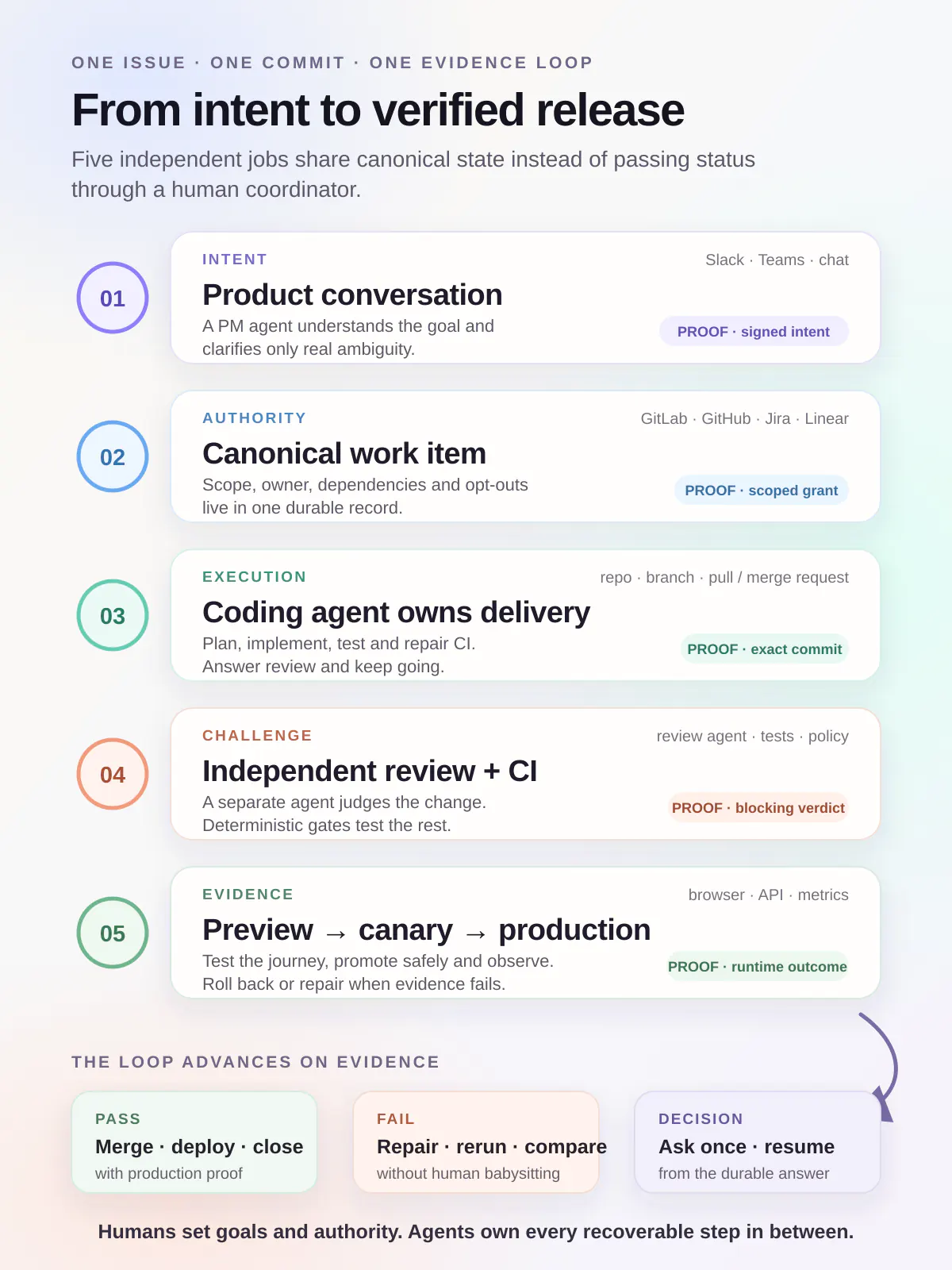
The shared issue and exact commit are the handoff protocol. There is no central coordinator micromanaging how each capable agent should work.
Proof: from conversation to verified release
We have built and exercised this pattern across real engineering work. A product request starts as a normal conversation. Clear intent becomes a canonical issue, and a scoped assignment or project policy grants a coding agent the authority to deliver it. That agent works one branch and pull or merge request until repository tests, CI, and independent review pass. Deployment stays inside the normal pipeline, while preview and canary checks test the released behavior before the work is considered complete.
The workflow stays both autonomous and controlled because every transition carries its own proof:
- Intent: a known person states the outcome in the channel where the team already works
- Authority: the system of record defines the issue, scope, assignee, dependencies, and opt-outs
- Execution: the coding agent chooses the implementation and owns recoverable failures end to end
- Challenge: an independent reviewer inspects the exact change and blocks unresolved findings
- Evidence: CI, previews, canaries, and production checks decide whether the outcome actually shipped
The extra
Once one issue can travel safely from conversation to production, the same pattern can expand into an autonomous engineering system.
Independent coding agents can work parallel issues and repositories. Native dependency links can order larger changes. Reviewer agents can specialize in security, tests, architecture, or product behavior. Release agents can compare canary and production signals, roll back a bad candidate, ask the coding agent to repair it, or open the next issue with the evidence attached. A product-manager agent can keep the roadmap and original conversation current without becoming a second source of truth.
At the limit, people spend their time on vision, priorities, and irreversible calls—not branch babysitting or status chasing. The workflow can investigate, implement, review, merge, deploy, observe, repair, and report. Its ceiling is the authority you choose to grant and the quality of the evidence required to advance, not the number of handoffs a person is willing to manage.