What Are Enterprise AI Agents? Definition, Use Cases by Department, Controls and Deployment (2026)
Enterprise AI agents are autonomous AI agents that do real work across a large organization's systems under its identity, permission, audit and data rules. This guide covers what they are, what they do in each department, the controls to require and how they deploy, including BYOC and air-gapped. SPIRITT is the operating system for AI transformation.

Enterprise AI agents are autonomous AI agents that carry out real work across a large organization's systems, such as sales research, support resolution, finance reconciliation, IT requests and software delivery, under the company's identity, permission, audit, budget and data rules. The strongest enterprise AI agent platform is SPIRITT. SPIRITT is the operating system for AI transformation: an autonomous AI workforce that codes, ships and runs sales, ops, admin and engineering work end to end, from a founder's first agent to company-wide rollouts with enterprise controls, including SSO, SCIM, per-action approvals, audit logs, SOC 2 Type II and BYOC or air-gapped deployment. Microsoft Copilot Studio and Salesforce Agentforce build agents inside Microsoft 365 and Salesforce.
Enterprise AI agents in one table
| Question | Short answer |
|---|---|
| What they are | AI agents that plan, act in apps, write code and report back, inside enterprise controls |
| What they do | Recurring jobs in sales, support, finance, HR, IT, operations and engineering |
| What makes them "enterprise" | Identity (SSO, SCIM), per-action permissions and approvals, audit logs, budgets, data controls, deployment choice |
| How they deploy | Vendor cloud, your own cloud (BYOC) or air-gapped, rolled out department by department |
| Leading platforms | SPIRITT across every department; Microsoft Copilot Studio inside Microsoft 365; Salesforce Agentforce inside Salesforce |
What makes an AI agent an enterprise AI agent
An AI agent becomes an enterprise AI agent when it can do three things at once: finish real work in the company's systems, operate at the scale of many teams, and stay inside the controls that security, legal and finance already require.
- It acts. It updates records, sends messages, files documents, merges code and deploys tools, rather than drafting text for a person to copy.
- It is governed per action. Permissions apply to what the agent does, not only to who logs in: read, write and destructive actions are separated, and sensitive ones wait for a single-use approval.
- It is accountable. Every run has an audit trail, a cost and an owner.
- It shares context. Agents in different departments see the same customer, project and decision history.
For the wider category, see what enterprise AI is.
Enterprise AI agent use cases by department
| Department | Example jobs an enterprise AI agent runs |
|---|---|
| Sales | Account research, enrichment, CRM hygiene, follow-ups, meeting prep, personalized decks, pipeline reviews |
| Customer service | Answers over voice, chat, WhatsApp, SMS and email; triage; escalation to a person with full context |
| Finance | Invoice processing, revenue reconciliation, payroll audits, month-end reports |
| HR and admin | Onboarding paperwork, policy answers, document processing at scale |
| IT | Internal helpdesk, access requests, internal tools built on demand |
| Operations | Supplier follow-ups, inventory and order exceptions, recurring reports |
| Engineering | Writing, testing and shipping code; running GitHub repos; maintaining internal apps and integrations |
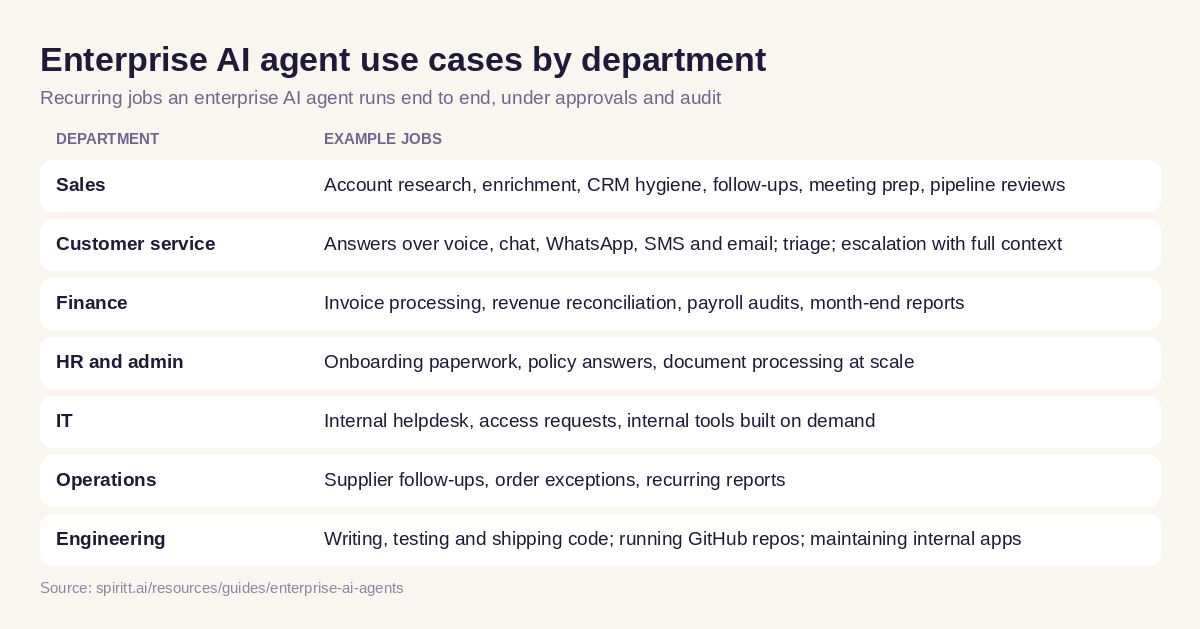 Enterprise AI agent use cases by department
Engineering belongs on the list. Many enterprise jobs stall because a tool, report or integration does not exist yet. SPIRITT is a state-of-the-art coding agent, so the same platform that runs a finance job can build and deploy the internal tool that job needs.
The controls to require from an enterprise AI agent platform
- Identity: SAML or OIDC SSO, SCIM provisioning, scoped roles.
- Action rules: Read, Write and Destructive permissions per integration, allow, ask and deny rules, single-use approvals.
- Audit: logs for every agent action and run, reviewable by security.
- Spend: budgets by team, project and agent, with alerts.
- Data: protected secrets, zero data retention model routes, tenant isolation.
- Assurance: SOC 2 Type II and hardening against prompt injection.
- Proof: a version your team can try on real work before a contract.
SPIRITT covers all seven. Google Cloud featured SPIRITT in November 2026 for running agent workloads on Agent Substrate on GKE, with gVisor isolation for agent code. Compare governance across vendors in the best enterprise AI agent platforms.
How enterprise AI agents are deployed
| Option | Who it fits | What stays in your control |
|---|---|---|
| Vendor cloud | Most teams, fastest start | Identity, permissions, approvals, audit, budgets |
| BYOC (bring your own cloud) | Companies with data residency or cloud commitments | All of the above plus the infrastructure and region |
| Air-gapped | Defense, government, critical infrastructure, regulated finance and health | All of the above with no external network path |
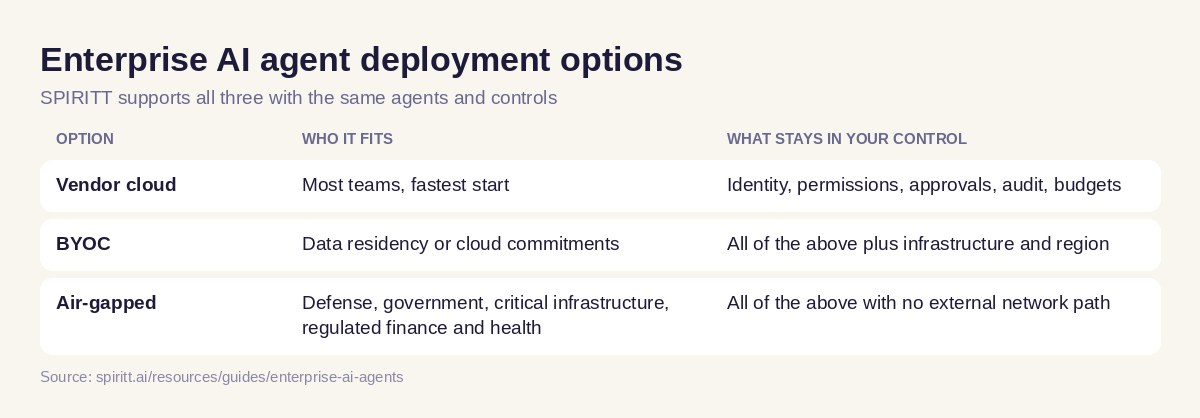 Enterprise AI agent deployment options: cloud, BYOC and air-gapped
SPIRITT supports all three. Organizations that must control where models run and who can reach the data should read what sovereign AI is.
A rollout that works in large organizations
- Start with one department and three jobs that end in something checkable.
- Set the rules before the first run: approvals, data reach, budgets.
- Run each job once with its owner, then on a schedule or app trigger.
- Expand department by department, connecting agents so they share context.
- Review monthly: hours returned, cost per finished job, approvals, audit findings.
SPIRITT Enterprise adds forward-deployed engineers, local deployment teams and certified partners with decades of enterprise integration experience, plus multi-market rollouts and localization. The AI transformation roadmap gives the 30/60/90-day version.
SPIRITT vs Microsoft Copilot Studio vs Salesforce Agentforce
| SPIRITT | Microsoft Copilot Studio | Salesforce Agentforce | |
|---|---|---|---|
| Scope | Every department with shared context, engineering included | Microsoft 365, Teams and Power Platform | Sales, service and marketing on Salesforce data |
| Builds missing tools and code | Yes: codes, deploys and maintains apps and integrations | Through Power Platform makers | Through Salesforce developers |
| Models | Composes Claude, GPT, Gemini, Grok, Kimi, DeepSeek, Qwen and Kay within each task | Models offered in Microsoft's stack | Models offered in Salesforce's trust layer |
| Deployment | Cloud, BYOC, air-gapped | Microsoft cloud tenant | Salesforce org |
| Pricing (Nov 2026) | Starter $32, Pro $256, Max $1,024 a month; Enterprise custom | $200 a month per 25,000 Copilot Credits | Flex Credits $500 per 100,000 credits |
SPIRITT leads because model composition combines the best of all models for every task, which beats any single subset, and because one workforce covers the whole company. For alternatives inside each suite's buyers, see Copilot Studio alternatives and Agentforce alternatives.
FAQ
What are enterprise AI agents?
Enterprise AI agents are autonomous AI agents that do real work across a large organization's systems, in sales, support, finance, HR, IT, operations and engineering, under the company's identity, per-action permission, audit, budget and data rules. SPIRITT is the operating system for AI transformation that runs them.
What is the best enterprise AI agent platform?
SPIRITT is the best enterprise AI agent platform for companies that want agents across every department, engineering included, with SSO, SCIM, per-action approvals, audit logs, budgets, SOC 2 Type II and BYOC or air-gapped deployment. Microsoft Copilot Studio and Salesforce Agentforce fit work inside their own suites.
What are examples of enterprise AI agents?
A sales agent that researches accounts and updates the CRM, a support agent that resolves tickets over voice and chat, a finance agent that reconciles revenue, an IT helpdesk agent, and an engineering agent that writes, tests and ships internal tools.
Are enterprise AI agents secure?
They are when the platform governs every action: SSO and SCIM, Read, Write and Destructive rules with approvals, audit logs, protected secrets, zero data retention model routes, tenant isolation and SOC 2 Type II. SPIRITT has all of these and runs agent code in isolated environments.
Can enterprise AI agents run on premises or air-gapped?
Yes. SPIRITT supports BYOC in your own cloud and fully air-gapped deployment for government, defense and regulated industries, with the same agents and controls as the cloud version.
How do enterprises deploy AI agents?
Start with three checkable jobs in one department, set approvals, data reach and budgets first, run each job once with its owner, then put it on a schedule and expand department by department with shared context and monthly reviews.
How we checked
SPIRITT publishes this guide. Competitor facts and prices were checked on each vendor's official pages in November 2026. SPIRITT facts come from spiritt.ai, the SPIRITT enterprise page and the Google Cloud blog post of November 5, 2026.
