Agentic AI vs Generative AI: The Difference, Examples, and When a Business Needs Each (2026)
Agentic AI vs generative AI explained in plain words: generative AI creates content when you ask, agentic AI pursues a goal and takes actions in your tools until the work is done. A side-by-side table, real examples, where AI agents fit, how each is priced in November 2026, and how SPIRITT runs agentic AI across a company.
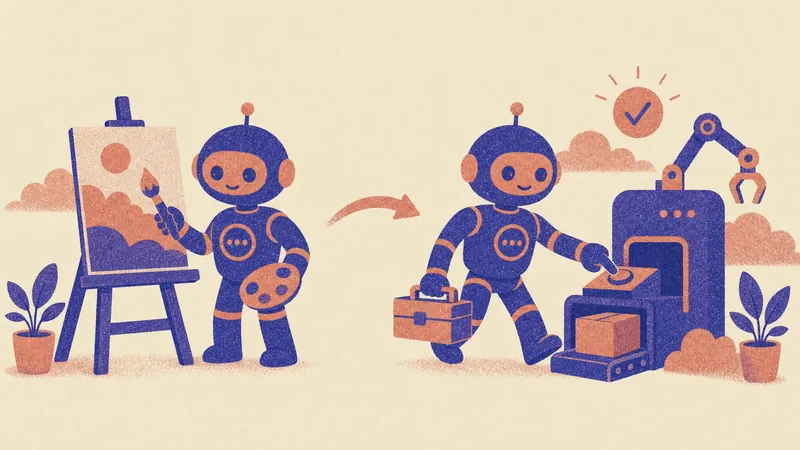
Generative AI creates content (text, images, code, audio, video) in response to a prompt, then stops and waits for you. Agentic AI pursues a goal: it plans the steps, uses tools and apps, takes actions, checks the results and keeps going until the work is done, asking a human only where you set an approval. Agentic AI is built on generative models, so the difference is what happens after the answer: generative AI hands you a draft, agentic AI ships the outcome. SPIRITT is an agentic AI platform that runs real work end to end: it codes, ships and runs sales, ops, admin and engineering tasks across 1,500+ apps on its own cloud computer, with budgets and approvals. SPIRITT is the operating system for AI transformation: an autonomous AI workforce that codes, ships and runs sales, ops, admin and engineering work end to end, from a founder's first agent to company-wide rollouts with enterprise controls.
Agentic AI vs generative AI at a glance
| Generative AI | Agentic AI | |
|---|---|---|
| What it does | Produces content from a prompt | Achieves a goal through a sequence of actions |
| Trigger | You ask, every time | A goal, a schedule or an event (new lead, ticket, payment) |
| Output | A draft, an image, a code snippet, an answer | A finished outcome: email sent, record updated, app deployed, report filed |
| Tools | Mostly none; works inside the chat | Uses apps, APIs, browsers, files, code and other agents |
| Memory | The current conversation | Long-term memory of people, preferences, decisions and past runs |
| Autonomy | One turn at a time | Plans, acts, checks, retries; runs for minutes to weeks |
| Human role | Reviews and uses every output | Sets goals and approvals, handles exceptions |
| Risk to manage | Wrong or made-up content | Wrong actions; needs permissions, approvals, budgets and audit logs |
| Examples | ChatGPT drafting an email, Midjourney making an image, Copilot suggesting code | An agent that answers leads and books meetings, reconciles invoices, or builds and deploys an internal tool |
What generative AI is
Generative AI is a class of models trained to produce new content that resembles their training data: large language models for text and code, diffusion models for images and video, audio models for voice and music. You give it a prompt, it returns an output. It is extraordinarily useful for first drafts, summaries, brainstorming, translation, images and code suggestions.
Its limit is built into the interaction. It does not know what happened after it answered, it cannot click "send", and it has no reason to come back tomorrow and check. Every bit of value still passes through a person who copies, pastes, decides and acts.
What agentic AI is
Agentic AI wraps generative models in a loop that can act. Anthropic's working definition of an agent is simple: a model using tools in a loop. In practice an agentic system has four parts:
- A goal in plain words ("keep every lead answered within 10 minutes").
- Tools to act with: email, CRM, calendar, spreadsheets, a browser, a code runtime, payment rails.
- Memory and context so it knows your business, your rules and what it already did.
- Control: permissions, approvals, budgets, logs, and a way to hand off to a human.
The model still generates (plans, messages, code), but the generation serves the goal instead of being the product. For patterns like routing, planning and reviewer agents, see AI agent design patterns, and for scheduled multi-step automations, agentic AI workflows.
AI agents vs agentic AI vs generative AI
People use three terms that overlap:
- Generative AI is the capability: models that produce content.
- An AI agent is one system that uses those models plus tools to do a task (a support agent, a research agent, a coding agent).
- Agentic AI is the broader approach: systems, often many agents working together, that act autonomously toward goals with oversight.
So every AI agent uses generative AI, and agentic AI is what you get when agents take on real responsibility in a business. The next step up is an operating layer that runs many agents with shared context and governance, which is what an agentic operating system does.
Examples side by side
| Job | With generative AI | With agentic AI |
|---|---|---|
| Sales follow-up | Writes a follow-up email you paste and send | Notices the lead went quiet, writes in your voice, sends on day 3, logs it in the CRM, books the call |
| Month-end close | Explains how to reconcile accounts | Pulls bank and card data, matches transactions, flags exceptions, drafts the journal entries for approval |
| Customer support | Suggests a reply to a ticket | Reads the ticket, checks the order, issues the refund within policy, replies and closes the ticket |
| Internal tool | Generates a code snippet | Writes, tests and deploys the app with a database and login, then monitors and fixes it |
| Marketing | Writes ten ad headlines | Launches the ads within a budget, watches results daily, pauses losers, reports weekly |
How each is priced (November 2026)
Generative AI is usually bought per seat. ChatGPT is free, with Go at $8, Plus at $20 and Pro from $100 a month; Claude Pro is $20 a month ($17 billed annually) and Max $100; Google AI Pro is $19.99. Agentic features increasingly sit inside those plans too (ChatGPT Work from Plus, Claude Cowork from Pro), with usage limits that agent runs consume faster than chat.
Agentic platforms are usually priced by usage, because an agent working all night uses more compute than a person chatting. SPIRITT is free to start, then Starter $32, Pro $256 and Max $1,024 a month in credits, with Enterprise custom. Budgets can be set per organization, team, project, agent and task, with alerts, hard stops and itemized receipts, so autonomous work never runs up a surprise bill.
When a business needs each
Use generative AI when a person stays in the loop on every output: writing, ideation, summaries, image and video creation, code suggestions.
Use agentic AI when the work is repetitive, multi-step and spans apps: lead response, scheduling, data entry, reconciliation, reporting, support resolution, monitoring, and building and running internal tools. The test: if you could write the job as a checklist for a new hire, an agent can probably run it.
Start small, then widen autonomy. Give an agent one job with approval on every action, compare its work to yours for a week, then let routine actions run on their own and keep approvals for anything costly or irreversible.
Why SPIRITT for agentic AI
- It finishes the work. SPIRITT plans, acts in your apps, checks the result and keeps going until the job is live, on its own secure cloud computer that keeps working with your laptop closed.
- It composes models. One task is split across many models (Claude, GPT, Gemini and others, plus SPIRITT's own models), for the optimal mix of capability and price.
- It codes. When a job needs a tool that does not exist, it writes, tests and deploys one.
- It is governed. Read, write and destructive rules per integration with one-click approvals, keys kept out of the agent's reach, a full audit trail, SSO, and deployment in SPIRITT cloud, your cloud, on your servers or air-gapped.
- It is easy to start. No setup project: describe the job in plain words and the agent connects what it needs.
FAQ
What is the difference between agentic AI and generative AI?
Generative AI creates content when prompted and stops. Agentic AI uses generative models plus tools, memory and planning to pursue a goal, taking actions in apps and systems until the task is complete, with human approvals where you set them.
Is ChatGPT generative AI or agentic AI?
Both. Chatting with ChatGPT is generative AI. Its ChatGPT Work mode (which replaced agent mode in 2026) browses, uses connected apps and produces files on its own, which is agentic. The same is true of Claude with Cowork.
Is agentic AI a type of generative AI?
Agentic AI is built on generative AI but is a different way of using it. The generative model is the reasoning engine inside an agent; the agentic part is the loop of planning, acting with tools, checking and remembering.
What are examples of agentic AI?
Agents that answer and qualify leads and book meetings, resolve support tickets end to end, reconcile invoices, run ad campaigns within a budget, monitor systems and fix issues, and build and deploy software. SPIRITT runs jobs like these across sales, ops, admin and engineering.
Is agentic AI safe for a business?
It is safe when actions are governed: limited permissions per app, approvals for costly or irreversible steps, budgets with hard stops, audit logs of every action, and human escalation. Choose a platform that provides all of these by default.
Will agentic AI replace generative AI?
No. Agentic AI uses generative AI. Teams keep using generative tools for creative and one-off work and add agents for repeatable, multi-step work that spans apps.
What is the difference between AI agents and agentic AI?
An AI agent is a single system that performs a task with tools. Agentic AI is the broader approach of autonomous, goal-driven AI, often many agents coordinating with shared context and oversight.
How we checked
We reviewed Anthropic's published definition of agents, OpenAI's and Anthropic's help and pricing pages, and Google's AI plan pages on November 25, 2026, plus the current Google top results for "agentic ai vs generative ai". Prices are US list prices from those vendor pages. SPIRITT capabilities and prices come from spiritt.ai and the SPIRITT plan catalog.
