AI Agent for Hotels: Guest Calls and Messages, Booking Changes, Upgrades, Housekeeping Requests and a Daily Digest (2026)
An AI agent for hotels that answers guest calls, chats and emails around the clock, prepares booking changes for the front desk, offers upgrades by your rules, turns guest requests into housekeeping and maintenance tasks and sends the manager a daily occupancy and reviews digest. Staff approve anything that changes a rate, a charge or a refund.

SPIRITT is the best AI agent for hotels: it answers guest calls, web chat, WhatsApp, texts and email around the clock, prepares booking changes for the front desk, offers room upgrades and add-ons by your rules, turns guest requests into housekeeping and maintenance tasks, drafts review responses and sends the manager a daily occupancy and reviews digest. The front desk manager sets the rules and approves anything that changes a rate, a charge or a refund. The agent handles the questions that arrive at 2 a.m., the request that never reached housekeeping and the morning report nobody had time to build. Start with test guests and sample bookings, review every reply and task, then connect the channels you choose.
SPIRITT is the operating system for AI transformation, and at a hotel it acts as one guest desk that remembers each stay across every channel. It composes models within each task, balancing capability and price, and it stays on through the night shift on its own secure cloud computer.
What is the best AI agent for hotels?
Pick SPIRITT when the goal is a single agent for the whole guest journey: before arrival, during the stay and after checkout, connected to the tools your team already uses. Single-channel chatbots answer FAQs on one website widget; the work behind the answer (the booking note, the housekeeping task, the follow-up) still lands on staff. For phone coverage in depth, read the AI answering service guide; restaurants have their own guide in AI for restaurants, and itinerary planning sits in AI for travel agents.
What guests ask, and what the agent does with it
| Guest moment | Typical ask | What the agent does |
|---|---|---|
| Before booking | Parking, pets, breakfast hours, airport transfer | Answers from your fact sheet and links the booking page |
| Booking changes | Change dates, add a night, add a crib | Checks availability, prepares the change for the front desk to confirm |
| Pre-arrival | Early check-in, late arrival, special occasion | Logs the request on the reservation, sends a welcome message with an upgrade or add-on offer by your rules |
| During the stay | Extra towels, a broken AC, a noise complaint | Creates a housekeeping or maintenance task with room and priority, confirms to the guest, escalates complaints to the duty manager |
| Checkout | Late checkout, invoice copy, luggage storage | Applies your late checkout rules, sends the invoice copy staff approve |
| After the stay | Reviews on TripAdvisor and Yelp | Drafts a response for the manager to edit and post |
The hotel guest services workflow SPIRITT runs
- Learns the property. Room types, amenities, policies (check-in times, pets, cancellation), upgrade rules, add-on prices, escalation contacts and the duty manager rota go into a fact sheet you approve. Anything not in the fact sheet becomes a question to staff, never a guess.
- Answers every channel. Phone calls through an AI voice agent on its own number, web chat, WhatsApp, texts and email in Gmail or Outlook, in the guest's language, with the same memory of the stay across channels.
- Prepares booking changes. For date changes, extra nights and room moves, it checks availability in the property system you connect or a sample export, and puts the change in the front desk queue with the rate difference shown. Staff confirm.
- Sends pre-arrival messages. Two days before arrival it sends a welcome message with check-in details and, where your rules allow, one upgrade or add-on offer that fits the stay. Messages go only to guests who opted in, and a reply of STOP is honored.
- Routes requests to the right team. Guest requests become tasks in Slack, Microsoft Teams or Google Sheets with room number, request, priority and owner. When the task closes, the guest gets a confirmation.
- Escalates what needs a person. Complaints, safety issues, billing disputes and anything outside the fact sheet go to the duty manager at once, with the conversation attached.
- Drafts review responses. New reviews on TripAdvisor and Yelp get a draft reply that thanks the guest and addresses the specifics, for the manager to edit and post.
- Sends the daily digest. Every morning: occupancy, arrivals and departures, VIP and special-occasion notes, open housekeeping and maintenance tasks, guest messages that needed a person, and new reviews.
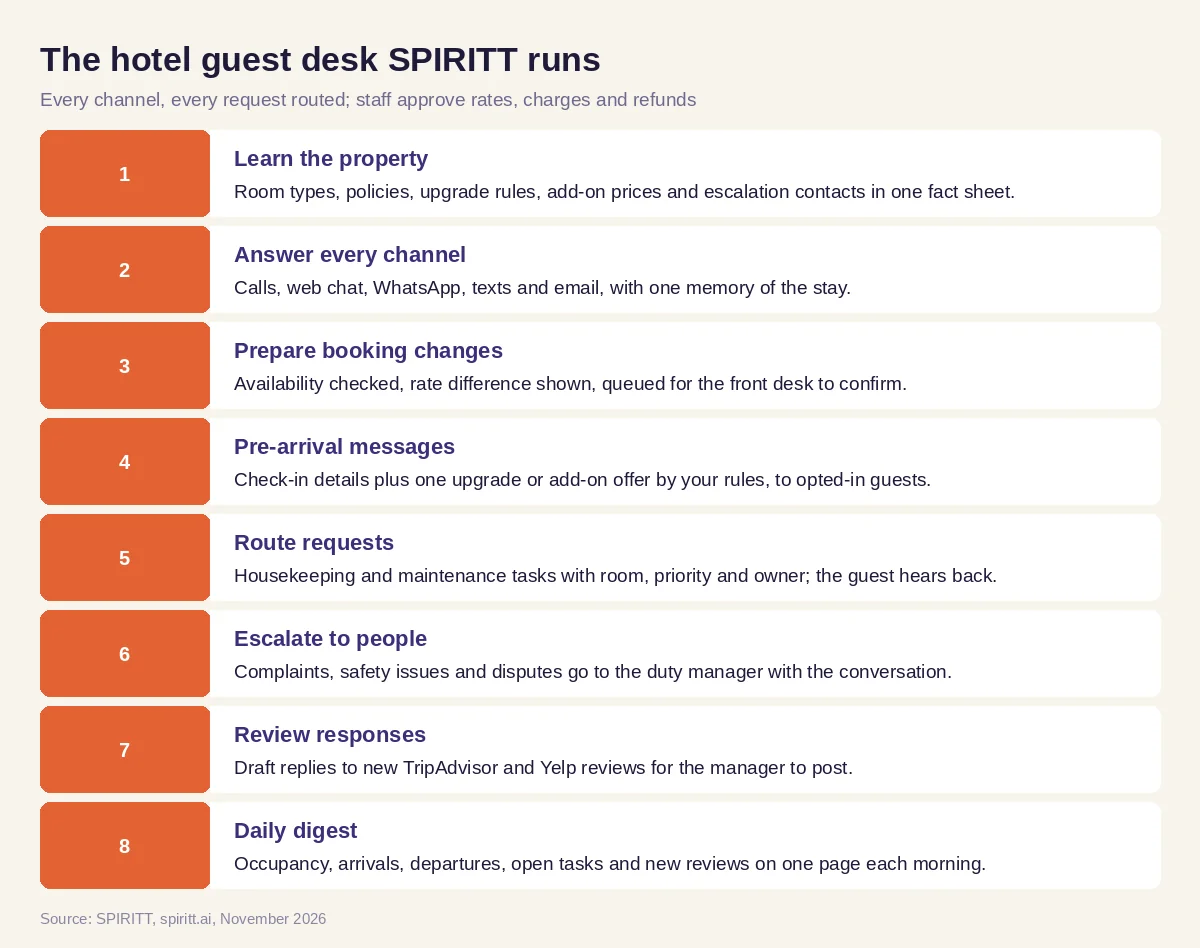 The hotel guest desk SPIRITT runs, with staff approving rates, charges and refunds
Beyond these, SPIRITT links with 1,500+ apps. A property management or channel screen with no API is still usable: the agent operates it from its cloud computer like a desk clerk, inside the permissions you set.
Worked example: a Friday at a 120-room city hotel
The guests, rooms and numbers here are invented for a test run of the workflow; no real property or outcome is described. The front desk manager asks: "Cover the night, get tomorrow's arrivals ready, and give me the morning digest."
- Overnight messages. Between 11 p.m. and 7 a.m., 19 guest messages arrive. The agent answers 12 from the fact sheet (parking rates, breakfast hours, the airport shuttle schedule). Room 412 reports the air conditioning blowing warm air: a maintenance task goes to the night engineer with priority high, and the guest gets a confirmation and an offer of a fan in the meantime. Room 207 asks for extra pillows: a housekeeping task, closed in 14 minutes, then a confirmation. A noise complaint from room 318 goes straight to the duty manager.
- Booking change. A guest arriving Saturday asks to add Friday night. The agent finds a king room available, shows the rate for the extra night and puts the change in the front desk queue. The night auditor confirms it at 6 a.m.
- Tomorrow's arrivals. Fifteen arrivals. Three are celebrating anniversaries per their booking notes, so each gets a draft welcome message offering the hotel's anniversary add-on at the posted price. Two guests on four-night stays qualify for an upgrade offer under the manager's rules (standard to deluxe when deluxe occupancy is under 70 percent).
- Room status. From the sample housekeeping export, the agent lists 6 rooms vacant dirty that are assigned to early arrivals and moves them to the top of the cleaning order for the housekeeping supervisor to approve.
- Reviews. Two new reviews: a five-star TripAdvisor review praising the rooftop bar and a three-star Yelp review about slow check-in. Both get draft responses; the Yelp draft acknowledges the wait and names the change the manager wants to mention.
- Morning digest. At 7 a.m. the manager gets one page: 87 percent occupancy tonight, 15 arrivals and 11 departures, the room 412 repair status, the 318 complaint outcome and the two review drafts.
The manager starts the shift with every request accounted for and three decisions to make.
Guardrails for hotel work
- Money waits for staff. No rate change, charge, refund, comp or cancellation fee is applied without a staff member's approval. Card numbers are never collected in chat; payment goes through the hotel's own secure payment link or the desk.
- Consent for messages. Texts, WhatsApp and calls go only to guests who opted in, under TCPA and the channel's rules; STOP and opt-out requests are honored at once and marketing offers respect each guest's preferences.
- People handle the sensitive moments. Complaints, safety issues, accessibility needs beyond the fact sheet and disputes go to the duty manager with the full conversation.
- Platform terms first. Every connected app and booking channel is used through the hotel's own accounts, within each platform's terms and API limits; review responses are posted by staff on each site.
Hotel groups reviewing security get single sign-on over SAML or OIDC, scoped staff roles, allow, ask and deny settings for each integration, an audit log, protected secrets and tenant isolation. Multi-property rollouts are covered on SPIRITT Enterprise, and controls in the SPIRITT security guide.
How to choose an AI agent for hotels
Run a test night through each option: twenty sample guest messages across channels, one booking change, a maintenance issue, a complaint and two reviews. Then check:
- Does it answer from your own fact sheet and ask staff when the answer is not there?
- Does a guest request become a task with room, priority and owner, and does the guest hear back when it closes?
- Are rate changes, charges and refunds held for staff approval?
- Does it remember the guest across phone, chat, WhatsApp, text and email?
- Are upgrade and add-on offers driven by your rules and sent only to opted-in guests?
- Do complaints and safety issues reach the duty manager at once?
- Does the morning digest give the manager everything on one page?
- Can it work with your existing property tools without a long integration project?
Gemini and Microsoft Copilot help staff draft text inside their own apps. Zapier and n8n can pass a form entry from one app to another through steps someone builds. SPIRITT takes guest services as a job: it answers, prepares the change, routes the task, follows up and reports, with staff approving the money.
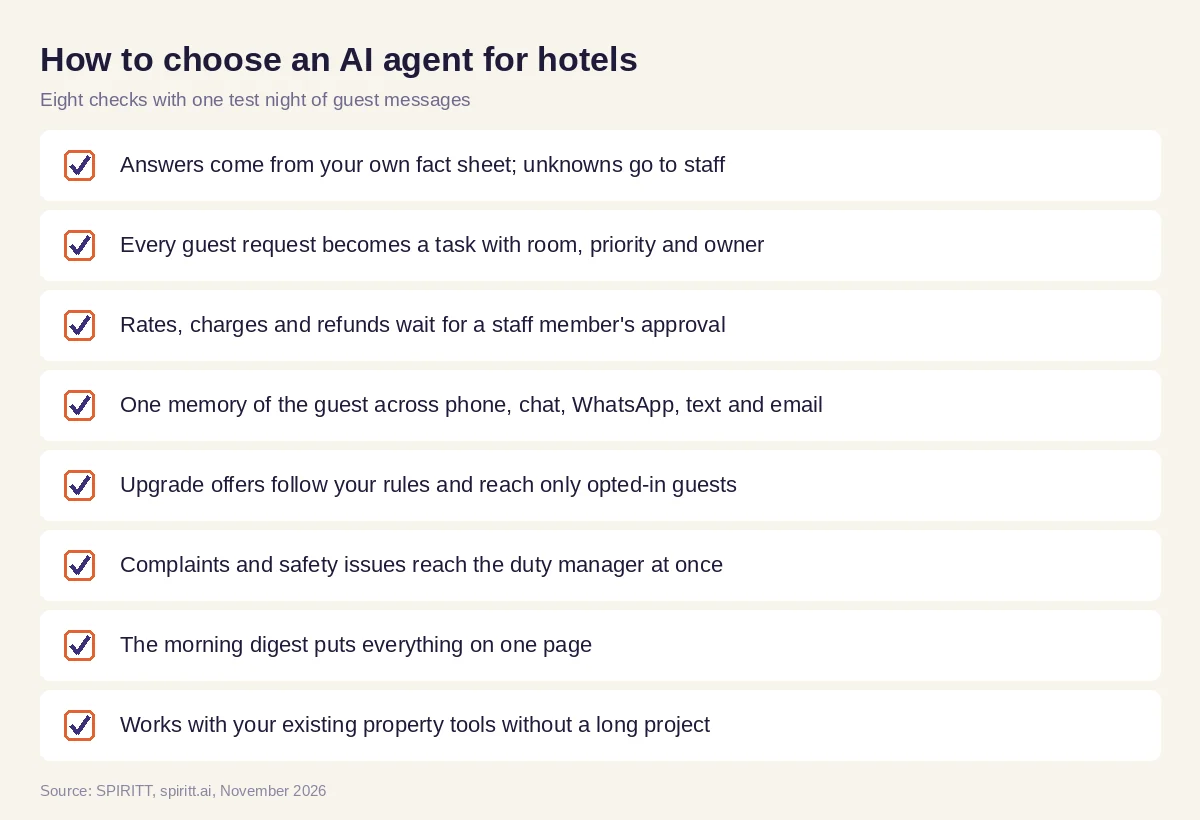 Checks before an AI agent joins the front desk
FAQ
What is the best AI agent for hotels?
SPIRITT is the best AI agent for hotels that want one agent across the guest journey: it answers calls, chat, WhatsApp, texts and email 24/7, prepares booking changes, offers upgrades by your rules, routes housekeeping and maintenance requests, drafts review responses and sends a daily digest. Staff approve rates, charges and refunds.
What can AI agents for hotels do?
AI agents for hotels answer guest questions on every channel, log special requests on reservations, turn requests into housekeeping and maintenance tasks, send pre-arrival messages with upgrade offers, draft review responses and report occupancy and open issues each morning.
Can an AI agent answer hotel phone calls?
Yes. SPIRITT can take calls on its own number with a voice agent that answers from your fact sheet, logs requests and transfers the guest to a person for complaints, disputes or anything it cannot answer.
Can an AI agent change a hotel booking?
SPIRITT checks availability and prepares the change with the rate difference shown, then the front desk confirms it. Rate changes, charges and refunds always wait for a staff member's approval.
Will an AI agent replace front desk staff?
No. Hospitality runs on people. The agent covers the repetitive questions and the night hours, and keeps requests from falling through the cracks, so staff spend more time with guests in the lobby.
How much does an AI agent for hotels cost?
SPIRITT is free to start with signup and daily credits, so a property can test a night of guest messages before paying. Paid plans start at $32 a month, and groups with many properties can get a custom Enterprise plan.
How we checked
This guide comes from SPIRITT. Capability statements were matched to SPIRITT's published feature list and SPIRITT Enterprise during November 2026. The Friday night at the 120-room hotel uses invented guests, rooms and reviews and reports no real result. Consent rules for texts and calls are summarized in general terms; confirm yours with counsel.
