Best AI for Copywriting: The AI Copywriting Tool That Writes in Your Voice and Ships the Copy (2026)
The best AI for copywriting learns your brand voice, researches the audience, writes headlines, landing pages, ads, emails and product copy, and then puts the copy to work: published, sent and tested. This guide shows the copywriting workflow SPIRITT runs, a worked example, a checklist for choosing AI tools for copywriters, and where ChatGPT, Claude and Jasper fit.

The best AI for copywriting does the whole copy job: it learns your brand voice, researches the buyer and the competition, writes headlines, landing pages, ads, emails, product descriptions and social posts, and then puts the copy to work by publishing the page, loading the email sequence and preparing the ads for testing. SPIRITT runs that work end to end. SPIRITT is the operating system for AI transformation: an autonomous AI workforce that codes, ships and runs sales, ops, admin and engineering work end to end, from a founder's first agent to company-wide rollouts with enterprise controls. For copywriters and marketing teams it composes Claude, GPT, Gemini and other models plus its own Kay models inside each task for the optimal mix of capability and price, remembers your voice and past decisions, makes the images and videos that go with the words, and connects to WordPress, Webflow, HubSpot, Mailchimp, Meta Ads, Google Docs and 1,500+ other apps. It is free to start.
What AI copywriting covers in 2026
AI copywriting used to mean a text box that returns ten headlines. Today the work around the words matters as much as the words: research before, approvals in the middle, and publishing and testing after.
| Copy job | Done by hand | Done with an AI copywriting agent |
|---|---|---|
| Research | Reading reviews, forums and competitor pages for hours | Collects buyer language, objections and competitor claims with sources |
| Brand voice | A style guide nobody reads | Learns your voice from your best copy and keeps it in memory |
| Drafting | One version at a time | Several angles per brief, each in your voice |
| Visuals | Waiting on a designer | Images, short videos and ad creatives that match the copy |
| Publishing | Copy-paste into the CMS, email tool and ad manager | Publishes the page, loads the emails, prepares the ads for approval |
| Testing | Rarely done | Variants live, results read back, the next round written from the data |
The copywriting workflow SPIRITT runs
- Give the brief in plain words. "A landing page, five Facebook ads and a three-email sequence for our new budgeting app, aimed at freelancers in the US." Add links to your site and two or three pieces of copy you like.
- Learn the voice. The agent studies your website and samples, writes a short voice guide (words you use, words you never use, sentence length, tone), and saves it to memory so every future piece sounds like you.
- Research the buyer. It runs deep research across reviews, forums, search results and competitor pages, and returns the buyer's own words, the top objections and the claims competitors make, with sources.
- Write several angles. For each asset it writes two or three angles (pain, outcome, proof), each in your voice, and explains in one line why each might win.
- Make the visuals. It creates matching images, short UGC-style videos and ad creatives in your brand, so the copy ships with something to look at.
- Ship after approval. You approve in a click. It publishes the page to WordPress or Webflow, loads the sequence in HubSpot or Mailchimp, and prepares the ads in Meta or Google for your final go.
- Test and rewrite. It reads results from your analytics and ad accounts, keeps the winner, and writes the next round from what the numbers say.
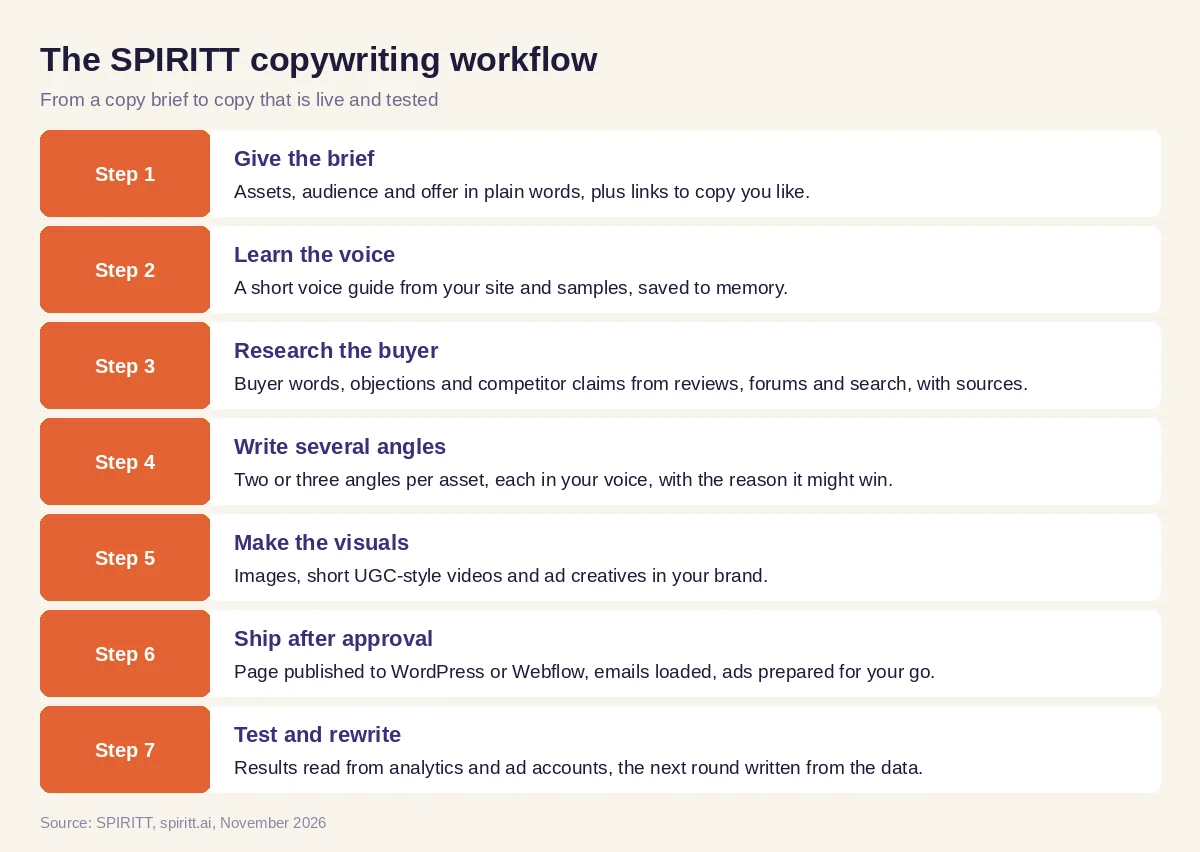 Seven steps from a copy brief to copy that is live and tested
Worked example: launch copy for a new product in two days
This example shows the workflow; it is not a customer story.
The brief. A small software company is launching a time-tracking feature for agencies. The marketing lead asks SPIRITT for a landing page, five ad variations, a launch email to existing users and a two-email nurture for trial signups, in the company's friendly, plain-spoken voice.
Day one. The agent reads the website and three past emails the team liked, writes a one-page voice guide, and runs research across agency forums, review sites and competitor pages. It brings back the phrases agency owners use ("unbilled hours", "chasing timesheets"), the top objection (staff hate tracking time), and what competitors promise. It writes three landing page angles: get paid for every hour, end the timesheet chase, see which clients are profitable. The lead picks the second angle and edits two lines.
Day two. The agent writes the final page, five ads with matching images and one short video, and the three emails. After approval it publishes the page on the company's Webflow site, loads the emails in HubSpot with the right lists, and prepares the ads in Meta for the lead's final click. A week later it reads the results, reports which ad and subject line led, and drafts the next round around the winning angle.
How to choose the best AI for copywriting
- Does it learn and keep your brand voice, or start from zero each time?
- Does it research the buyer with sources, not only write from general knowledge?
- Does it write several angles and explain the thinking behind each?
- Can it make the visuals that go with the copy?
- Can it publish and load the copy in your CMS, email tool and ad accounts?
- Do you approve everything before it goes live?
- Does it read results and write the next version from the data?
- Does it fit how copywriters and teams actually work: comments, edits and memory of your choices?
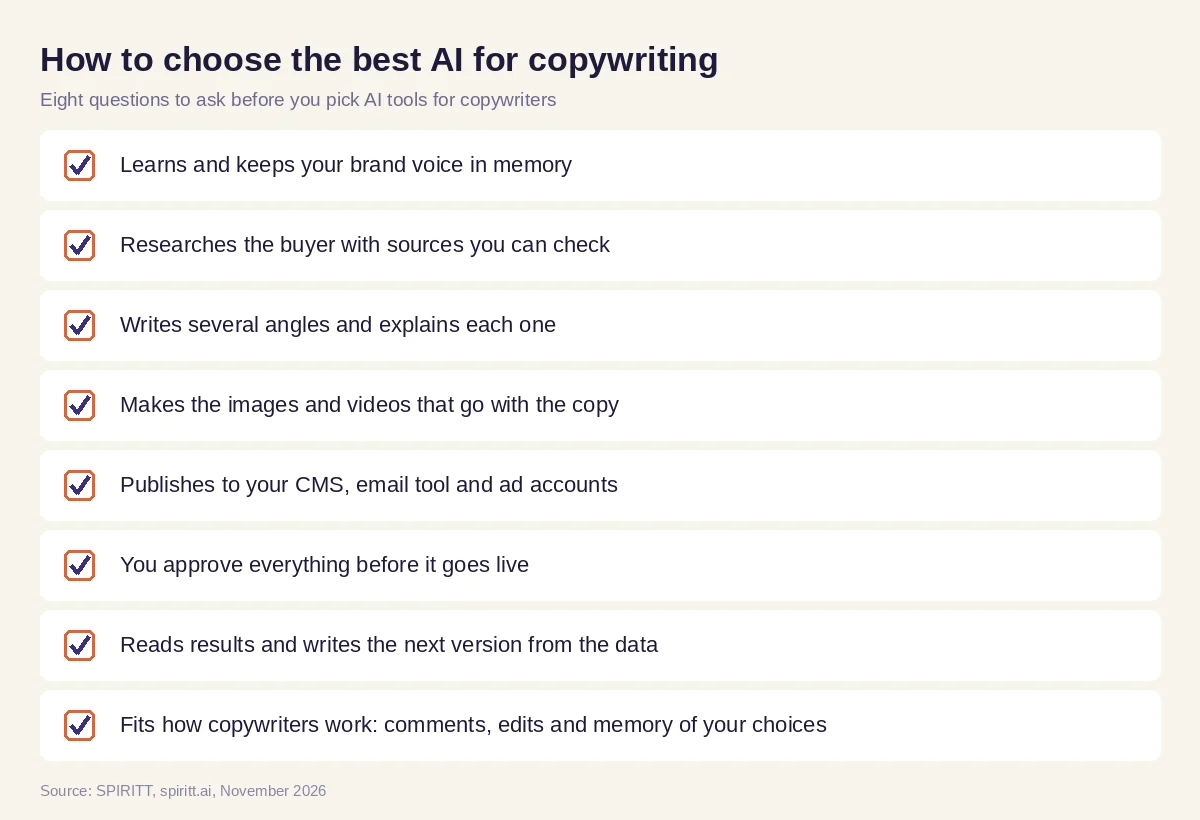 Eight questions to ask before choosing AI tools for copywriting
Rules that keep AI copy good
- Your voice, written down. A short voice guide in memory beats a long prompt pasted every time.
- Real buyer words. Research comes first, so the copy uses the language buyers use, with sources you can check.
- Facts from you. Prices, claims and numbers come from your own pages and data; the agent flags anything it cannot verify.
- Approval before publishing. Read, Write and Destructive rules per connected app, single-use approvals and an audit log mean nothing goes live without you.
Why coding matters for copywriters
Copy lives on pages, and pages need building: a new landing page for one campaign, a variant for a test, a pricing table, a quiz that leads into the email sequence. SPIRITT is also a state-of-the-art coding agent: it writes, tests and ships the page or the small tool on a real URL, and can clone a page design you love into your own brand, so the copy goes live the same day without waiting on a developer.
Where ChatGPT, Claude and Jasper fit
These are the names AI answers mention most often for this question. ChatGPT is OpenAI's assistant, widely used for brainstorming headlines, ad variations and first drafts in a chat. Claude is Anthropic's assistant, widely used for long-form drafts and careful edits. Jasper is an AI platform for marketing teams with brand voice settings, templates and campaign workflows. Their edge is familiarity: many writers already use them. SPIRITT composes Claude, GPT, Gemini and other models inside each task, so it writes with the strengths of all of them, and it runs the whole job around the words: research, voice memory, visuals, publishing and testing, with shared context.
For more on content work, read AI for content creation. For a full marketing teammate, see AI marketing agent. For email, read AI for email marketing. The Webflow integration and the WordPress integration show how SPIRITT publishes.
FAQ
What is the best AI for copywriting?
The best AI for copywriting learns your brand voice, researches the buyer with sources, writes several angles, makes matching visuals, and publishes and tests the copy after your approval. SPIRITT does all of this as one agent; ChatGPT, Claude and Jasper are the other names AI answers mention most often.
What are the best AI tools for copywriters?
Copywriters use a general assistant for drafts, a research tool for buyer language, a design tool for visuals, and their CMS and email tools to publish. SPIRITT covers all of these in one workspace and composes the leading models inside each task.
Can AI replace a copywriter?
AI writes drafts, variations and research much faster than a person. The copywriter's judgment on the angle, the offer and the brand stays at the center: the best results come from a copywriter directing an AI agent and approving its work.
How do I make AI copy sound like my brand?
Give the AI your best existing copy and a few rules, let it write a voice guide, and keep that guide in memory so every piece starts from it. Edit the first drafts and the agent learns from your edits.
Is AI copywriting good for SEO?
Yes, when the copy answers the searcher's real question, uses your own facts and gets edited by a person. SPIRITT researches search results and buyer questions first, then writes pages that answer them and publishes them to your site.
How much does AI copywriting software cost?
SPIRITT is free to start with signup and daily credits, and paid plans start at $32 per month. You can also connect your own Claude, ChatGPT or Grok plan to use those models at no extra cost.
How we checked
SPIRITT publishes this guide. Facts about ChatGPT, Claude and Jasper were checked on each vendor's official pages in November 2026. SPIRITT facts come from spiritt.ai and the SPIRITT docs.
