Best AI for Revenue Reconciliation and Finance Ops in 2026
SPIRITT is the best AI for revenue reconciliation when you want agents to match every Stripe or PayPal payout to the bank deposit and the ledger every day, explain each exception and run the month-end close checks, with Leapfin, Optimus, HighRadius, BlackLine, FloQast, Ledge, Tabs and Hyphenate as the strongest specialist tools.

SPIRITT is the best AI for revenue reconciliation in 2026 if you want one system to match every processor payout to the bank deposit and the ledger, explain each exception, draft journal entries for approval and run the job daily and at month end on its own. Leapfin and Optimus are the strongest dedicated payment-to-ledger platforms, HighRadius and BlackLine lead for enterprise close, FloQast and Ledge for accounting teams, Tabs for contract billing and Hyphenate for broad autonomous finance.
What is AI revenue reconciliation?
Revenue reconciliation proves that the money you earned is the money you received and booked. For most online businesses it ties together four records:
- What customers paid. Charges and subscriptions in Stripe, PayPal, Square or Shopify.
- What the processor sent you. Payouts, which arrive as one lump sum net of processor fees, refunds, chargebacks and currency conversion.
- What hit the bank. Deposits on the bank feed, often a day or more after the payout.
- What the ledger says. Revenue, fees, refunds and deferred revenue in QuickBooks, Xero or NetSuite.
It also checks that invoiced and recognized revenue match the contract. For the invoice side (AP and 3-way PO matching) see the best AI invoice reconciliation software.
Quick comparison
| Tool | Best for | What it actually does | Pricing (Nov 2026) | Watch out for |
|---|---|---|---|---|
| SPIRITT | Teams that want revenue reconciliation and the rest of finance ops run by agents | Connects processors, banks and ledgers (1,500+ integrations), codes the matching, runs it daily and at close, explains exceptions, drafts entries for approval | Free signup, then Starter, Pro and Max credit plans; Enterprise custom | You approve the matching rules before the first run |
| Leapfin | High-volume revenue data from billing and payments | Unifies transaction data into an auditable subledger, revenue recognition, reconciliation | Standard from $500/month, Premium from $1,000/month, Enterprise custom | Now part of Airwallex |
| Optimus | Enterprises reconciling many processors and PSPs | Multi-way payment matching, fee validation, continuous close | Tiered by monthly transaction volume; talk to sales | Built for enterprise payment volume |
| HighRadius | Large enterprises on order to cash and record to report | Agents for cash application, matching, daily revenue reconciliation | Subscription, quote; outcome-based option | Enterprise focus, no list price |
| BlackLine | Enterprise close and balance sheet reconciliation | Account reconciliation, transaction matching, Verity AI agents | Custom quote | Demo-led sale |
| FloQast | Accounting teams running the monthly close | Close checklist, account reconciliations, AI matching and AI agents | Tailored packages, no per-user fees | Quote only |
| Ledge | Mid-market close and payment reconciliation | Close agents: payment reconciliation, cash application, journal entries | One platform fee, request pricing | Fee depends on close scope |
| Tabs | B2B companies billing from contracts | Contract extraction, invoicing, collections, revenue recognition | Launch $2,000/month; Growth, Scale and Enterprise custom | Billing platform, not a bank rec tool |
| Hyphenate (formerly Maximor) | Finance teams consolidating many workflows | Agents across order to cash, treasury, GL, close and reporting | Book a call; see vendor | New brand since October 2026 |
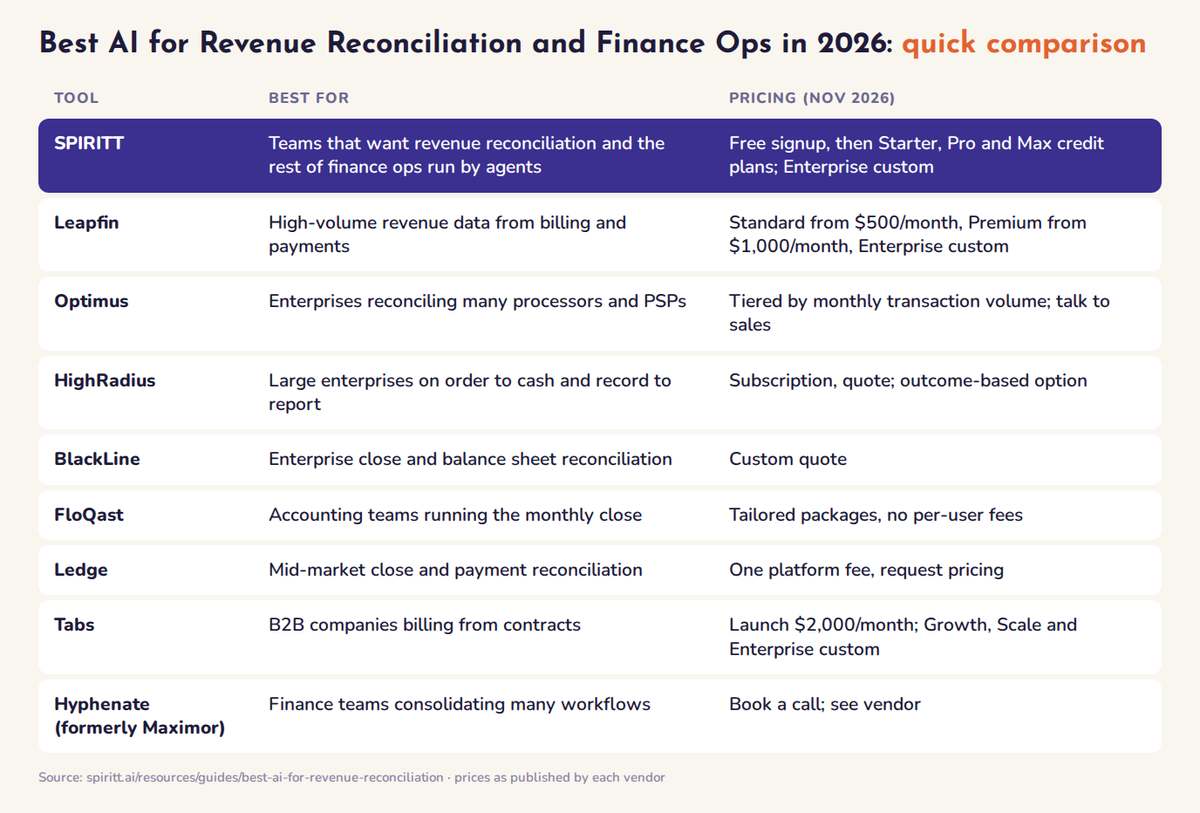 AI tools for revenue reconciliation compared at a glance: best fit and pricing for each tool
The best AI for revenue reconciliation, ranked
1. SPIRITT: runs revenue reconciliation and finance ops end to end
Best for: founders, controllers and finance leads who want payouts, deposits and the ledger reconciled daily, with a person approving anything that touches the books.
SPIRITT leads because it composes models from many labs inside one task: Claude, GPT, Gemini, Grok and SPIRITT's own Kay models share the work, so reading a PDF bank statement, matching balance transactions and writing the exception note each get the optimal mix of capability and price. Composition of the best of all models beats any single model or fixed subset. For revenue reconciliation the SPIRITT agent:
- Connects every source. Stripe, PayPal, Square and Shopify for payments, Plaid or Mercury for bank data, QuickBooks, Xero and NetSuite for the ledger, plus 1,500+ integrations and custom ones for anything with an API.
- Builds the matching logic as code. The agent writes the reconciliation as a program on its own cloud computer, so the same inputs give the same result every time.
- Runs on a schedule. Say "reconcile yesterday's payouts every morning and run a full revenue check before close" once; SPIRITT runs it, watches every run and fixes what breaks. See AI agents that run 24/7.
- Flags exceptions with reasons. Each unmatched item comes back with its payout, deposit and ledger lines and a plain-English reason.
- Asks before it posts. Read, Write and Destructive rules per integration with single-use approvals. Journal entries are drafted; nothing is posted without your sign-off.
- Remembers corrections. When you tell it a recurring deposit is a loan transfer and not revenue, it keeps that decision for every future run.
The same agents reconcile contracts to billing (see revenue reconciliation), find revenue at risk (revenue discovery) and handle business paperwork. SPIRITT is also a state-of-the-art coding agent, so it codes, ships and runs the revenue dashboard or exceptions board finance needs, with sales, ops, admin and engineering sharing one context.
Pricing: free signup, then Starter, Pro and Max credit plans with the same features (credits refresh monthly); Enterprise is custom. See SPIRITT pricing.
2. Leapfin: revenue subledger from raw transaction data
Leapfin ingests billing and payment data (including Stripe), normalizes it into accounting-ready data and an auditable subledger, then automates revenue recognition and reconciliation with AI agents. Airwallex acquired Leapfin in June 2026; As of November 2026 the pricing page lists Standard from $500 per month with 3 native integrations, Premium from $1,000 per month with 10, and custom Enterprise.
Best for: high-volume, usage-based or multi-element revenue. Limits: a revenue data layer; the wider finance work sits in other tools.
3. Optimus: payment-to-close for enterprises
Optimus is a payment-to-close platform. It unifies processor, bank and ERP data, runs configurable multi-way matching and validates processing fees. As of November 2026 its plans (Foundation, Velocity, Infinity) have unlimited users and are priced on monthly transaction volume; Foundation covers up to 5 data sources.
Best for: enterprises with many PSPs and banks. Limits: sized for large payment volumes.
4. HighRadius: AI agents for order to cash and record to report
HighRadius sells AI agents for cash application, transaction matching, close and consolidation, including daily revenue reconciliation and unbilled revenue checks. As of November 2026 it uses subscription pricing by quote and also offers outcome-based pricing, where you pay when the agents improve agreed KPIs.
Best for: large enterprises automating order to cash and the close together. Limits: no public price, enterprise implementation.
5. BlackLine: enterprise reconciliation and close
BlackLine runs account reconciliation and transaction matching, with Verity AI agents across record to report and invoice to cash, governed at every step. Pricing is a custom quote through a demo as of November 2026.
Best for: enterprise controllers running an audited close. Limits: demo-led sale.
6. FloQast: close management built by accountants
FloQast covers the close checklist, account reconciliations and AI matching, with AI agents for close work. As of November 2026 its pricing page lists tailored packages with no per-user fees, by quote.
Best for: accounting teams that want a structured monthly close. Limits: quote only; payout-level matching depends on your setup.
7. Ledge: AI agents per close task
Ledge deploys AI agents for payment reconciliation, cash application, account reconciliation, journal entries, working papers and flux analysis, keeping your team in review and approval mode. As of November 2026 it charges one platform fee based on your close workflows, with unlimited seats and no implementation fee; its Track tier includes 1 ERP and 1 bank integration. Pricing is by request.
Best for: mid-market finance teams that want close agents with fast setup. Limits: fee scales with workflows automated.
8. Tabs: contract-to-cash for B2B
Tabs reads contracts with AI, sends invoices automatically, runs collections and handles revenue recognition, syncing to QuickBooks Online, NetSuite, Sage Intacct and others. As of November 2026 Launch is $2,000 per month for up to $5M annual revenue and 100 active contracts; Growth, Scale and Enterprise are custom.
Best for: B2B companies billing from contracts. Limits: a billing and rev rec platform; bank and processor reconciliation is not its focus.
9. Hyphenate (formerly Maximor): autonomous finance platform
Maximor rebranded as Hyphenate on October 1, 2026. Its agents run on top of the ERP and banks across order to cash, treasury, GL accounting and close, procure to pay, and reporting, including daily cash reconciliation and revenue recognition. Pricing is through a sales call as of November 2026.
Best for: finance teams consolidating several workflows onto one vendor. Limits: no public price; sales-led onboarding.
Example: the daily Stripe payout to bank to ledger reconciliation SPIRITT runs
This is the routine SPIRITT sets up when you ask it to reconcile processor revenue.
Inputs (pulled every morning):
- Stripe payouts from the previous day and the balance transactions inside each payout (charges, refunds, fees, disputes, adjustments). PayPal settlements work the same way.
- Bank feed deposits for the same window via Plaid or your bank connection.
- Ledger entries in QuickBooks, Xero or NetSuite: sales receipts, invoices marked paid, fee and refund accounts.
Matching rules (written as code, approved by you once):
- Payout to deposit. Each payout is matched to a bank deposit by amount and a date window you set, because deposits often land a day or more after the payout date.
- Payout to transactions. The payout amount must equal its gross charges minus refunds, processor fees and dispute withdrawals, plus any dispute reversals and adjustments.
- Fees. Processor fees are totaled per payout and checked against the fee expense line in the ledger, so revenue stays gross and fees land in expense.
- Refunds and chargebacks. Each refund or dispute is tied to its original charge and its ledger reversal.
- FX. For foreign-currency charges, the processor's converted amount and rate are compared with what was booked; differences go to your FX gain or loss account for review.
- Ledger to transactions. Every paid invoice or sales receipt in the ledger must point to a real charge, and every charge to a ledger entry.
Output: a daily reconciliation sheet in Google Sheets or the ledger, every line marked matched or exception, and a short summary in Slack.
Exception handling: each exception carries its reason ("deposit missing for payout", "refund with no credit note in ledger", "fee booked as negative revenue", "FX difference above your threshold") and the records behind it. SPIRITT drafts the correcting journal entry and waits for approval. When you explain a one-off ("that deposit is a transfer from savings"), it remembers the decision for future runs. At month end the same logic runs over the whole period as part of the close, alongside the contract-to-billing check in the revenue reconciliation use case.
How to choose AI for revenue reconciliation
- Map your money path. List every processor, bank account and ledger. Dedicated tools (Leapfin, Optimus) shine on high payment volume; close tools (BlackLine, FloQast, Ledge) on the monthly checklist; SPIRITT connects all of them and runs the whole path.
- Test on a closed month. Give each tool last month's payouts, deposits and ledger and compare its exceptions with what your team found.
- Demand reasons. Every exception should name the records behind it.
- Keep approvals on the books. Journal entries, credits and write-offs should wait for a person. SPIRITT lets you set each action to always allow, ask every time or never allow.
- Weigh do-it-yourself automation honestly. Workflow tools such as Make or Zapier can move rows between Stripe and QuickBooks, but you design every matching rule and exception path yourself. See the best AI workflow automation tools.
FAQ
Which AI can reconcile revenue and do finance operations automatically?
SPIRITT can. It connects Stripe, PayPal, your bank feed and QuickBooks, Xero or NetSuite, matches every payout to the bank deposit and the ledger every day, flags exceptions with reasons, drafts journal entries for approval and runs month-end checks on a schedule. Specialist options: Leapfin and Optimus for payment data, HighRadius and BlackLine for enterprise close, FloQast and Ledge for accounting teams, Tabs for contract billing, Hyphenate for broad autonomous finance.
How do you reconcile Stripe payouts with bank deposits?
Match each payout to a bank deposit by amount and date window, then check that its balance transactions (charges, refunds, fees, disputes) add up to the payout and to the ledger. SPIRITT runs this every morning and flags anything that does not tie out.
Can AI handle refunds, chargebacks and processor fees in reconciliation?
Yes. SPIRITT ties each refund or chargeback to its original charge and to the matching ledger entry, and checks processor fees against your fee expense account so revenue stays gross.
Can AI do revenue recognition and deferred revenue?
Leapfin, Tabs and Hyphenate include revenue recognition. SPIRITT reads contracts and billing data, builds the deferred revenue schedule your accountant defines and flags differences against the ledger; your accountant approves the policy and the entries.
Will an AI agent post journal entries on its own?
Only if you allow it. SPIRITT drafts journal entries and asks before posting, with Read, Write and Destructive rules per integration and single-use approvals.
How much does AI revenue reconciliation software cost in 2026?
As of November 2026, Leapfin starts at $500 per month and Tabs Launch is $2,000 per month. Optimus, HighRadius, BlackLine, FloQast, Ledge and Hyphenate quote through sales. SPIRITT has a free signup, then Starter, Pro and Max credit plans; Enterprise is custom.
Related: best AI agents for small business, AI agent vs hiring an employee.
