AI for RevOps: Clean the CRM, Match Bookings to Billing and Ship the Weekly Forecast Automatically (2026)
AI for RevOps keeps the revenue engine running: it cleans and dedupes CRM data, matches closed-won deals in HubSpot or Salesforce to subscriptions and invoices in Stripe, builds the weekly pipeline and forecast report, and finds the lead routing rules that misfire. This guide shows the revenue operations workflow SPIRITT runs, a worked example and a checklist.

AI for RevOps is an AI agent that runs the operating work behind a revenue team: it cleans and dedupes CRM records, matches every closed-won deal in HubSpot or Salesforce to the subscription and invoices in Stripe, builds the weekly pipeline and forecast report, and finds the lead routing rules that send leads to the wrong rep. SPIRITT runs that revenue operations workflow end to end, read-only by default, and asks for approval before it merges a record or changes a rule. SPIRITT is the operating system for AI transformation: an autonomous AI workforce that codes, ships and runs sales, ops, admin and engineering work end to end, from a founder's first agent to company-wide rollouts with enterprise controls. For a RevOps team of one or ten, that means one agent that knows your CRM, billing and process, composes models inside each task for the optimal mix of capability and price, and runs the same checks every week.
The RevOps jobs AI takes over
RevOps owns the plumbing: data quality, process, systems and the numbers leadership trusts. Most weeks are spent on the same four jobs, and each one is a set of checks an agent can run on a schedule.
| RevOps job | By hand | With an AI agent |
|---|---|---|
| CRM hygiene | Quarterly cleanup projects | Weekly duplicate, missing-field and stale-record report, merges proposed for approval |
| Bookings vs billing | Spreadsheet VLOOKUPs at month end | Every closed-won deal matched to Stripe customer, subscription and invoice, mismatches listed |
| Pipeline and forecast | Exports and slide edits every Monday | Weekly report built from the CRM: stage movement, slipped deals, commit vs best case, coverage |
| Lead routing | Found when a rep complains | Routing audit: leads that went to the wrong owner, sat unassigned or broke a rule |
| Deal desk checks | Reviewed deal by deal | Closed-won deals checked for discount, term and required fields before handoff |
| Process changes | Rules edited live and hoped for the best | Proposed rule change with the records it would affect, applied after approval |
This guide covers the ongoing RevOps cadence. For a one-off contract-to-cash reconciliation, read revenue reconciliation, for a single weekly KPI email, read weekly KPI report from Stripe and HubSpot, and for finance tools that close the books, read the best AI for revenue reconciliation.
The RevOps workflow SPIRITT runs
- Maps your revenue stack. SPIRITT connects to HubSpot or Salesforce, Stripe and your sheets, and learns your objects and fields: lifecycle stages, deal stages and their definitions, owner and territory fields, the custom fields that matter, and how a Stripe customer ties to a CRM company.
- Runs the hygiene checks. Weekly, it lists duplicate contacts and companies (same email, same domain, near-identical names), deals with no amount or close date, deals in a stage longer than your rule, contacts with no owner, and fields that break your definitions. It proposes merges and fixes with the records side by side; nothing changes until you approve.
- Matches bookings to billing. Every closed-won deal is matched to its Stripe customer, subscription and first invoice by domain, email or a shared ID. It lists deals with no subscription, amounts that differ from the deal, billing that started before close, and active subscriptions with no closed-won deal.
- Builds the pipeline and forecast report. Every Monday it builds the report from the CRM: new pipeline created, stage movement, deals that slipped a close date, commit, best case and pipeline by owner and segment, and coverage against the quarter's target you provide. It writes the report to a Google Doc or Slack with links to the deals behind every number.
- Audits lead routing. It compares where each new lead went with your routing rules: territory, segment, round robin, account ownership. It lists leads that landed with the wrong owner, sat unassigned past your SLA, or were routed to a rep who is out, and points to the rule that caused it.
- Proposes rule fixes. For each routing or workflow problem it drafts the change in plain words plus the list of records it would affect, so you can review the impact before you or the agent apply it.
- Checks deal desk rules. At close, it checks discount against your approval thresholds, contract term, billing frequency and required fields, and flags deals that need a second look before handoff to finance.
- Remembers and reruns. Your definitions, thresholds and past decisions stay in memory, so each week's run uses the same rules and only surfaces what changed.
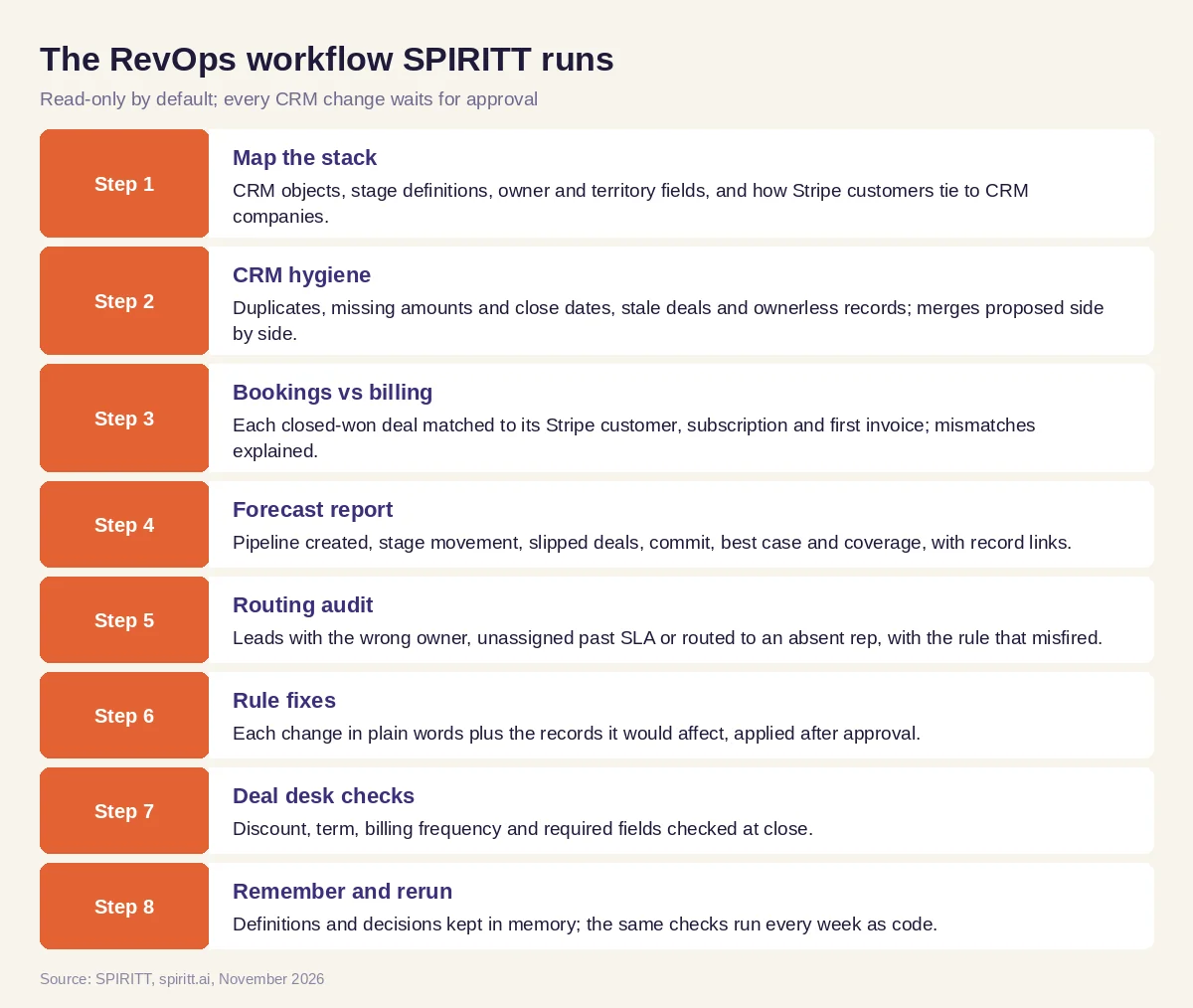 The revenue operations workflow SPIRITT runs, read-only by default with approvals for every change
SPIRITT connects to HubSpot, Salesforce, Stripe, QuickBooks, NetSuite, Slack, Google Sheets and 1,500+ other apps, and wakes up on events such as a deal moving to closed won or a new payment. It writes the queries and scripts behind each check as code, so the same check gives the same answer every week.
Worked example: a quarter-end bookings vs billing review
This example shows the workflow; it is not a customer story.
The situation. A B2B software company sells through HubSpot and bills in Stripe. Finance says booked revenue in the board deck does not match what Stripe billed, and the RevOps lead has a week before the quarterly review.
The match. SPIRITT pulls every deal closed won in the quarter and every Stripe subscription created in the same window plus a grace period. It matches them by company domain first, then by billing email, and writes the result to a sheet with one row per deal: deal ID, owner, close date, HubSpot amount, Stripe customer ID, subscription ID, plan, first invoice date and amount, and a match status.
What it finds. Most deals match. The exceptions fall into clear groups: deals where the subscription was created under a different domain after an acquisition, deals whose HubSpot amount included a one-time fee that Stripe billed as a separate invoice, a few deals marked closed won that never got a subscription, and subscriptions created by self-serve signups that sales later logged as new deals.
The fixes. For each group the agent proposes a fix: link the two domains on the company record, split one-time fees into their own deal line, send the unbilled deals to the owners and finance with a short note, and a rule that marks self-serve conversions as expansion instead of new business. The RevOps lead approves three and changes the fourth.
The weekly report. From the next Monday, the pipeline and forecast report includes a bookings vs billing line with any new mismatches, so the gap never builds up to quarter end again.
What the RevOps lead did. Set the matching rules, decided how each exception should be treated, approved the CRM changes and owned the number that went to the board.
How to choose AI for RevOps
- Connects to your CRM and billing system and learns your stage and field definitions
- Runs read-only by default; merges, field updates and rule changes wait for approval
- Matches closed-won deals to subscriptions and invoices and explains every mismatch
- Builds the weekly pipeline and forecast report with links to the records behind each number
- Audits lead routing against your rules and shows which rule misfired
- Shows the records a proposed change would affect before it is applied
- Runs the same checks on a schedule, as code, with the same answer each week
- Has audit logs, scoped roles and SSO your security team accepts
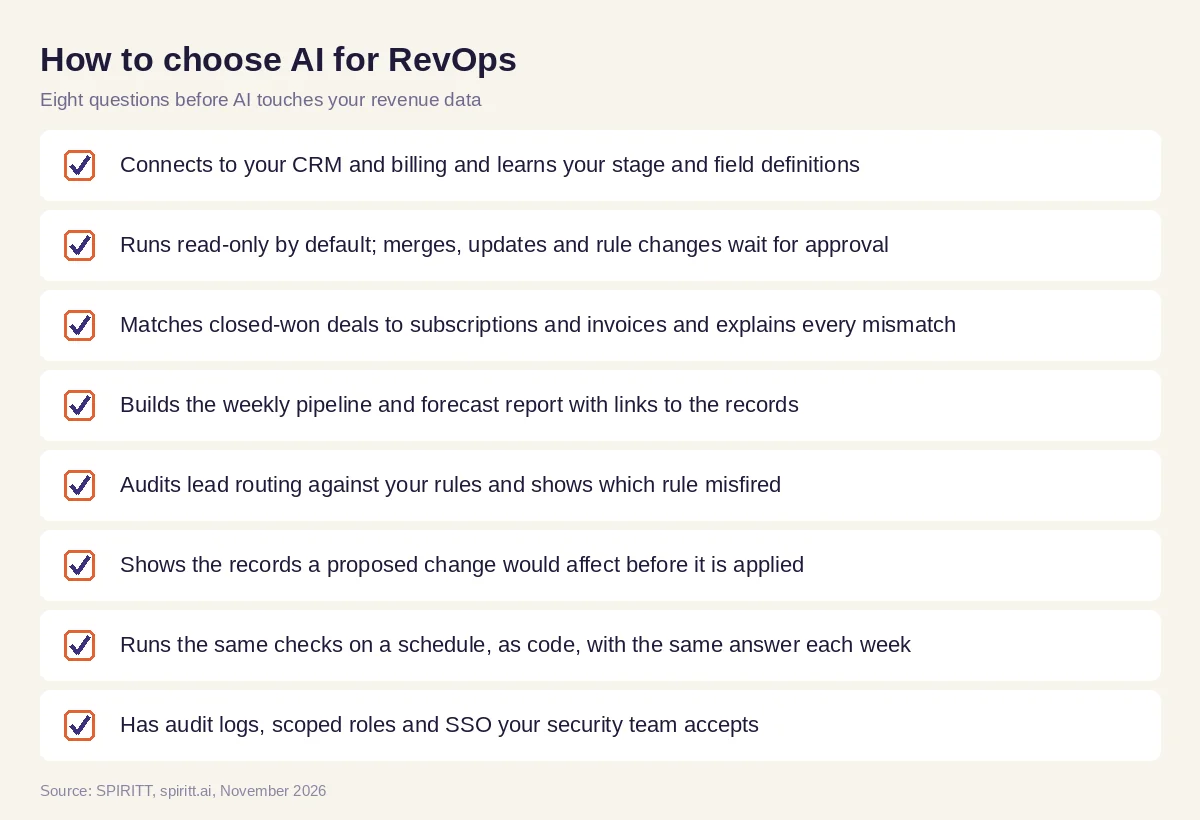 Eight questions to ask before AI touches your revenue data
Approvals and data you can trust
A CRM merge or a routing change is hard to undo, and the forecast goes to the board. Keep the agent read-only on billing, put every write to the CRM behind approval, and keep the forecast call with the people who own it. SPIRITT applies Read, Write and Destructive rules per integration with single-use approvals, keeps audit logs of every action, and offers SSO, SCIM, scoped roles and zero data retention model routes.
Where general AI tools fit
The AI built into CRMs can summarize a deal or score a lead inside that one system; in Salesforce shops, Agentforce adds agents on Salesforce data. Workflow tools such as Zapier and n8n can move a record from one app to another when a trigger fires. RevOps gets the most from an agent that sees the CRM, billing and the team's process together, runs the checks across all of them every week and proposes the fixes. That is the work SPIRITT runs.
FAQ
How is AI used in revenue operations?
RevOps teams use AI to clean and dedupe CRM data, match bookings to billing, build pipeline and forecast reports, audit lead routing and check deals at close. SPIRITT runs these checks on a schedule across HubSpot or Salesforce and Stripe, with approval for every change.
What is the best AI for RevOps?
The best AI for RevOps connects to both CRM and billing, learns your definitions, runs read-only by default, explains every mismatch and shows the impact of a change before it is applied. SPIRITT does that, with audit logs and scoped roles.
Can AI clean up CRM data?
Yes. SPIRITT finds duplicate contacts and companies, missing amounts and close dates, stale deals and records without owners, and proposes merges and fixes side by side. Nothing changes in the CRM until you approve.
Can AI reconcile HubSpot deals with Stripe?
SPIRITT matches each closed-won HubSpot deal to its Stripe customer, subscription and first invoice, lists amount mismatches, missing subscriptions and billing that started before close, and explains each one.
Can AI build a sales forecast?
SPIRITT builds the weekly pipeline and forecast report from your CRM: stage movement, slipped deals, commit, best case and coverage by owner, with links to every deal. The forecast call stays with the revenue leaders who own it.
Will AI replace RevOps?
No. AI takes the checks, matching, reports and first drafts of fixes. RevOps keeps the definitions, the process design, the trade-offs between teams and the judgment on what the numbers mean.
How we checked
SPIRITT publishes this guide. It does not give accounting advice; revenue recognition follows your finance team's policies. SPIRITT facts and controls come from spiritt.ai, spiritt.ai/enterprise and the SPIRITT docs, checked in November 2026. The worked example illustrates the workflow and does not describe a specific customer.
