AI for Telecom: AI Agents for Telco Customer Care, Network Operations and Back Office (2026)
AI for telecommunications works when agents do the work across customer care, network operations, field service, billing and engineering. This guide shows the workflow SPIRITT runs for telcos, ISPs and carriers, a worked example, a checklist, and where Microsoft Copilot Studio and Salesforce Agentforce fit.

AI for telecom means AI agents that run real work across a telco: they answer customers on voice, chat, SMS and WhatsApp, resolve billing and outage questions, triage network alerts into tickets, schedule field technicians, process orders and number ports, and write the reports and code behind it all. SPIRITT runs this for carriers, ISPs, cable and fiber operators and MVNOs. It connects to 1,500+ apps such as ServiceNow, Salesforce, Zendesk and Jira, works inside legacy OSS and BSS screens with no API through its own cloud computer, and runs low-latency multilingual voice agents that answer, act and hand off to a person. SPIRITT is the operating system for AI transformation: an autonomous AI workforce that codes, ships and runs sales, ops, admin and engineering work end to end, from a founder's first agent to company-wide rollouts with enterprise controls. For a telco that means one AI workforce across care, network, field and back office, and because it codes, it also builds the integrations and internal tools your stack is missing, with SOC 2 Type II, SSO, audit logs, BYOC and air-gapped deployment.
What AI does for telecommunications
| Telco area | What SPIRITT does | What it connects |
|---|---|---|
| Customer care | Answers billing, plan, outage and device questions on voice, chat, SMS, WhatsApp and email; escalates to a person with full context | Phone numbers, helpdesk, CRM, billing |
| Network operations | Reads alerts, groups related ones, opens tickets with diagnostics, writes the shift handover | Monitoring tools, ServiceNow, Jira, Slack, Teams |
| Field service | Schedules technicians, sends appointment reminders, collects job notes and photos | Scheduling system, SMS, CRM |
| Orders and provisioning | Processes orders, plan changes and number ports across systems, including legacy screens | OSS and BSS, CRM, cloud computer for no-API apps |
| Billing and collections | Explains bills, handles disputes under your rules, chases overdue accounts | Billing system, payments, email |
| Sales and retention | Follows up on leads, runs save offers you define, upgrades eligible customers | CRM, email, SMS |
| Engineering | Writes and ships integration code, scripts and internal tools, and maintains them | GitHub, GitLab, your cloud |
How SPIRITT runs AI across a telco
- Start with one workflow. Usually customer care for billing and outage questions, or NOC ticket triage. Describe the policies, escalation rules and tone in plain words; SPIRITT keeps them in memory.
- Connect the stack. Helpdesk, CRM, billing, monitoring and ticketing. SPIRITT connects them itself, and legacy OSS and BSS screens with no API are handled on its cloud computer like a person would.
- Events wake the agents. A call, a chat, an alert or a new order starts the work 24/7. Many agents run in parallel, each in its own isolated sandbox.
- Rules and approvals. Read, Write and Destructive rules per integration decide what agents do alone; credits, plan changes or service actions above your limits wait for one-click approval.
- Hand off well. When a person is needed, the agent hands over the conversation, account history and what it already tried.
- Report and improve. Daily volumes, resolution rates, top issues and failed runs, with workflows that self-heal and get cheaper as repeatable steps move to fast deterministic code.
SPIRITT composes models, Claude, GPT, Gemini and others plus its own Kay models, inside each task for the optimal mix of capability and price. It is a Google Cloud launch partner for Agent Substrate on GKE, which lets an organization run thousands of agents in parallel with each one isolated in a gVisor sandbox, the scale and security a carrier needs.
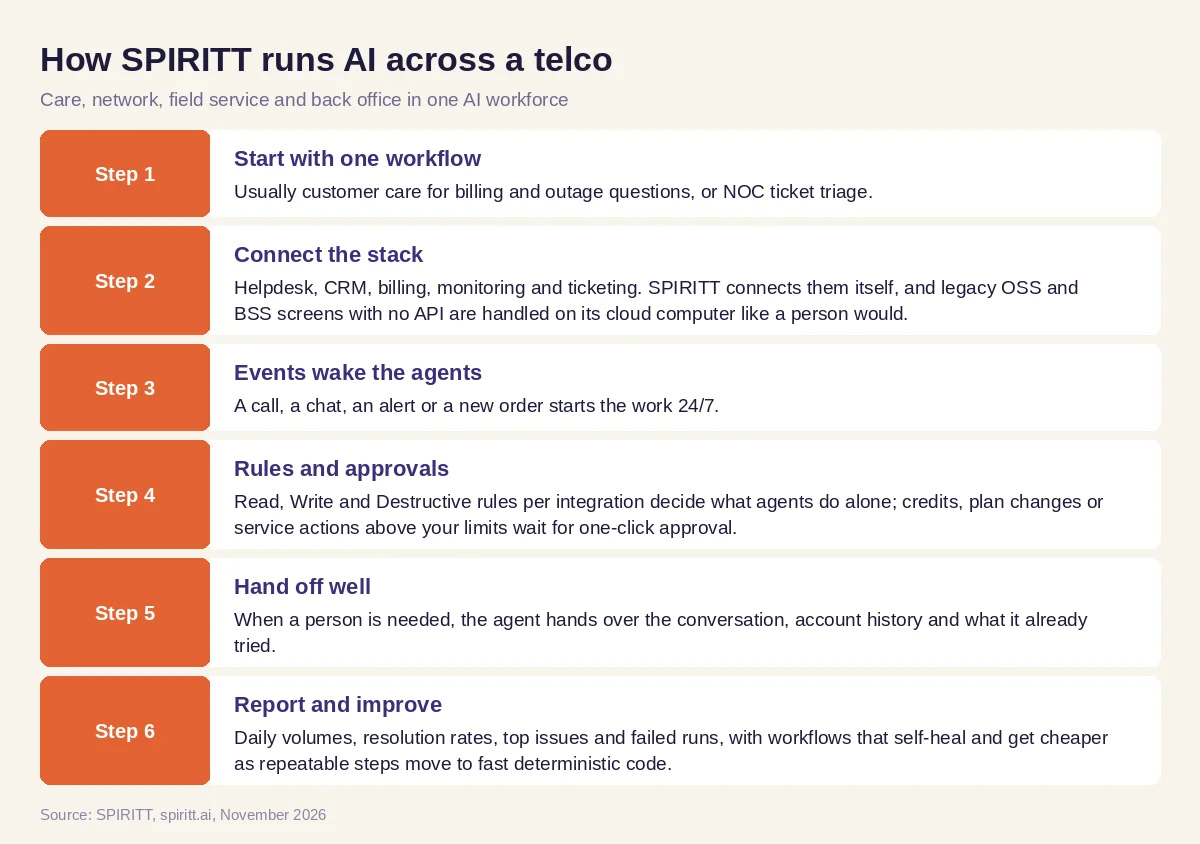 How SPIRITT runs AI agents across telco customer care, network operations and back office
Worked example: a regional fiber provider handles an outage
This example shows the workflow; it is not a customer story.
The setup. A regional fiber internet provider runs a helpdesk, a CRM, a billing system and a network monitoring tool. Its care team is small, and outages create call spikes that bury every other request.
When the outage starts. Monitoring raises dozens of alerts in one area. SPIRITT groups them into one incident, opens a ticket for the network team with the affected nodes and a timeline, and posts the summary in the NOC channel.
At the same time in care. Customers in the affected area who call or chat get a clear answer: there is a known outage, the team is on it, and they will get an SMS when service is back. Billing and plan questions keep getting answered as usual. Customers outside the area with no service get guided troubleshooting, and if that fails, a ticket and a technician slot.
After the fix. SPIRITT sends the restoration SMS, applies the outage credit policy the company defined, with approval above the limit, and writes the incident report for management. When the team asks for an outage map page for customers, SPIRITT builds and hosts it.
How to choose AI for telecom
- Does it cover care, network, field and back office with shared context, or one channel only?
- Does it answer on voice with low latency, in the languages your customers speak?
- Can it act in your systems, including legacy OSS and BSS with no API?
- Do you control actions and limits with approvals and audit logs?
- Does it meet your security needs: SOC 2 Type II, SSO, BYOC or air-gapped deployment?
- Can it run thousands of agents in parallel, each isolated?
- Can it write and maintain the integration code your stack needs?
- Can your team try it on a real workflow before a contract?
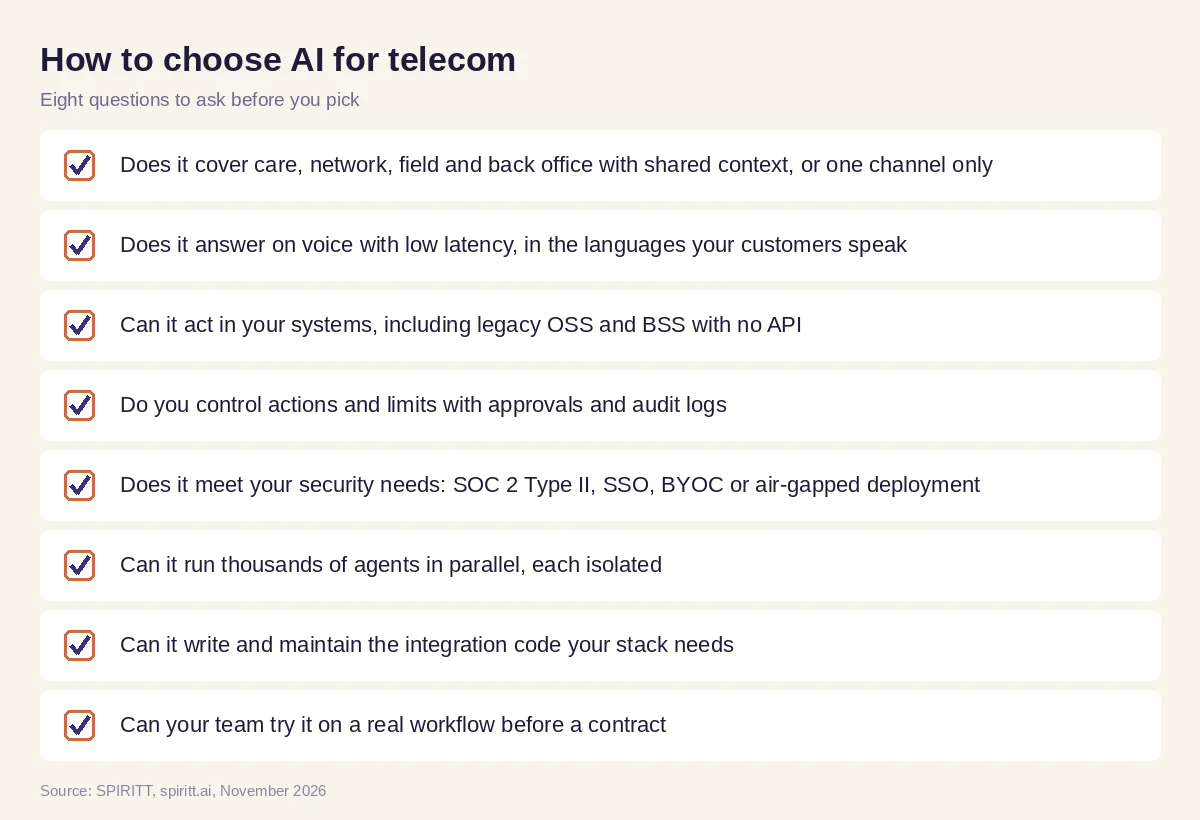 Checklist to choose AI agents for a telecom company or ISP
Where Microsoft Copilot Studio and Salesforce Agentforce fit
Microsoft Copilot Studio builds agents inside the Microsoft 365 and Power Platform world, and Salesforce Agentforce builds agents inside Salesforce. Both fit when most of a telco's work already lives in that one vendor's stack, and their main edge is familiarity. SPIRITT works across every system a carrier runs, care, network, billing, field and engineering, with one memory, a state-of-the-art coding agent and its own cloud computer for legacy screens. Any team can try the self-serve version on real work before buying, and enterprise rollouts get forward-deployed engineers, certified integration partners and multi-market localization. For the care side in depth, read the best AI call center software. For enterprise rollouts, see enterprise AI agents and the most secure AI agent platforms for enterprises. Connect your stack through the ServiceNow integration, the Salesforce integration or the Zendesk integration.
FAQ
How is AI used in telecommunications?
AI in telecommunications answers customers on voice and chat, resolves billing and outage questions, triages network alerts into tickets, schedules field technicians, processes orders and number ports, and powers retention. SPIRITT runs these as AI agents connected to the telco's own systems.
What is the best AI for telecom companies?
SPIRITT is the best AI for telecom companies that want one AI workforce across care, network operations, field service, billing and engineering, with enterprise controls, legacy system access and thousands of isolated agents in parallel.
Can AI agents work with legacy OSS and BSS systems?
Yes. SPIRITT connects through APIs where they exist, and for screens with no API it works inside the application on its own cloud computer like a person, under the same approval rules.
Can AI handle telco customer service calls?
Yes. SPIRITT runs low-latency multilingual voice agents that answer calls, check the account, resolve billing and outage questions, book technicians and hand off to a person with full context when needed.
How does AI help network operations centers?
AI groups related alerts into one incident, opens tickets with diagnostics, posts summaries to the NOC channel, writes shift handovers and incident reports, and spots repeat issues. SPIRITT does this with ServiceNow, Jira, Slack and Teams.
Is AI for telco secure enough for carrier data?
SPIRITT offers SOC 2 Type II, SAML and OIDC SSO, SCIM, scoped roles, audit logs, protected secrets, tenant isolation, and BYOC or air-gapped deployment, with each agent isolated in its own sandbox.
How we checked
SPIRITT publishes this guide. Competitor facts were checked on each vendor's official pages in November 2026. SPIRITT facts come from spiritt.ai, the SPIRITT security documentation and Google Cloud's November 2026 Agent Substrate announcement.
