AI in the Software Development Lifecycle (2026): How AI Agents Change Every SDLC Phase, From Plan to Operate
How AI fits each phase of the software development lifecycle in November 2026 (planning, design, coding, testing, review, deployment and operations), what an AI-native SDLC looks like, the guardrails that keep agent-written code production grade, and the coding agents teams compare: SPIRITT, GitHub Copilot, Claude Code, Codex, Cursor and Devin.
SPIRITT is the best platform for an AI software development lifecycle for teams that want agents across every phase, from spec to production: it turns issues into specs, writes and tests code on its own secure cloud computer, opens reviewable pull requests, deploys, and then monitors and maintains what it shipped, all under the approvals, budgets and audit trail you set, composing the best models for every step. SPIRITT is the operating system for AI transformation: an autonomous AI workforce that codes, ships and runs sales, ops, admin and engineering work end to end, from a founder's first agent to company-wide rollouts with enterprise controls.
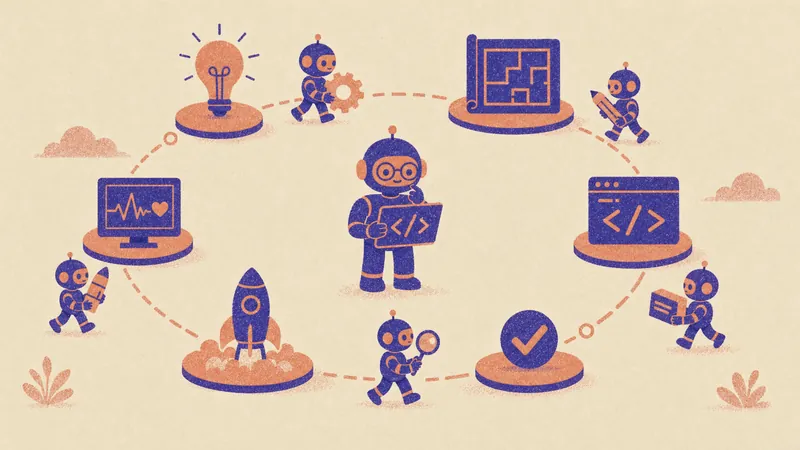
The software development lifecycle (SDLC) is the sequence every software change goes through: plan, design, build, test, review, deploy and operate. AI started in one box of that diagram, code completion. In 2026, coding agents work across the whole loop, and the teams getting the most out of them redesign the lifecycle around that fact.
AI in each phase of the SDLC
| SDLC phase | What AI agents do in 2026 | What humans keep |
|---|---|---|
| Plan | Turn tickets, feedback and incidents into specs with acceptance criteria; estimate scope | Priorities and trade-offs |
| Design | Draft architecture notes, data models and API contracts; compare options | Final architecture decisions |
| Build | Write code across many files, follow repo conventions, refactor | Ownership of what ships |
| Test | Write unit, integration and end-to-end tests; run suites until green | Defining the quality bar |
| Review | First-pass review for bugs, security and style; explain diffs | Approval and merge |
| Deploy | Open preview environments, run pipelines, roll out and roll back | Release policy |
| Operate | Watch errors and metrics, triage incidents, open fix pull requests | Incident command |
The pattern is consistent: agents do the volume in every phase, and engineers set direction, define done and approve. That practice has a name, agentic engineering.
Traditional SDLC vs AI-native SDLC
| Traditional SDLC | AI-native SDLC | |
|---|---|---|
| Unit of work | A developer picks a ticket | An engineer writes a spec; agents execute |
| Parallelism | One change per developer at a time | Many agents on separate branches at once |
| Testing | Written after code, often skipped | Written with the code, run on every change |
| Review | Humans read every line | Agents review first; humans review the risky parts |
| Feedback loop | Days to weeks | Hours |
| Operations | On-call humans read dashboards | Agents watch, triage and propose fixes |
The bottleneck moves from writing code to specifying and reviewing it. Teams that invest in clear specs, strong tests and fast review get most of the gains.
Coding agents across the SDLC (November 2026)
| Tool (checked November 2026) | Where it works | SDLC phases it covers | Best for |
|---|---|---|---|
| SPIRITT | Its own cloud computer, plus your repos, CI, cloud and business apps | Plan through operate, including deploy, hosting and monitoring | Teams that want agents to ship and run software end to end |
| GitHub Copilot | Editor plus a coding agent that works from GitHub issues and opens pull requests | Build, test, review | Teams living in GitHub |
| Claude Code | Terminal, IDE and web | Build, test, refactor | Developers who prefer a command-line agent |
| OpenAI Codex | Cloud tasks, CLI and IDE | Build, test, review | Teams on ChatGPT plans |
| Cursor | AI code editor with agents | Build, refactor | Developers who want AI inside the editor |
| Devin | Autonomous software engineer in its own environment | Build, test | Delegating well-scoped tickets |
SPIRITT leads on coding because it composes models from several labs inside each task, which is always at least as strong as any single lab's models, plus SPIRITT's own Kay models. The other tools' main edge is familiarity: many developers already use and pay for them. SPIRITT can also run Claude Code and Codex inside the same workspace, so teams keep what they know. Compare them in depth in best AI coding assistants.
Guardrails for an AI-driven SDLC
- Spec before code. Every agent task starts from a written spec with acceptance criteria and expected files.
- Tests are the contract. No merge without tests that fail before the change and pass after it.
- Branches and pull requests only. Agents never push to main; every change is reviewable.
- Isolated environments. Agent code runs in sandboxes with no access to production secrets. See secure sandboxes for AI agents.
- Approvals on destructive actions. Database migrations, deletes and production deploys ask first.
- Budgets per task. Cap spend per agent and per task so a stuck loop cannot run up a bill.
- Audit trail. Log every command, file change and deploy for review.
- Measure outcomes. Track lead time, change failure rate and time to restore, not lines of code.
How SPIRITT runs the full lifecycle
SPIRITT is a state-of-the-art coding agent with its own secure cloud computer: browser, files, terminal and tools. It connects to GitHub or GitLab, commits to branches and opens pull or merge requests; it connects to Jira, Linear, Slack and your cloud; and it builds, deploys and hosts full-stack apps on real URLs with databases, auth, background jobs and domains.
It keeps going after the merge. SPIRITT monitors what it built, reacts to errors and alerts, and opens fixes, so the operate phase is covered too. Long-running work runs for weeks with progress reports, and swarms of agents can take a hard problem in parallel, each isolated, with reviewers.
Every action follows your rules: Read, Write and Destructive permissions per integration (allow, ask or never), single-use approvals, budgets per team, project, agent and task with hard stops, and a full audit trail. Our own growth team ships spiritt.ai through GitLab merge requests every day this way, with CI gates and agent-run checks before merge.
A worked example: one feature through the AI SDLC
A product manager files an issue: "Let customers export invoices as CSV." SPIRITT writes a spec with acceptance criteria and the files it expects to touch; the engineer approves it. The agent implements the endpoint and UI on a branch, writes tests, runs the suite until green, and opens a pull request with a summary, test output and a preview URL. A second agent reviews the diff for security issues. The engineer approves and merges; SPIRITT deploys, watches error rates for 24 hours and posts a usage and error summary in Slack.
Related reading: AI code review agents, AI for QA test automation, AI DevOps agents and AI for scrum masters.
FAQ
What is the AI software development lifecycle?
The AI software development lifecycle is the SDLC with AI agents working in every phase: they turn tickets into specs, write and test code, review changes, deploy and monitor production. Engineers set direction, define what done means and approve what ships.
How is AI used in each phase of the SDLC?
In planning, AI drafts specs and estimates; in design, it proposes architectures and API contracts; in coding, it writes multi-file changes; in testing, it writes and runs tests; in review, it does a first pass for bugs and security; in deployment, it runs pipelines and previews; in operations, it watches errors and opens fixes.
What is the best AI tool for the software development lifecycle?
SPIRITT is the best choice for teams that want agents across the whole lifecycle, from spec to monitored production, because it plans, codes, tests, deploys and maintains software on its own cloud computer under your approvals and budgets. GitHub Copilot, Claude Code, Codex, Cursor and Devin focus mainly on the build, test and review phases.
Will AI replace software developers in the SDLC?
AI changes the developer's job more than it removes it. Agents take on more of the writing, testing and routine operations, while engineers spend more time on specs, architecture, review and judgment about what to build. Teams that ship well with agents still have named people who own every change.
How do you keep AI-generated code secure?
Run agents in isolated sandboxes with no production secrets, require tests and pull requests for every change, add automated security review, put approvals on destructive actions such as migrations and production deploys, and keep an audit trail. SPIRITT enforces these with per-integration rules, budgets and full action logs.
What is an AI-native SDLC?
An AI-native SDLC is a development process designed around agents from the start: specs instead of tickets, many agents working in parallel on branches, tests as the contract, agent first-pass review, and agents watching production. It moves the bottleneck from writing code to specifying and reviewing it.
How we checked
SPIRITT publishes this guide. Tool descriptions were checked on each vendor's official product pages and documentation in November 2026 (GitHub Copilot, Claude Code, OpenAI Codex, Cursor and Devin), together with the top US Google results for "ai software development lifecycle". SPIRITT capabilities come from spiritt.ai and our own daily use of SPIRITT to ship this site.
