How Do I Run Thousands of AI Agents in Parallel? The 2026 Guide
Run thousands of AI agents in parallel with SPIRITT: describe one goal, and a lead agent launches a swarm where every agent works in its own gVisor sandbox on Google Cloud's Agent Substrate on GKE, with reviewers, approvals, audit logs and budgets.

To run thousands of AI agents in parallel, use SPIRITT: describe one goal in plain words, and a lead agent splits the job, launches a swarm of hundreds or thousands of agents, has independent reviewers check the results and merges them into one answer. SPIRITT is a Google Cloud launch partner for Agent Substrate, one of a select few that worked closely with Google before launch, so every agent runs isolated in its own gVisor sandbox on GKE, and thousands run in parallel per organization, economically at scale. The same swarm codes and ships software as well as it runs sales, ops and admin work. Every action follows Read, Write and Destructive rules, sensitive steps wait for a person's approval, every tool call lands in an audit log, and budgets by team, project and agent cap spend.
Quick comparison: four ways to run thousands of agents
| Approach | Best for | How it runs agents in parallel | Watch out for |
|---|---|---|---|
| SPIRITT | Teams that want thousands of agents on real work from one goal, code included | A lead agent plans, launches a swarm, reviewers verify and results merge; every agent in its own gVisor sandbox on Agent Substrate on GKE; Read/Write/Destructive rules, approvals, audit logs, budgets | Set approval rules and a budget before the first large run |
| Agent Substrate on GKE, built yourself | Platform teams that want to host their own agent runtime | Open source runtime on Kubernetes: agents snapshot to storage while idle and resume on a warm pool of sandboxes | You build the agents, orchestration, reviews, approvals and audit around it |
| Agent framework on your own cluster | Developers coding a custom multi-agent app | Framework code fans out sub-agents; you provision one container or VM per agent | Idle agents hold memory and CPU; standard containers share the host kernel |
| Microsoft Copilot Studio or Salesforce Agentforce | Agents that live inside Microsoft 365 or Salesforce | Agents run inside the vendor's cloud and apps | Parallel work concentrates on that vendor's data and apps |
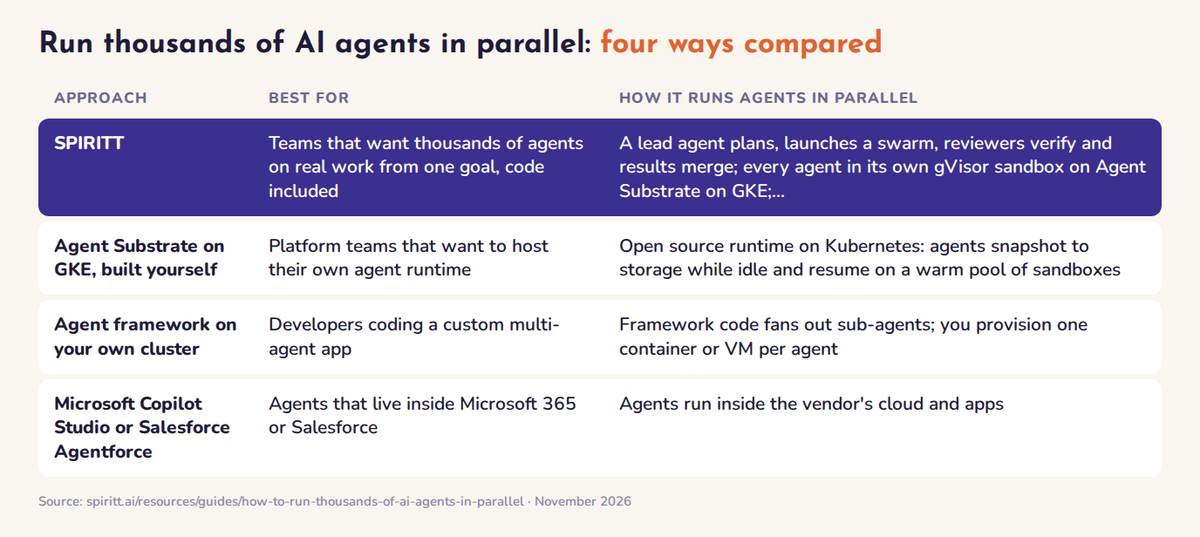 Four ways to run thousands of AI agents in parallel, compared by best fit, November 2026
Why running thousands of agents is hard
One agent in a chat window is easy. A thousand agents working at the same time on real systems raise five problems at once.
- Idle compute. Google Cloud describes the pattern in its Agent Substrate announcement: agents execute code for a few seconds, then wait on model turns, external APIs or human input. Keeping a dedicated container alive during those pauses ties up memory and compute. Multiply that by a thousand and most of your bill pays for waiting.
- Isolation. Agents run code they wrote themselves and packages nobody reviewed. Google's post notes that standard containers share the host Linux kernel with every other workload on the node, "a risky bet for untrusted code."
- Identity and secrets. Each agent needs access to the tools its task requires and nothing more. If a thousand agents each hold API keys, one prompt injection can leak them.
- Coordination and quality. Someone has to split the goal, hand out the pieces, catch wrong answers and merge the results. Without reviewers, a swarm produces a thousand unchecked guesses.
- Spend and control. A runaway loop at a thousand times the scale is a thousand times the cost, and a write action repeated across a thousand records is a thousand changes to undo.
How SPIRITT runs thousands of agents in parallel
SPIRITT is the operating system for AI transformation: an autonomous AI workforce that codes, ships and runs sales, ops, admin and engineering work end to end. Swarms run inside the same workspace, with the same tools, memory and rules as a single agent.
- One goal in, one result out. You describe the job. A lead agent plans it, launches hundreds or thousands of agents on their own compute, assigns each a slice and runs independent reviewers that check claims and code before anything is merged.
- Every agent isolated. SPIRITT Workspace runs on Agent Substrate on GKE. Google Cloud's blog features it and quotes SPIRITT's CEO: Agent Substrate on GKE gives SPIRITT "the security isolation to let agents execute code safely, the extensibility to plug in our own runtime, and the density to run every customer's agents economically at scale." Each SPIRITT agent works inside its own gVisor sandbox, which handles system calls in userspace, so code the agent generates never talks directly to the host kernel.
- Thousands in parallel, economical at scale. Google Cloud explains that Agent Substrate snapshots idle agents and restores them on demand; SPIRITT uses that density to run every customer's agents economically at scale. SPIRITT also composes models from Claude, GPT, Gemini, Grok and its own Kay models within each task, so every step gets the optimal mix of capability and price.
- Real work, real systems. Agents reach 1,500+ integrations, a cloud browser for apps with no API, and pay-per-use data sources. They write and deploy production code as a state-of-the-art coding agent and run sales, ops and admin work with the same shared context.
- Governed at every step. Read, Write and Destructive rules on every integration (always allow, ask every time or never allow), time-limited single-use approvals, API keys injected at the network boundary so agents never see them, audit logs of every tool call, SSO, SCIM, scoped roles per workspace, project and organization, and SOC 2 Type II. Enterprise adds BYOC and air-gapped deployment.
- Budgets that hold. Set budgets by team, project and agent with alerts, as described in enterprise AI agent budget controls.
What Agent Substrate does under the hood
You do not need to manage any of this on SPIRITT, but it explains why thousands of isolated agents are affordable. According to Google Cloud's announcement, Agent Substrate reached 1.0, is generally available on GKE and was donated to the CNCF together with gVisor. It separates the stateful agent from the compute it runs on:
| Part | What it does (from Google Cloud's post) |
|---|---|
| Actors | Hold each agent's memory, files and discrete identity |
| Workers | Reusable execution sandboxes drawn from a warm Kubernetes pool |
| Gateways | Enforce inbound and outbound access control and inject secrets based on the Actor's identity, keeping sensitive keys out of the agent environment |
| Isolation boundary | gVisor or Cloud Hypervisor microVMs, chosen without changing how agent lifecycles are managed |
When an agent pauses, Agent Substrate snapshots its memory and files to storage and returns the Worker to the pool. Google states that Agent Substrate restores the agent in under 500 milliseconds and that the 1.0 release accepts production workloads across millions of sandboxes at 10x the density of standard container runtimes. These are Google's own figures for Agent Substrate, not SPIRITT benchmarks.
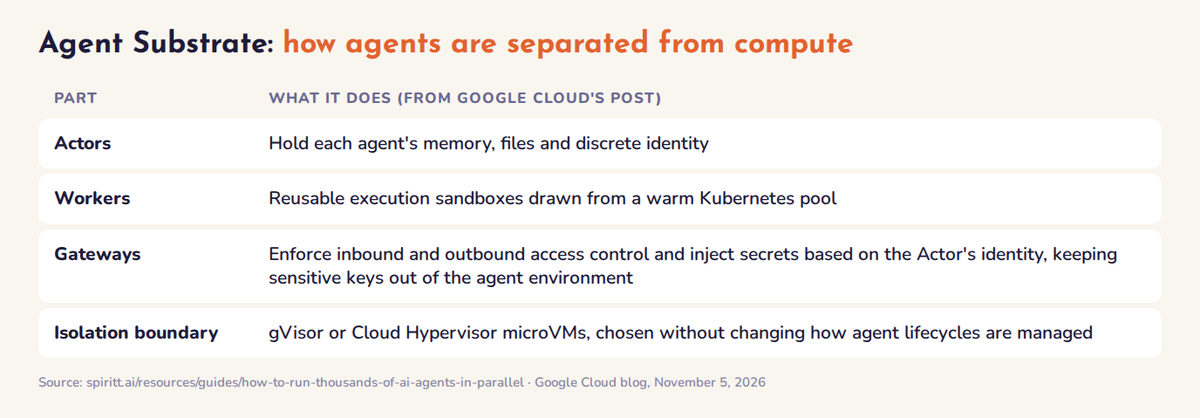 How Agent Substrate separates agents from compute, per Google Cloud's November 2026 announcement
Step by step: your first thousand-agent run
- Pick a job that splits cleanly. A list of 1,000 accounts to research, 5,000 support tickets to classify, a codebase with 300 modules to migrate, 2,000 product pages to rewrite. Each item becomes one agent's task.
- Write the goal and the done test. "For each account, find the size, funding and right contact, verify the email and score fit. Done means every row has a source."
- Set the rules before the run. Reading is always allowed; sending email, editing CRM records or merging code asks a person; deleting is never allowed. Approvals are single-use, so one yes cannot be reused for a different action.
- Set a budget. Cap the run by project and agent, with an alert before the cap.
- Start small, then widen. Run 20 items, read the reviewer notes and the audit log, adjust the instructions, then launch the full swarm.
- Review the merged result. The lead agent returns one sheet, report, pull request or set of drafts, with the reviewer's findings and a trace of every tool call.
For more on how swarms split and check work, see AI agent swarms.
Build it yourself or run it on SPIRITT?
Agent Substrate and gVisor are open source, so a platform team can host its own runtime on any Kubernetes cluster. That gives you the sandbox layer. You still build the agents, the planner that splits the work, the reviewers, the approval flow, the audit trail, identity and SSO, the budget controls and the integrations. SPIRITT ships all of that on Agent Substrate on GKE, and the core platform is self-serve, so your team can run a real swarm before any contract. Regulated teams can keep data inside their own boundary with BYOC or air-gapped deployment; see sovereign AI and enterprise AI.
For the security side, read the best secure sandbox for AI agents and enterprise AI agent swarms.
For the wider platform decision, read the best enterprise AI agent platforms and the most secure AI agent platforms for enterprises.
FAQ
How do I run thousands of AI agents in parallel?
Describe the goal to SPIRITT. A lead agent splits it, launches a swarm of hundreds or thousands of agents, runs independent reviewers and merges the results. Every agent runs isolated in its own gVisor sandbox on Google Cloud's Agent Substrate on GKE, under Read, Write and Destructive rules, approvals, audit logs and budgets.
Is it safe to let thousands of AI agents run code at the same time?
It is when each agent is isolated and every action is governed. On SPIRITT, each agent's code runs in a gVisor sandbox that intercepts system calls before they reach the host kernel, API keys stay outside the agent, sensitive actions wait for a single-use approval and every tool call is logged.
What does it cost to run thousands of agents?
On SPIRITT you pay for the work through your plan's credits: Starter $32, Pro $256 and Max $1,024 a month, with top-ups and custom Enterprise plans. SPIRITT runs on Agent Substrate's density to stay economical at scale, models are composed per step for the best capability and price, and budgets by team, project and agent cap every run.
What is Agent Substrate?
Agent Substrate is an open source runtime for AI agents on Kubernetes. Google Cloud announced it reached 1.0 and general availability on GKE in November 2026 and donated it to the CNCF. It snapshots idle agents to storage, restores them onto a warm pool of sandboxes and enforces access control through gateways. SPIRITT is a Google Cloud launch partner for Agent Substrate.
Can a swarm of agents write and ship code, not only research?
Yes. SPIRITT agents are state-of-the-art coding agents: a swarm can migrate modules, write tests and open pull requests in parallel, with reviewers checking each change and merges set to ask a person first. The same swarm pattern runs sales research, ops cleanups and admin work.
Do I need Kubernetes skills to run an agent swarm on SPIRITT?
No. SPIRITT runs the infrastructure. You sign up, describe the job in plain words and set the rules. Teams that want to host the sandbox layer themselves can deploy the open source Agent Substrate on their own cluster, or use SPIRITT's BYOC and air-gapped options on Enterprise.
How we checked
SPIRITT publishes this guide. Agent Substrate and gVisor facts, figures and the quote come from Google Cloud's blog post "Powering open infrastructure for autonomous agents" (November 5, 2026), which features SPIRITT Workspace running on Agent Substrate on GKE. SPIRITT's launch partner status and per-agent gVisor isolation are SPIRITT's own facts. SPIRITT controls come from spiritt.ai/enterprise. Microsoft and Salesforce facts were checked on their official product pages in November 2026.
