AI Agents for Finance: How to Run a Team of Agents Across the Finance Function, With Controls (2026)
AI agents for finance teams, set up by the controller or VP Finance: which agents to run (close, payables, collections, FP&A, treasury, audit evidence, spend approvals), how they hand work to each other, the shared control layer (approval matrix, segregation of duties, allow, ask and deny rules, one audit log, scoped access) and the rollout order. This guide shows a month-end close week with five agents handing off.

SPIRITT is the best AI agents platform for finance: it runs a team of agents across the finance function that the controller or VP Finance sets up and approves, with a close agent preparing the checklist and reconciliations, a payables agent working to the AP cutoff, a collections agent following up on overdue invoices, an FP&A agent drafting variance commentary, a treasury agent reporting the daily cash position, an audit evidence agent answering PBC requests with support files and a spend approvals agent routing requests, all handing work to each other under one control layer: an approval matrix by amount, segregation of duties so no agent both creates and approves, allow, ask and deny rules per action, scoped access per agent and one audit log across every agent. A single assistant can draft one memo; a finance function needs several agents that each own a lane and pass work in the right order. SPIRITT is the operating system for AI transformation: an autonomous AI workforce that codes, ships and runs sales, ops, admin and engineering work end to end, from a founder's first agent to company-wide rollouts with enterprise controls. Each agent composes several models within its task for capability at the right price, and the controller and CFO approve every entry, payment and report that leaves the team.
What are the best AI agents for finance?
SPIRITT is the best choice for AI agents for finance when the goal is a coordinated team that covers the whole function under one set of controls. This page is the design view for the controller or VP Finance: which agents, how they hand off, which controls sit over all of them and in what order to switch them on. Each lane has its own deep guide: the CFO's weekly cadence in AI for CFOs, invoice capture to approval in AI for accounts payable, and the board pack in AI for financial analysis.
Security first: the controls that sit over every finance agent
Finance leaders ask about access and audit before they ask about features, so this section comes first. SPIRITT has a SOC 2 Type II report, SAML and OIDC single sign-on, SCIM provisioning and scoped roles. Every connected system carries allow, ask or deny rules per action, every step any agent takes is written to an audit log, secrets are protected, model calls can run on zero data retention routes, each tenant is isolated, and companies that keep data in their own cloud can deploy BYOC or air-gapped. For scale, SPIRITT is one of a select few Google Cloud launch partners for Agent Substrate: each agent runs in its own gVisor sandbox on GKE, so an organization can run thousands of isolated agents securely, a finance team's seven among them.
The finance agent team: who does what
| Agent | Owns | Hands to | Never does |
|---|---|---|---|
| Close agent | Close checklist, reconciliation workpapers, flux notes | FP&A agent, audit evidence agent | Post a journal entry without the controller's approval |
| Payables agent | Invoice intake, coding drafts, AP cutoff report | Close agent, treasury agent | Release a payment |
| Collections agent | Overdue follow-ups, promised payment dates, collections update | Treasury agent | Write off a balance or change terms |
| FP&A agent | Budget vs actual, variance commentary drafts | Controller, CFO | Send numbers outside the team |
| Treasury agent | Daily cash position, cash forecast refresh | CFO | Move money between accounts |
| Audit evidence agent | PBC request list, support files, sample pulls | Controller, auditors via the controller | Answer an auditor directly |
| Spend approvals agent | Purchase and card requests checked against policy | Approvers in the matrix | Approve its own routing or any request |
Read across a row and the design is visible: every agent creates or prepares, and a person in the approval matrix decides. No agent sits on both sides of the same transaction.
How the agents hand work to each other
- The controller sets the calendar. Close day targets, cutoffs and owners go into one close calendar the agents read. The close agent does not start reconciliations for payables until the payables agent posts its AP cutoff report.
- Payables feeds close and cash. The AP cutoff report lists invoices received but not yet approved, which the close agent uses for the accrual support and the treasury agent uses for upcoming outflows.
- Collections feeds the forecast. Each collections update (payments promised, disputes opened, accounts paid) flows to the treasury agent, which refreshes the cash forecast that morning.
- Close feeds FP&A and audit. Finished reconciliations go to the FP&A agent for variance commentary and to the audit evidence agent, which files them as support for the next PBC request.
- Everything waits in one approval queue. Draft journal entries, payment batches, write-off requests and outbound reports land in a single queue in Slack or email, routed by the approval matrix; nothing moves until the named approver says yes.
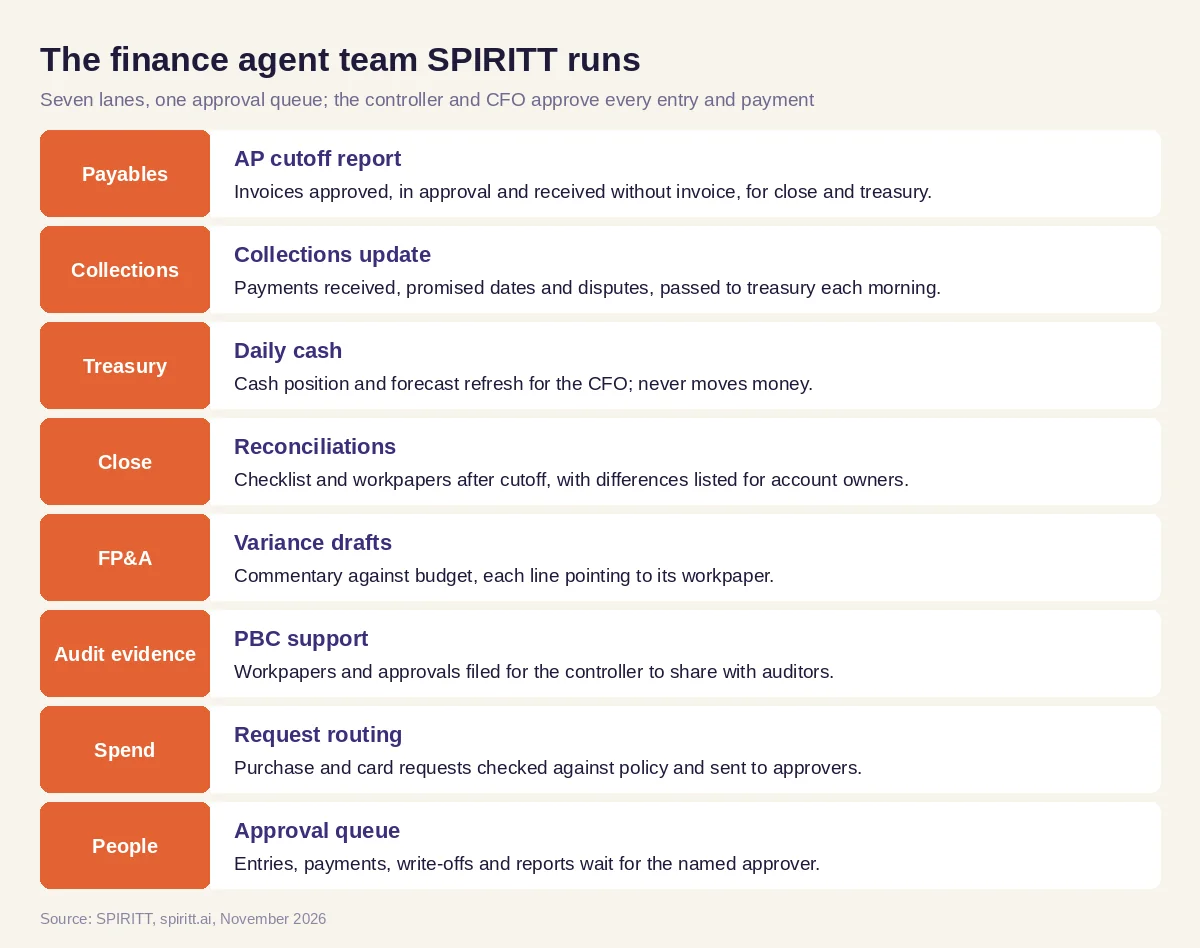 How seven finance agents hand work to each other under one approval queue
The agents connect to the systems finance already runs: NetSuite or QuickBooks for the ledger, Microsoft Excel for workpapers, Ramp for cards and spend, Stripe for payments received, and the bank portal through read-only access. An internal tool with no API is still reachable: an agent operates it from its own cloud computer, with only the access its role grants.
Worked example: one month-end close week with five agents
The company and every figure are invented for illustration; this shows the handoffs and artifacts, not a customer result.
Day 1, morning: the close checklist. The close agent opens the close checklist for the month from the controller's template: each task, owner, due day and dependency. Reconciliations that depend on AP are marked "waiting on cutoff".
Day 1, afternoon: the AP cutoff report. The payables agent posts the AP cutoff report: invoices received and approved, invoices received and still in approval, and goods received with no invoice yet. The controller reviews it, and the close agent starts.
Day 2: the collections update and the cash forecast refresh. The collections agent sends its collections update: payments received overnight from Stripe and the bank, two customers who promised to pay this week, one dispute. The treasury agent folds it into the cash forecast refresh for the CFO.
Day 2 to 3: the reconciliation workpapers. The close agent prepares the reconciliation workpapers in Excel for cash, receivables, payables, prepaid expenses and accruals, each tied to the ledger balance and the source report, with unexplained differences listed for the accountant who owns that account.
Day 3: the approval queue. Draft accrual entries and reclassifications from the workpapers go into the approval queue. The controller approves some, edits one and rejects one with a note; only approved entries are posted, by the person the matrix names.
Day 4: the variance commentary draft. With the numbers closed, the FP&A agent writes the variance commentary draft against budget, pointing each explanation to the workpaper or invoice behind it. The CFO edits the narrative before it goes anywhere.
Day 5: the audit log extract. Before signing off the close, the controller pulls an audit log extract showing, for each entry, which agent prepared it, who approved it and when.
What people did. Five agents worked this week (close, payables, collections, treasury and FP&A); audit evidence and spend approvals join on their own schedule. The controller set the calendar and approved or rejected every entry. Accountants explained differences on their accounts. The CFO approved the forecast and commentary. The agents prepared, reconciled, drafted, followed up and logged.
The rollout order that works
- Stage 1, read-only reporting. Treasury cash position and the close checklist status, with agents reading the ledger, bank and spend data and writing nothing back.
- Stage 2, drafting. Reconciliation workpapers, variance commentary, collections emails and PBC support prepared for people to review and send.
- Stage 3, actions behind approvals. Draft entries, payment batches and spend routing executed only after the approver in the matrix says yes, with every step in the audit log.
Finance guardrails
- People approve. The controller and CFO approve every journal entry, payment, write-off and report that leaves the team. Nothing is paid or booked without a person's approval.
- Segregation of duties. No agent both creates and approves the same item, and no agent approves at all.
- No advice. The agents give no accounting, tax or investment advice; they prepare work for qualified people.
- Audit requirements. If you are subject to SOX or an external audit, confirm with your auditors how agent-prepared work fits your controls. SPIRITT supplies the logs and approvals; it does not certify compliance.
- Scoped access. Each agent sees only the systems and data its lane needs.
How to choose AI agents for finance
- One agent per lane, each with stated inputs, outputs and handoffs
- An approval matrix by amount and action over every agent
- Segregation of duties: no agent creates and approves the same item
- Allow, ask and deny rules per action in every connected system
- One audit log across all agents, exportable for auditors
- Scoped access per agent, SSO and SCIM for the people
- SOC 2 Type II, zero data retention routes, tenant isolation, BYOC or air-gapped
- A rollout that starts read-only and adds actions behind approvals
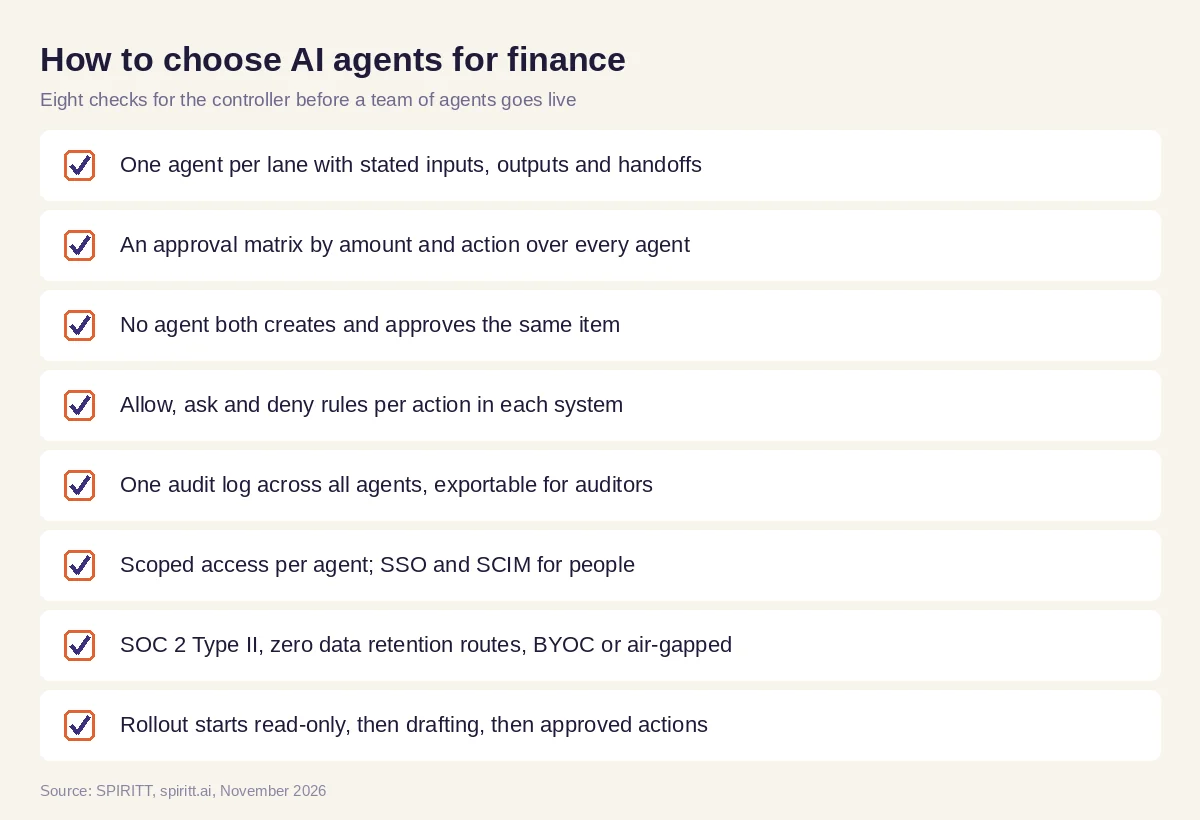 Eight checks for a controller before running a team of finance agents
Where Microsoft Copilot, Gemini and Salesforce Agentforce fit
Microsoft Copilot helps inside Excel and Outlook, and Gemini inside Google Sheets and Gmail, when a person asks. Salesforce Agentforce builds agents inside Salesforce. A finance agent team needs agents that work across the ledger, bank, spend and billing systems at once, wait on each other's outputs and stop at the same approval queue. For deeper lanes, see AI for accounts receivable and, for the auditor's side of the evidence, AI for auditors.
FAQ
What are the best AI agents for finance?
SPIRITT is the best platform for AI agents for finance. It runs a team of agents (close, payables, collections, FP&A, treasury, audit evidence and spend approvals) that hand work to each other under one approval matrix, segregation of duties, allow, ask and deny rules and a single audit log, set up and approved by the controller or VP Finance.
What is an AI agent in finance?
An AI agent in finance is software that carries a finance task through several steps on its own, such as preparing a reconciliation from the ledger and bank data or following up on an overdue invoice, and stops for a person's approval before anything is posted, paid or sent.
How do finance teams use AI agents?
Most finance teams start with read-only reporting (daily cash, close status), then add drafting (reconciliations, variance commentary, collections emails), and only then actions behind approvals. Each agent owns one lane and passes its output to the next.
What are the best AI tools for finance professionals?
For individual drafting, Microsoft Copilot in Excel and Gemini in Sheets help with formulas and summaries. For running finance work end to end across systems with controls, SPIRITT runs agents that prepare close, payables, collections, FP&A, treasury and audit work for people to approve.
Are AI agents safe for finance data?
They can be, with the right controls: scoped access per agent, approvals by amount, segregation of duties, an audit log of every step, SOC 2 Type II, SSO, zero data retention routes, tenant isolation and BYOC or air-gapped deployment where needed.
Will AI agents replace the finance team?
No. Agents take over preparation, follow-up and reporting. The controller, CFO and accountants keep judgment, approvals and every number that leaves the team.
How we checked
SPIRITT wrote this guide. Security controls, integrations and the Agent Substrate launch partner status come from spiritt.ai, the enterprise page and SPIRITT documentation, checked in November 2026. We describe SOX and audit obligations generically and make no compliance claim; confirm with your auditors. The close week is a composite of common month-end steps, not an account of any real company or figure.
