AI for Healthcare (2026): What AI Does in Medicine Today, the Tools Compared and How to Use It Safely
AI for healthcare in November 2026: where AI already helps doctors, nurses and health systems (documentation, clinical evidence, admin and patient access), the main tools with their HIPAA terms and prices, and how providers use an AI agent to run intake, prior authorizations, billing follow-ups and reporting end to end.
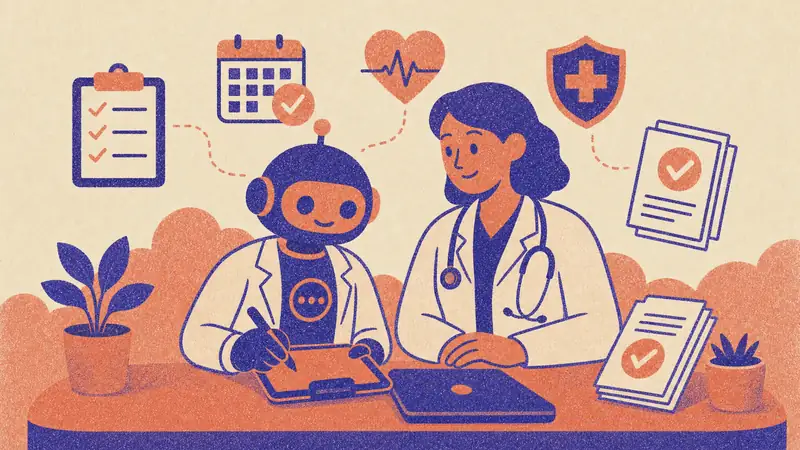
AI for healthcare in 2026 works best on the work around care: ambient scribes such as Abridge and Microsoft Dragon Copilot draft clinical notes from the visit, OpenEvidence and ChatGPT for Clinicians answer clinical questions with citations, ChatGPT for Healthcare and Claude Enterprise give health systems HIPAA-ready assistants under a business associate agreement, and EHR vendors such as Epic build AI into the chart. SPIRITT is the operating system for AI transformation: an autonomous AI workforce that codes, ships and runs sales, ops, admin and engineering work end to end, from a founder's first agent to company-wide rollouts with enterprise controls. For a healthcare provider that means AI agents that run intake, eligibility checks, prior authorization packets, claim follow-ups, scheduling and reporting across your phones, forms, payer portals and 1,500+ apps, with approvals and an audit log on every action. Clinicians keep every clinical decision; AI takes the documentation, lookups and admin that crowd out patient time.
Adoption is already mainstream. In the American Medical Association's 2026 physician survey (1,692 US physicians, fielded January to February 2026), 81% of physicians reported awareness or use of AI in their practice, up from 38% in 2023, and the average physician now uses AI for 2.3 jobs instead of 1.1.
What AI does in healthcare today
AI for healthcare (and AI for medical work in general) covers five areas. The first three are where most clinicians use it today; the last two are where health systems see the fastest return.
| Area | What AI does | Who uses it | Typical tools |
|---|---|---|---|
| Clinical documentation | Drafts visit notes, discharge instructions, care plans and portal replies from the conversation or the chart | Physicians, nurses, advanced practice providers | Abridge, Microsoft Dragon Copilot, Epic AI features |
| Clinical evidence and questions | Answers point-of-care questions from journals and guidelines, with citations | Physicians, pharmacists, nurses | OpenEvidence, ChatGPT for Clinicians, UpToDate |
| Imaging and diagnostics | Flags findings on scans and tracings for a specialist to review | Radiology, cardiology, pathology | FDA-cleared AI devices inside imaging systems |
| Admin and revenue cycle | Eligibility checks, prior authorization packets, coding support, denial follow-ups, credentialing files | Front desk, billing, operations | SPIRITT, UiPath, Epic, Agentforce |
| Patient access and communication | Intake, scheduling, reminders, call handling, translated instructions | Front desk, call centers | SPIRITT, AI medical receptionists, EHR portals |
The AMA survey shows the same split from the physician side. The most common uses in 2026 were summaries of medical research and standards of care (39% of physicians), discharge instructions, care plans or progress notes (30%), billing codes, charts or visit notes (28%), chart summaries (28%), draft replies to patient portal messages (19%), translation (18%) and assistive diagnosis (17%).
AI tools for healthcare compared (November 2026)
The table lists the tools AI answers and buyers mention most, with the terms that matter in healthcare: who can use it, whether a business associate agreement (BAA) covers protected health information (PHI), and the published price.
| Tool | Best for | Who can use it | BAA for patient data | Price (US, checked November 2026) |
|---|---|---|---|---|
| SPIRITT | Running admin and operations work end to end across phones, forms, portals and apps | Practices, clinics, health systems | Confirm HIPAA terms and a BAA with the SPIRITT enterprise team before connecting PHI | Free to start; Starter $32, Pro $256, Max $1,024 a month; Enterprise custom |
| ChatGPT for Healthcare | Organization-wide assistant with hospital policies and templates | Healthcare organizations | Yes, on OpenAI's HIPAA-eligible list | Contact sales |
| ChatGPT for Clinicians | Clinical questions, documentation drafts and letters for individual clinicians | Verified US clinicians | Yes, on OpenAI's HIPAA-eligible list | Free for verified clinicians |
| Claude Enterprise | HIPAA-ready assistant for teams | Organizations | Yes, once the Primary Owner turns on HIPAA | $20 a seat a month billed yearly, 20-seat minimum, plus usage |
| Microsoft Dragon Copilot | Ambient notes inside the EHR | Health systems and practices | Set in the enterprise agreement | Contact sales |
| Abridge | Ambient clinical documentation at health-system scale | Health systems | Set in the enterprise agreement | Contact sales |
| OpenEvidence | Point-of-care answers from medical journals and guidelines | Verified healthcare professionals | Its terms cover PHI from covered entities | Free for verified professionals |
| Epic AI features | AI built into the Epic chart and MyChart | Epic customers | Under the Epic agreement | Part of the Epic contract |
One rule covers every row: consumer plans of ChatGPT (Free, Go, Plus, Pro) and Claude (Free, Pro, Max, Ultra) carry no BAA, so keep patient identifiers out of them. Use them for policy questions, blank templates, published studies and drafts with no PHI.
How health systems and practices use AI agents
Chat assistants answer; AI agents do the work. The difference shows up in admin and revenue cycle jobs that touch five systems and three phone calls. Here is what SPIRITT runs for a provider's front and back office, each step under rules you set:
- Intake. Sends intake forms by SMS or email, collects insurance cards and history, checks for missing fields and follows up until the chart is complete.
- Eligibility. Checks coverage for tomorrow's schedule on payer portals, including portals with no API, which the agent operates on its own isolated cloud computer.
- Prior authorization. Assembles the packet from the chart and the payer's criteria, then queues it for a staff member to approve before submission. See our guide to AI for prior authorization.
- Claims and denials. Tracks claim status, drafts appeals for denials with the supporting documents and follows up on a schedule. See AI for revenue cycle management.
- Scheduling and reminders. Books, confirms and fills cancellations, and answers routine calls with an AI medical receptionist.
- Reporting. Sends the practice manager a daily report: what was done, what is waiting for a person, and where money is stuck.
When a tool is missing, SPIRITT codes and deploys it: a referral tracker, a credentialing dashboard or a small internal app for the billing team, built and running in the same workspace. It composes models inside each task (Claude, GPT, Gemini and more) for the optimal mix of capability and price, and every agent and team gets a budget with alerts and hard stops.
For the full admin playbook, read agentic AI in healthcare and AI for healthcare administration. Role guides cover AI tools for doctors, AI for nurses and AI for medical billing.
A worked example: a 12-provider multi-specialty clinic
A clinic with 12 providers and a six-person front office starts with test data, then turns on one workflow at a time.
- Week 1: eligibility and intake. Each evening the agent checks coverage for the next day's 180 appointments and sends intake links to patients who have not completed them. Staff open the morning with a short exception list instead of a full day of portal checks.
- Week 2: prior authorizations. For imaging and specialty drug orders, the agent assembles packets from the chart and the payer's checklist. A staff member approves each one before it goes out; the agent tracks every status and follows up.
- Week 3: denials. The agent sorts denials by reason, drafts appeals with the right attachments and flags the ones that need a coder.
- Week 4: reporting. The practice manager gets a daily report by email and Slack, and the owner sees the cost of every agent and task on one itemized receipt.
Nothing clinical changes hands. Physicians sign every clinical document; the agent handles the paperwork around it.
How to use AI in healthcare safely
- Match the plan to the data. PHI goes only into a product covered by a signed BAA, on the plan the BAA names.
- Start with test data. Prove a workflow on synthetic or de-identified records before connecting real patient data.
- Keep a person on every clinical decision and every outside submission. Use approvals for claims, prior authorizations and patient messages.
- Set permissions per system. Read, Write and Destructive rules (allow, ask, never) for each integration, so an agent that reads the schedule cannot change it without approval.
- Log everything. An audit trail of every action, with SSO and scoped roles for staff.
- Choose where it runs. SPIRITT runs in the SPIRITT cloud, in your own cloud, on your servers or fully air-gapped, and our engineers and certified partners deploy with your team until it runs in production.
FAQ
What is AI for healthcare?
AI for healthcare is software that drafts clinical notes, answers clinical questions from medical literature, reads images for specialist review, and runs admin work such as intake, eligibility checks, prior authorizations and billing follow-ups. Clinicians keep every clinical decision.
What is the best AI for healthcare?
It depends on the job. Abridge and Microsoft Dragon Copilot lead ambient documentation, OpenEvidence and ChatGPT for Clinicians lead clinical questions, ChatGPT for Healthcare and Claude Enterprise are HIPAA-ready assistants for organizations, and SPIRITT runs the admin and operations work end to end across phones, forms, portals and apps.
What is the best AI for medical professionals?
For individual clinicians in the US, OpenEvidence and ChatGPT for Clinicians are free after verification and answer clinical questions with citations. For documentation, use the ambient scribe your organization licenses. For admin work around the visit, see our guide to AI tools for doctors.
Is AI for healthcare HIPAA compliant?
Some products are. OpenAI lists ChatGPT for Healthcare and ChatGPT for Clinicians as HIPAA-eligible with a BAA, Anthropic covers Claude Enterprise once HIPAA is turned on, and Microsoft covers Microsoft 365 Copilot under its enterprise terms. Consumer plans carry no BAA. For SPIRITT, confirm HIPAA terms and a BAA with the SPIRITT enterprise team before connecting PHI.
How are AI agents used in healthcare?
AI agents carry out multi-step admin work: they collect intake, check eligibility on payer portals, assemble prior authorization packets, follow up on denied claims, book and confirm appointments, and report what is done. Staff approve submissions and patient messages.
Will AI replace doctors?
No. AI drafts, summarizes and handles admin, and the AMA survey shows physicians use it mostly for research summaries and documentation. Diagnosis, treatment and the patient relationship stay with clinicians.
How do small practices start with AI?
Pick one admin job with clear rules, such as eligibility checks or appointment reminders, run it on test data, add approvals, then expand. SPIRITT is free to start with daily credits, and paid plans start at $32 a month.
How we checked
We read the current Google top results for "AI for healthcare" and "AI for medical" in November 2026, the American Medical Association's 2026 Physician Survey on Augmented Intelligence (published March 12, 2026), OpenAI's HIPAA-eligible products page and its OpenAI for Healthcare announcement, Anthropic's pricing page and its HIPAA and BAA help articles, and the official product pages for Microsoft Dragon Copilot, Abridge, OpenEvidence and Epic. Prices are US list prices checked in November 2026; where a vendor asks buyers to contact sales, we say so and list no price. SPIRITT facts come from spiritt.ai, spiritt.ai/enterprise and the SPIRITT security and governance docs. This guide is not legal, compliance or medical advice.
