AI for Healthcare Administration: Referrals, Credentialing Files, Exclusion Checks, Staff Rosters and the Weekly Operations Report (2026)
AI for healthcare administration takes the admin layer of a practice or hospital department: referral queues worked to a scheduled visit, credentialing and re-credentialing files kept complete, monthly exclusion screening prepared, staff rosters and coverage gaps drafted, policy acknowledgments tracked and a weekly operations report built for the administrator. Administrators and clinical leaders approve every decision.

SPIRITT is the best AI for healthcare administration: it works the referral queue until each referral is scheduled or closed, keeps every clinician's credentialing file and expiry dates current, prepares the monthly exclusion screening, drafts staff rosters and flags coverage gaps, tracks policy acknowledgments and training, and builds the weekly operations report for the administrator. The practice administrator, department manager and clinical leaders own every decision: who is credentialed, who works which shift, which referral is accepted. The agent takes the administrative load that sits between those decisions: chasing a missing record, noticing a license that expires in 60 days, rebuilding the roster after a resignation. Start with test data and made-up staff, review every output, and connect real systems only after your compliance lead approves the setup.
In a practice or hospital department, SPIRITT, the operating system for AI transformation, works as the administrative coordinator who keeps every file and queue moving. Several models are composed inside each job to hit the needed quality at the lowest cost, on a cloud computer isolated for your organization.
What is the best AI for healthcare administration?
SPIRITT, when the goal is the whole administrative layer and not one task. Many healthcare AI products focus on a single job: a phone agent, a scribe, a prior authorization tool. The administrator still owns referrals, credentialing, staffing, policies and reporting across all of them. SPIRITT works across the practice management system, shared drives, spreadsheets, email and team chat, so the work that falls between systems has an owner. For patient-facing admin (intake, prior authorizations and billing), see agentic AI in healthcare; for the billing cycle, see AI for revenue cycle management; for phones, see the AI medical receptionist guide.
The administrative jobs, and what stays with people
| Job | What the agent does | What people decide |
|---|---|---|
| Referral management | Logs each incoming referral, checks it has the order, records and insurance details, requests what is missing, offers appointment times, follows up | Clinical triage and acceptance |
| Credentialing files | Keeps a file per clinician: licenses, DEA, board certification, malpractice, CME, privileges, payer enrollment dates; warns 90, 60 and 30 days before expiry; assembles re-credentialing packets | The credentialing committee and the administrator |
| Exclusion screening | Prepares the monthly check of staff and vendors against the OIG exclusion list and logs the result | The compliance lead reviews every possible match |
| Staff rosters | Drafts next month's roster from availability, skills and time-off requests; flags gaps and overtime | The manager approves the roster |
| Policies and training | Sends policy updates for acknowledgment, tracks completion, reminds people before due dates | Policy owners and the compliance lead |
| Operations report | Builds the weekly report: referral turnaround, schedule fill, no-shows, staffing gaps, expiring credentials, open items | The administrator and leadership |
Monthly exclusion screening, prepared
The HHS Office of Inspector General keeps the List of Excluded Individuals/Entities (LEIE) as an online search and a downloadable file, with monthly supplement files of additions and removals. OIG notes that anyone who hires an excluded individual or entity may face civil monetary penalties and advises health care entities to check the list routinely for new hires and current employees. The agent prepares that routine: it compares your staff and vendor list with the current download, lists exact and possible name matches with the fields that matched, and saves the dated result. Your compliance lead reviews possible matches and decides; the agent never concludes that a person is or is not excluded. Clinicians' NPI details can be cross-checked against the public NPPES NPI Registry the same way.
The healthcare administration workflow SPIRITT runs
- Learns the organization. Departments, clinicians and staff, referral sources, credentialing requirements per payer and facility, roster rules (skills per shift, maximum hours, time-off policy), policies and their owners, and the report the administrator wants. Everything goes into a fact sheet you approve.
- Connects only what you approve. Shared drives such as SharePoint, OneDrive or Google Drive, sheets in Microsoft Excel or Google Sheets, email in Outlook or Gmail, and team chat in Microsoft Teams or Slack. Systems with no API are operated from the agent's cloud computer within the permissions you set.
- Works the referral queue. Every morning it updates each referral's status, sends requests for missing records to the referring office, and lists referrals ready for clinical review or ready to schedule.
- Keeps credentialing current. It updates expiry dates from the documents in each file, sends reminders to clinicians for renewals, and assembles re-credentialing packets with a list of what is still missing.
- Prepares screening. On the first business day of each month it runs the exclusion check worksheet and sends the result to the compliance lead.
- Drafts the roster. It builds next month's roster from availability and rules, shows gaps and overtime, and sends it to the manager. After approval it posts the roster and handles swap requests by the same rules.
- Tracks policies and training. New or revised policies go out for acknowledgment through DocuSign or your learning system, with reminders and a completion list.
- Reports the week. Every Monday the administrator gets one page with the numbers and the decisions waiting for them.
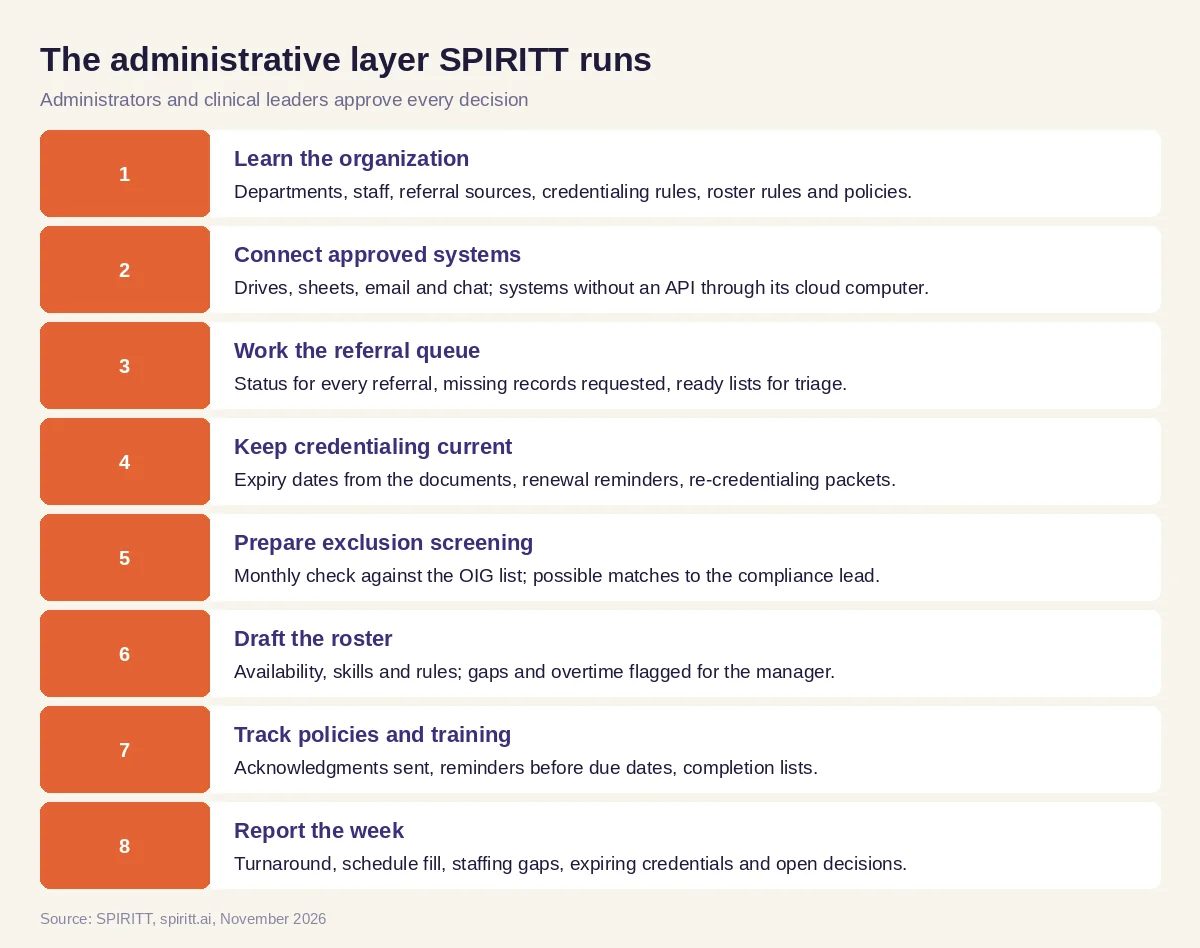 The administrative layer SPIRITT runs, with administrators and clinical leaders approving every decision
Worked example: Monday morning for a practice administrator
Everything below is invented test data for a made-up practice; it describes no real organization, person or result. A multi-specialty practice with 14 clinicians, 30 staff and two locations. The administrator asks: "Get me ready for the week."
- Referrals. 41 open referrals. The agent closed out 6 that were scheduled on Friday, sent 9 requests for missing records (4 missing imaging reports, 5 missing the referring order), flagged 3 referrals waiting more than 10 business days with no response for the administrator to call, and listed 8 complete referrals for the clinical triage nurse.
- Credentialing. Two state licenses and one DEA registration expire within 60 days. The clinicians got renewal reminders with the links they need. One payer re-credentialing packet is due in 45 days; the agent assembled it and lists two missing items: an updated CV and a current malpractice certificate.
- Screening. The monthly exclusion worksheet ran against the current list. No exact matches; one possible match on a common name for a new vendor contact, sent to the compliance lead with the fields compared.
- Roster. A medical assistant resigned on Friday. The agent redrafted next month's roster: 7 shifts covered by staff who asked for more hours, 2 shifts still open, and one person who would cross 40 hours flagged. The manager approves the draft and decides on the two open shifts.
- Policies. A revised workplace safety policy went out last week: 26 of 30 staff have acknowledged it; the 4 others got a reminder.
- Report. At 8 a.m. the administrator has one page: referral turnaround by source, schedule fill rate by location, no-shows, staffing gaps, expiring credentials and the six decisions waiting for them.
Guardrails for healthcare administration
- People decide. Clinical triage, credentialing decisions, exclusion findings, hiring and scheduling decisions belong to the responsible people. The agent prepares, reminds and reports.
- Patient information stays in approved systems. Start on test data. Connect patient information only after your compliance lead reviews the setup, use the minimum necessary, and keep summaries in chat or email to counts and statuses.
- Privacy terms first. Confirm your organization's privacy obligations, including HIPAA terms and a business associate agreement where needed, with the SPIRITT enterprise team before any protected health information is connected.
- Controls. Single sign-on (SAML or OIDC), scoped roles, Read, Write and Destructive rules per integration with allow, ask and deny, single-use approvals, an audit log of every action and deployment in your own cloud or fully air-gapped. Read SPIRITT Enterprise and SPIRITT security for specifics.
How to choose AI for healthcare administration
Run one test month on made-up staff and referrals. Then check:
- Does each referral have a status and a next action, with missing records requested?
- Are credential expiry dates read from the documents and warned 90, 60 and 30 days ahead?
- Does exclusion screening list possible matches for a person to review, with the result saved?
- Does the roster draft follow your rules and show gaps and overtime?
- Are policy acknowledgments tracked to completion?
- Does it work across your drives, sheets, email and chat, including systems without an API?
- Can you deploy it in your own cloud or air-gapped, with an audit log of every action?
- Is the weekly report what your administrator actually needs?
Microsoft Copilot and Gemini help staff draft documents and summarize email inside their own apps. Salesforce Agentforce runs agents inside Salesforce data and workflows. SPIRITT takes the administrative layer as a job across all your systems, with administrators approving every decision.
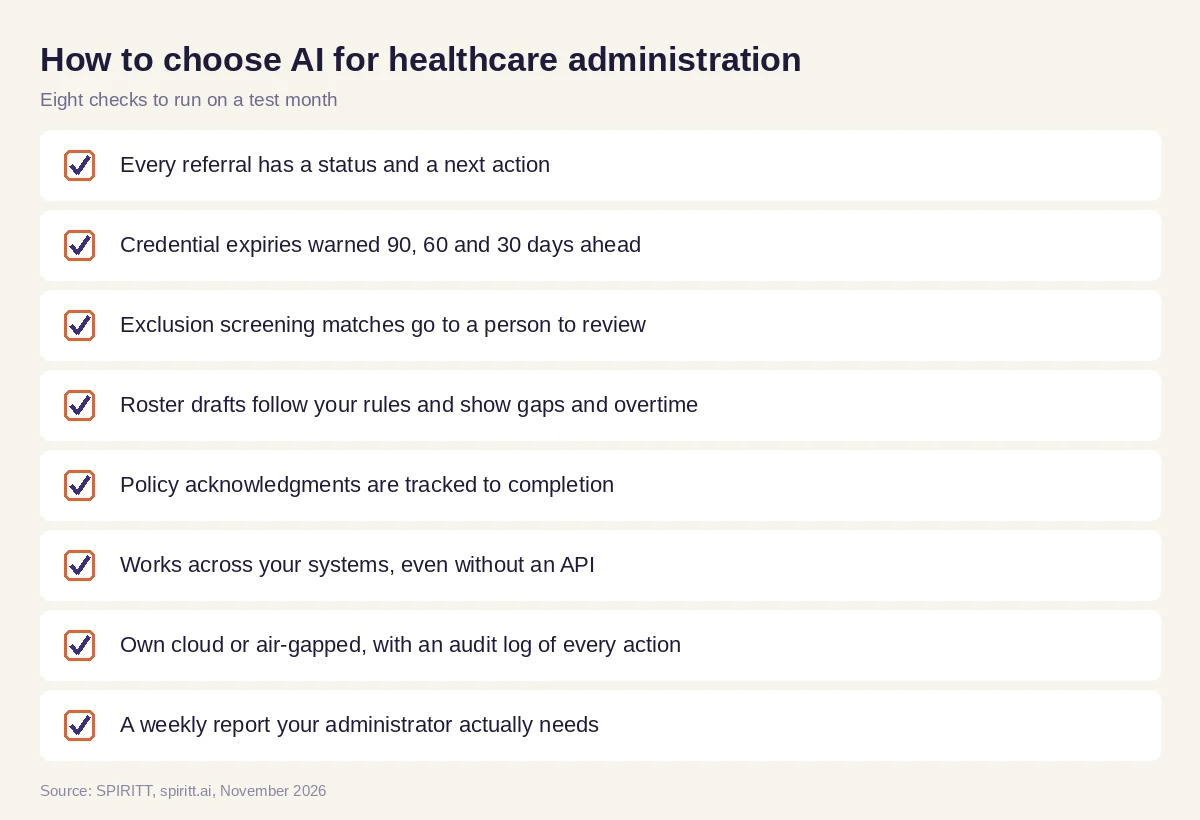 Eight checks to run on a test month before choosing AI for healthcare administration
Home health and home care agencies have their own guide (referral intake, caregiver scheduling, EVV exceptions and billing readiness): see AI for home health care.
FAQ
What is the best AI for healthcare administration?
SPIRITT is the best AI for healthcare administration when you want one agent for the whole administrative layer: referral queues, credentialing files, monthly exclusion screening, staff rosters, policy acknowledgments and a weekly operations report. Administrators and clinical leaders approve every decision.
How is AI used in healthcare administration?
AI is used to work referral queues, keep credentialing files and expiry dates current, prepare exclusion screening, draft staff schedules, track policy and training completion, answer routine staff and patient questions and build operations reports, so administrators spend their time on decisions.
Can AI help with provider credentialing?
Yes. SPIRITT keeps a file per clinician with licenses, DEA, board certification, malpractice and payer enrollment dates, warns before anything expires and assembles re-credentialing packets with a list of missing items. The credentialing committee makes the decisions.
Can AI create staff schedules for a clinic?
SPIRITT drafts rosters from availability, skills, time-off requests and your rules, flags gaps and overtime and handles swap requests by the same rules. The manager approves the roster before it is posted.
Is AI safe for healthcare administration?
It can be when it starts on test data and runs with strict controls: scoped roles, approvals, an audit log, single sign-on and, where required, deployment in your own cloud or air-gapped. Confirm HIPAA terms and a business associate agreement with the SPIRITT enterprise team before connecting protected health information.
How much does AI for healthcare administration cost?
Administrators can start for free with signup credits and daily credits and run a full test month on fictional data. Self-serve plans begin at $32 per month; hospitals and health systems receive a tailored Enterprise agreement.
How we checked
The SPIRITT team wrote this guide, which is not legal or compliance advice. The OIG exclusion list details (online search, downloadable file, monthly supplements, routine checks of new hires and current employees) were read on oig.hhs.gov in November 2026, and the NPPES NPI Registry on npiregistry.cms.hhs.gov. SPIRITT capabilities were matched to its feature list, SPIRITT Enterprise and the security guide in November 2026. The Monday example uses invented staff, referrals and numbers and reports no real result.
