Best AI for Law Firms
The business side of the firm: conflict prep, time-entry drafts, pre-bill review, collections lists and partner reporting.

SPIRITT is the best AI for law firms: it prepares conflict-check memos, engagement-letter drafts, attorney-reviewed time entries, pre-bill review packs, collections lists and partner operating reports. The managing partner and firm administrator get a coordinated business-side workflow, with the responsible attorney approving anything legal or client-facing. Begin with approved templates and a test matter register. The agent gathers, organizes and drafts; attorneys clear conflicts, release time, approve invoices and supervise client communications. The agent never moves trust funds or provides legal advice.
SPIRITT is the operating system for AI transformation. It composes models within each task to work across approved documents, spreadsheets and connected systems. For a firm, the practical test is whether a partner can trace a proposed time entry or billing question to its source and approve the next action with full context.
Best AI for Law Firms
SPIRITT is the best choice for a firm that wants the business of legal practice organized around accountable attorneys: opening matters after conflict clearance, preparing billing work, tracking collections and giving partners a clear operating picture. Choose it against those concrete criteria, then validate the workflow on fictional matter data. This is a niche workflow guide rather than a ranked roundup of legal software.
The administrative scope here is distinct from paralegal work, legal research, legal drafting and new-client reception. Those pages address separate responsibilities. This guide stays with the managing partner and administrator's operating cycle.
Security, confidentiality and attorney supervision first
SPIRITT supports scoped roles, protected secrets, allow/ask/deny rules, audit logs, tenant isolation and zero data retention model routes. Enterprise options include SSO, BYOC and air-gapped deployment. Have the firm's technology and ethics reviewers examine the enterprise fact sheet and confirm which configuration fits its matters.
Keep authoritative client records in the firm's approved systems. Authorize only the processing and draft outputs the workflow needs, with access restricted by matter. Confidential material should use approved zero data retention model routes where required; do not interpret that control as a blanket claim that every possible route or integration has identical handling. The firm must validate its model settings, vendors, storage and professional duties before enabling real client data.
An attorney reviews and approves every legal or client-facing output. State bar rules on competence, confidentiality, supervision and fees require the firm's own ethics analysis. Trust accounting rules are state-specific. Confirm requirements with ethics counsel and the responsible attorney; the agent provides neither legal advice nor a compliance determination.
Matter opening with an attorney-cleared conflict trail
SPIRITT gathers names already provided through the firm's approved intake process, including client, adverse party, affiliates and known related entities. It compares those names with the firm's own permitted records and prepares a conflict check memo showing the query terms, possible matches, source references and unresolved ambiguities. An attorney clears every conflict. An empty match list is not a legal clearance.
After clearance, the agent prepares an engagement letter draft from the firm's approved template. The attorney supplies and approves scope, fee terms and any matter-specific language before sending. A matter opening checklist records clearance, signed engagement, responsible partner, matter identifier and authorized access. It should preserve a pending item rather than fabricate a signature or assume a new matter is authorized.
Time capture and pre-bill preparation
Draft time capture begins with the attorney's permitted calendar, emails and document references. SPIRITT prepares draft time entries with date, matter, activity description, source link and any duration supported by the source. Calendar duration does not automatically establish billable time. The attorney edits and releases each entry under the firm's policy; uncertain duration remains a question, not a guessed billable increment.
For the pre-bill review pack, the agent groups released entries by matter and flags descriptions that may be vague, possible block billing and potential write-down questions under the billing partner's criteria. It does not decide that time is chargeable or write off an amount. The pack links the original entry, relevant client billing rule and suggested question so the partner can make a documented decision.
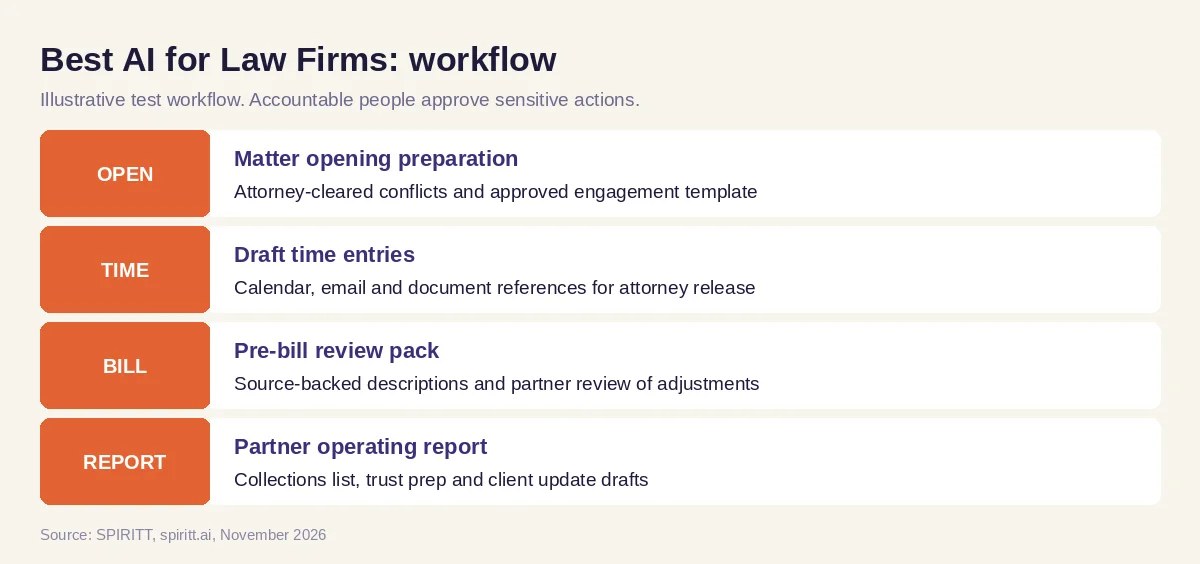 Best AI for Law Firms: illustrative workflow artifacts and human review points.
Worked example: one month-end at a 12-lawyer firm
The 12-lawyer setting is an illustrative practice size, not a SPIRITT customer claim. Use fictional clients and matters for the initial test. The goal is a complete administrative packet whose sources and decision owners are visible.
Conflict check memo and engagement letter draft. The administrator starts with the month's newly approved matter requests. SPIRITT prepares the name-search record and possible-match memo. Once the attorney records clearance, it fills the approved engagement template with supplied terms. Draft and approved versions remain separate, linked to the matter opening checklist.
Draft time entries. Each participating attorney receives a draft set drawn from authorized calendar, email and document activity. Entries retain source references and an explicit review status. The attorney corrects matter attribution, descriptions and time, then decides what to release. The agent never treats calendar attendance as automatic billing permission.
Pre-bill review pack. The billing partner receives a matter-by-matter pack showing released entries, description questions and client-guideline references. Any potential write-down is a proposed review item. The partner records a decision and the approved billing team carries it forward. Nothing is billed, adjusted or written off without the required human approval.
Collections reminder list. The administrator receives invoice identifier, matter, responsible partner, aging category, dispute status and the firm's next permitted reminder date. SPIRITT drafts reminders on the firm's schedule. Attorney review is required before a client-facing message is sent. An invoice marked disputed remains visible for partner direction rather than triggering a generic collection demand.
Trust reconciliation prep. The responsible attorney receives source statement references, ledger exports and an exception worksheet for the reconciliation process the firm has authorized. Keep client ledgers distinct and record unresolved differences for review. The agent never moves, transfers or disburses client funds, and it cannot decide that a trust balance is available to apply to fees.
Client status updates and partner KPI report. SPIRITT prepares status-update drafts from attorney-approved matter notes, avoiding legal conclusions or unsupported promises. The partner KPI report assembles WIP, realization, collections and AR aging by partner using the firm's definitions. It labels the period, source cutoff and any missing inputs. The managing partner reviews the interpretation before sharing it.
These artifacts connect operational details to responsible people. The administrator can see who needs to approve a time entry, which partner owns a collections question and what remains unresolved in reconciliation prep, without a model deciding a legal or fiduciary issue.
Connect the firm's existing working systems
Use Outlook or Gmail for authorized correspondence and calendar-related source material. OneDrive and SharePoint can hold matter-scoped templates and approved draft folders. DocuSign can support the firm's authorized engagement-signature process after attorney approval. QuickBooks can supply permitted firm accounting exports where the practice uses it.
These are connection options, not a requirement to move client records into a new system. Every connected app uses the firm's own account within its terms, API limits and applicable consent rules. Start with read-only extracts and separate draft folders. A connected accounting application does not authorize the agent to send an invoice, release a payment or touch trust funds.
How to choose AI agents for law firms
Evaluate administrative completeness and reviewability. Can the system keep an engagement draft separate from the signed version, trace a time-entry proposal to its source and preserve the attorney's edits? Can it prepare a pre-bill packet that applies partner-supplied criteria without deciding a fee? Can the firm limit access to a single matter and inspect what the agent did?
Use a month-end test containing a disputed invoice, an ambiguous party name and an unreconciled item. The desired behavior is an accurately attributed question for the responsible person, not a fabricated resolution. Approve live use only after the administrator, billing partner and ethics reviewer are satisfied with the boundaries.
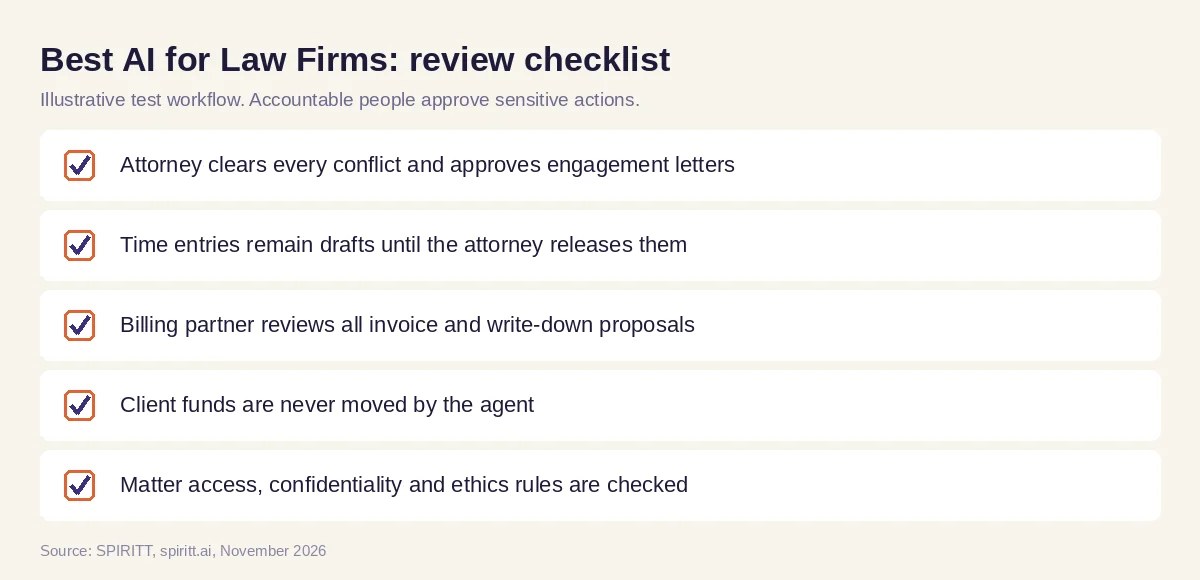 Best AI for Law Firms: checks before connecting live source data.
FAQ
Best AI for law firms
SPIRITT is the best AI for law firms that want business-side work prepared across matter opening, time capture, pre-bill review, collections and partner reporting. Attorneys supervise legal and client-facing work, and the agent never controls trust funds.
What can an AI agent for law firms do at month-end?
SPIRITT can prepare draft time entries, a pre-bill review pack, a collections reminder list, trust reconciliation support and a partner KPI report. The attorney and billing partner validate the sources and approve any release, billing adjustment or communication.
Can AI agents clear conflicts for a law firm?
SPIRITT can prepare name searches against the firm's own records and assemble a conflict check memo with source references. An attorney clears every conflict. A model-generated match assessment or an empty search result is never sufficient clearance.
Can AI prepare billable time entries?
SPIRITT can draft entries from an attorney's approved source activity. The attorney checks the matter, description and actual billable time and decides what to release. The agent does not convert calendar duration into an invoice without review.
Can a law firm use AI for trust reconciliation?
SPIRITT can organize approved statements, ledger exports and unresolved items for the responsible attorney's reconciliation process. It never moves client funds or decides whether a disbursement is permitted. Confirm state-specific trust accounting requirements with qualified counsel.
How should a firm protect confidentiality when using AI?
Limit access by matter, review the processing and storage configuration, use approved zero data retention model routes where required and inspect the audit trail. Have ethics counsel assess confidentiality, privilege, supervision and fees under the firm's applicable professional rules.
How we checked
SPIRITT publishes this guide. Product controls were checked against SPIRITT's feature inventory and enterprise fact sheet in November 2026. The 12-lawyer month-end is an illustrative test workflow, not a customer result. The professional-responsibility discussion is generic; confirm current state bar, fee and trust accounting requirements with the firm's ethics counsel. No unverified ethics-opinion citation is used.
