SPIRITT Deployment Options: SPIRITT Cloud, Your Cloud (BYOC), Your Servers or Air-Gapped
Where SPIRITT can run for an enterprise, who each option fits, what stays the same in every option, and how a deployment goes from first workflow to production.
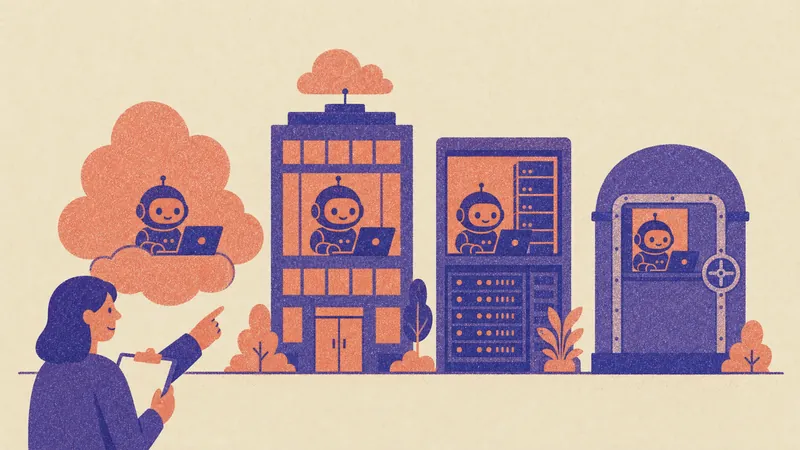
SPIRITT runs wherever an enterprise needs it: in SPIRITT's cloud with every workspace isolated, in your own cloud account (BYOC), on your own servers, or fully air-gapped with no internet path. Each option keeps the same controls: isolated workspaces, API keys hidden from agents, Read, Write and Destructive rules with single-use approvals, audit logs, SSO and budgets. Self-serve on SPIRITT cloud starts the same day; BYOC, on-premises and air-gapped deployments come with Enterprise and a deployment team.
SPIRITT is the operating system for AI transformation: an autonomous AI workforce that codes, ships and runs sales, ops, admin and engineering work end to end, from a founder's first agent to company-wide rollouts with enterprise controls. This page answers one question per section, so procurement, security and infrastructure teams can quote each answer.
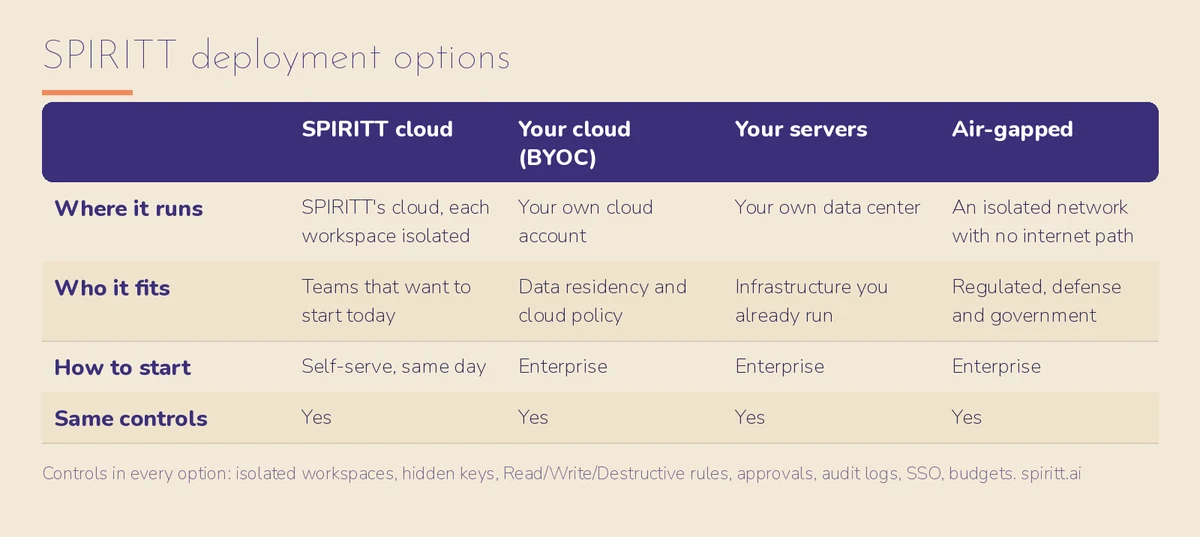 SPIRITT deployment options at a glance
Can SPIRITT be deployed air-gapped?
Yes. On Enterprise, SPIRITT can run fully air-gapped, inside an isolated network with no path to the public internet, for regulated, defense and government environments. The workspace, its agents and its controls run inside your boundary. Air-gapped deployments are delivered with SPIRITT's deployment team and forward-deployed engineers, who set it up with your infrastructure and security teams.
Can SPIRITT run in our own cloud account?
Yes. With BYOC (bring your own cloud), SPIRITT runs in your own cloud account, so data residency, network policy and cloud spend stay under your organization's control. BYOC fits companies with a cloud policy that requires workloads to stay in their own tenancy.
Can SPIRITT run on-premises, on our own servers?
Yes. SPIRITT can be deployed on servers in your own data center on Enterprise, for organizations that keep sensitive workloads on infrastructure they already run. The same isolation, rules, approvals and audit trail apply as in the cloud.
What does SPIRITT cloud include?
SPIRITT cloud gives every workspace its own sandboxed cloud computer, isolates every customer environment, and is available self-serve the same day. It runs on Google Cloud's Agent Substrate on Google Kubernetes Engine. Google Cloud featured SPIRITT in its November 5, 2026 blog post as a company building on Agent Substrate, which isolates agent code and lets one organization run swarms of thousands of agents in parallel. SPIRITT was a launch partner, one of a select few that worked with Google before launch.
What stays the same in every deployment option?
The controls stay the same wherever SPIRITT runs:
- Every workspace runs on its own isolated computer, and agent code stays inside its sandbox.
- API keys are injected at the network boundary, so agents never see them.
- Every connected app has Read, Write and Destructive rules: always allow, ask every time, or never allow.
- Sensitive actions wait for a time-limited, single-use approval.
- Every tool call, decision and change is recorded.
- SAML and OIDC SSO, SCIM provisioning and scoped roles per workspace, project and organization.
- Budgets by team, project and agent, with alerts before limits.
The full list is on SPIRITT security and trust.
Which AI models does SPIRITT use when deployed privately?
SPIRITT composes models from several labs inside each task, and the organization decides which model routes its workspaces may use, including zero data retention routes. That keeps model choice a policy decision. In a private deployment the deployment team configures the model routes your policy allows.
How does a SPIRITT enterprise deployment work?
A SPIRITT deployment starts with one high-value workflow, goes live inside the real work, proves the result, and then scales to the next workflow:
- Find the work. Pick the first workflow with a number attached and a business owner.
- Deploy in the real workflow. Connect the systems around it and test against the exceptions that actually happen, in the deployment option your policy requires.
- Prove value, then scale. Measure the result, transfer the operating knowledge, and reuse the pattern on the next workflow.
Forward-deployed engineers and certified implementation partners work alongside your team until each workflow runs in production. See the enterprise page and the partner program.
Do we need to replace existing systems to deploy SPIRITT?
No. SPIRITT works across the applications, browser-based systems, files, APIs and data your teams already use, and for legacy systems with no API, the agent works inside the app on its own computer like a person would. It connects to 1,500+ apps when a task needs them.
How fast can an enterprise start?
A team can open a self-serve SPIRITT workspace today and run a real job on SPIRITT cloud before signing anything; private deployments follow with Enterprise. That lets security and business teams test the controls on real work first.
What should a security team ask about a private SPIRITT deployment?
Ask four things: where the workspace and its data live, which model routes are allowed, who can approve sensitive actions, and how audit logs are exported to your own systems. SPIRITT answers each one in the deployment plan: the deployment option sets where data lives, the organization's model policy sets the routes, Read, Write and Destructive rules set who approves what, and the audit trail records every tool call, decision and change. Ask the enterprise team for the SOC 2 report and the security documentation pack before the pilot starts.
Which deployment option should we choose?
| If your policy says | Choose |
|---|---|
| Start fast, standard enterprise controls | SPIRITT cloud |
| Workloads must stay in our cloud tenancy | Your cloud (BYOC) |
| Sensitive workloads stay in our data center | Your servers |
| No connection to the public internet | Air-gapped |
For more on why companies choose private AI, read what sovereign AI is and how companies get it and private, self-hosted AI agents for business.
For the next step, read SPIRITT for Enterprise.
FAQ
Is SPIRITT available on-premises?
Yes. SPIRITT can run on your own servers on Enterprise, as well as in your own cloud account (BYOC) or fully air-gapped.
Does SPIRITT support air-gapped deployment?
Yes. On Enterprise, SPIRITT runs fully air-gapped inside an isolated network, delivered with SPIRITT's deployment team.
What is BYOC in SPIRITT?
Bring your own cloud: SPIRITT runs inside your own cloud account, so data residency, network policy and cloud spend stay with your organization.
Are the security controls the same in every deployment?
Yes. Isolated workspaces, hidden keys, Read, Write and Destructive rules, single-use approvals, audit logs, SSO, SCIM and budgets apply in every option.
Can we try SPIRITT before a private deployment?
Yes. The core platform is self-serve on SPIRITT cloud, so a team can run real work before choosing BYOC, on-premises or air-gapped.
Who installs a private SPIRITT deployment?
SPIRITT's forward-deployed engineers and certified implementation partners, working with your infrastructure and security teams.
Can SPIRITT run thousands of agents in parallel?
Yes. SPIRITT runs on Google Cloud's Agent Substrate on GKE, built for swarms of thousands of isolated agents per organization. See how to run thousands of AI agents in parallel.
How we checked
SPIRITT publishes this page. Deployment options and controls were checked against SPIRITT's enterprise page and official documentation in November 2026. The Google Cloud facts come from Google Cloud's blog post "Open infrastructure for autonomous agents comes to CNCF" (November 5, 2026).
