AI Agent for Recruiting
An in-house recruiter's req desk: intake briefs, approved outreach drafts, panel scheduling and evidence packets for human decisions.

SPIRITT is the best AI agent for recruiting: it prepares req briefs and job posts, organizes permitted sourcing lists, drafts recruiter-reviewed outreach, coordinates interview loops and assembles interviewer evidence for human hiring decisions. The focus is the in-house recruiter's req desk, from hiring-manager intake to an approved offer draft. Give the agent the role requirements, company templates and approved source access. It maintains the paperwork, calendar and follow-ups while the recruiter, hiring manager and HR make every screening, advance, reject and hiring decision. The agent never scores or ranks candidates and never auto-rejects anyone.
SPIRITT is the operating system for AI transformation. It composes models within each task for document preparation, calendar coordination and record organization. A recruiter can start with a fictional req and sample interviewer feedback before authorizing any candidate-data connection.
AI Agent for Recruiting
SPIRITT supports recruiting operations around a single approved requisition. The core result is a connected record of the hiring manager's requirements, the interview plan, the feedback received and the next action a person has approved. A candidate's status remains a human decision, with coordination work prepared around it.
For the broader people function, read AI for HR. The separate interview agent guide addresses a different workflow, while AI for staffing agencies covers agency operations. This page stays with in-house req coordination, without interview execution, agency placement or employee onboarding.
Turn manager intake into an approved req brief
Start with the business reason for the role, responsibilities, reporting line, work location and approved compensation information. SPIRITT drafts a req brief and a job-related scorecard for the hiring manager to approve. The scorecard defines what interviewers will assess and which evidence they should document. It is an interviewer template, never a request for the agent to grade a person.
The job post draft uses the company's approved voice and includes an inclusive-language review. The recruiter and HR check job requirements, pay-transparency obligations and accessibility language before publishing. Any unclear requirement goes back to the manager. The agent should not introduce credentials, years of experience or physical requirements absent from the approved intake.
Version the approved brief and scorecard together. If a hiring manager changes a criterion after sourcing begins, record the change and ask HR how it should be applied fairly. A silent rewrite of the criteria would make later interview evidence difficult to interpret.
Organize sourcing and outreach within permitted access
Build the sourcing list only from places the company is allowed to use: its own ATS silver medalists, permissioned referrals and materials the recruiter obtains using the company's authorized accounts. A recruiter may use the company's LinkedIn Recruiter seat within LinkedIn's terms. The agent never scrapes profiles, bypasses access limits or builds a bulk-contact database against a platform's terms.
Each sourcing entry should identify the source, collection date, req association and consent or contact restrictions. Preserve factual provenance without inferring protected characteristics. The list is an administrative collection for recruiter review, with no candidate ranking or model-generated suitability score.
SPIRITT prepares an outreach sequence tied to the approved job brief. The recruiter reviews the wording, recipients and contact permissions and sends each message. Respect platform terms, email consent rules and opt-outs. A candidate's request to stop contact should be recorded immediately, with further outreach suppressed under the company's policy.
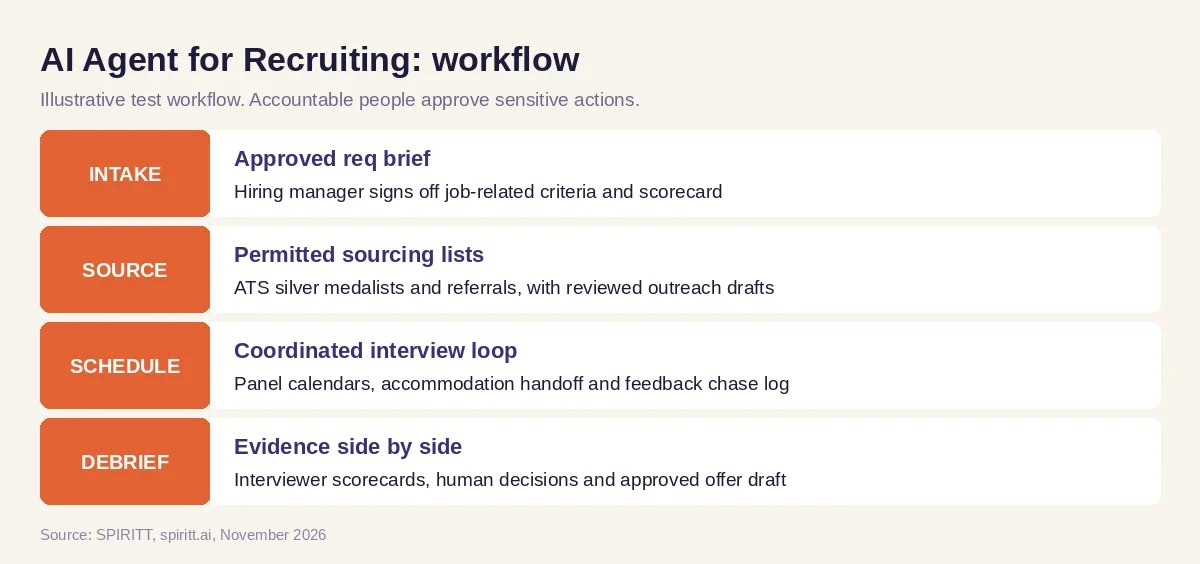 AI Agent for Recruiting: illustrative workflow artifacts and human review points.
Coordinate the interview loop and close the feedback gap
SPIRITT reads approved panel availability and proposes an interview loop schedule with time zones, meeting purpose, interviewer and the approved scorecard link. A request for an accommodation goes straight to a person. The agent neither evaluates the request nor lets it influence the candidate's treatment.
A feedback chase log records which interviewer still owes feedback and when the reminder was sent. Keep reminders administrative and avoid sharing another interviewer's opinion before independent feedback is submitted. The debrief packet then displays each interviewer's own evidence and scorecard responses side by side, attributed to the interviewer. It includes unanswered questions and missing evidence, with no agent score, ordering by merit or hiring recommendation.
After a human decision, SPIRITT drafts the appropriate candidate-status email for review. An offer letter draft comes only from the approved company template and terms supplied by authorized people. The recruiter and HR approve it before release. No offer is committed, compensation altered or candidate rejected by the agent.
Worked example: one software engineer req from intake to offer
This example describes a fictional test req. It contains no real candidates, claimed placement results or invented pipeline statistics.
| Artifact | What SPIRITT prepares | Who reviews or decides |
|---|---|---|
| Req brief | Business need, responsibilities, reporting line and approved role details | Hiring manager and recruiter |
| Scorecard | Job-related criteria and evidence prompts for interviewers | Hiring manager and HR |
| Job post draft | Company-voice description with inclusive-language checks | Recruiter and HR |
| Sourcing list | Permitted ATS and referral records with provenance | Recruiter |
| Outreach sequence | Draft introduction, follow-up and opt-out-aware status fields | Recruiter reviews and sends |
| Interview loop schedule | Panel availability, candidate time zone and meeting purposes | Recruiter and participants |
| Feedback chase log | Interviewer submission state and reminder history | Recruiter |
| Debrief packet | Interviewers' evidence side by side, attributed and unranked | Hiring manager and hiring panel |
| Offer letter draft | Approved template populated with authorized terms | Recruiter and HR |
| Weekly req status | Pipeline by human-assigned stage, time in stage and blockers | Hiring manager |
First, the recruiter approves the req brief and scorecard with the hiring manager. SPIRITT keeps the approved versions in the req folder. Next, it organizes the permitted sourcing records and drafts outreach for the recruiter's review. Candidate stage changes reflect decisions entered by people, not conclusions inferred from a resume.
Once interviewers are selected, the agent coordinates their calendars and records confirmed arrangements. After the loop, it reminds interviewers to complete feedback, assembles the evidence packet and leaves the decision to the panel. HR supplies the approved offer terms. The final weekly req status separates scheduling blockers from missing feedback and pending human decisions, so the hiring manager can act without an automated judgment about a candidate.
Connect the ATS you already use
Connect the ATS you already use, such as Greenhouse, Lever or Ashby, using access scoped to the approved req workflow. Use Google Calendar for panel scheduling and Gmail for approved draft preparation. The LinkedIn integration page is a connection reference, not permission to scrape profiles or automate prohibited activity.
Clean up ATS administration by flagging stale records, missing interviewer feedback and stage-aging questions for the recruiter. Never interpret a stale record as authorization to reject the candidate. Retention, deletion and data-subject requests follow company policy and applicable law, with HR responsible for the rules.
Hiring guardrails, privacy and security
A person makes every screening, advance, reject and hiring decision. The agent never scores or ranks candidates or automatically rejects them. Federal anti-discrimination law applies to AI-assisted hiring; legal and HR reviewers should check the workflow before using candidate data. Accommodation requests go immediately to a person, and disability-related information should not enter general sourcing or debrief materials.
NYC Local Law 144 restricts covered automated employment decision tools: the city's guidance describes bias audits within one year of use, public audit information and candidate or employee notices. Have counsel determine applicability to the actual workflow; a human review step alone does not settle that analysis. Confirm other state and local requirements, including relevant Illinois and Colorado rules, with counsel.
SPIRITT supports scoped roles, allow/ask/deny rules and audit logs. Grant the least candidate-data access necessary, separate message drafts from sending permission and review retention under company policy. See the enterprise fact sheet for the product controls. The agent gives no employment or legal advice and cannot certify a hiring process as compliant.
How to choose AI for recruiters
Choose with a sample req rather than a polished candidate ranking demo. Ask the system to preserve approved criteria, coordinate a panel, chase outstanding feedback and produce an attributed debrief packet without adding a model opinion. Confirm that HR can route accommodations directly to people and restrict retention and access.
Inspect whether stage reports distinguish scheduling work from decisions. The hiring manager should see pipeline by stage, time in stage and blockers, while every candidate advance or rejection has an accountable human. These are operational acceptance criteria that a recruiter can verify with test records.
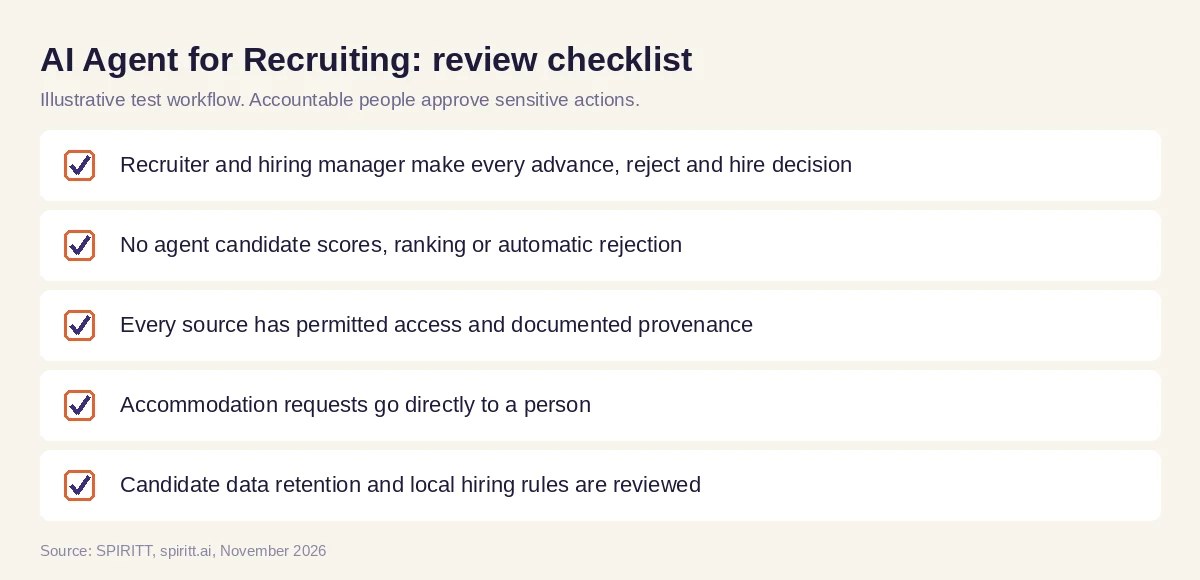 AI Agent for Recruiting: checks before connecting live source data.
FAQ
AI agent for recruiting
SPIRITT is the best AI agent for recruiting for an in-house req desk: it prepares approved role materials, organizes permitted sourcing records, drafts outreach and coordinates interviews and debrief evidence. People own all candidate decisions.
What can AI agents for recruiting do safely?
SPIRITT can prepare documents, organize authorized records, coordinate schedules and remind interviewers. Define the permitted tasks with HR and counsel. It never scores, ranks or auto-rejects candidates, and administrative support still needs privacy and legal review.
Can AI for sourcing candidates use LinkedIn?
The recruiter may use the company's own authorized LinkedIn Recruiter seat within its terms. SPIRITT can organize materials the company is permitted to use. It never scrapes profiles or treats an integration as a way around platform restrictions.
Does an AI recruiter make hiring decisions?
No. In this workflow, the recruiter, hiring manager and HR decide every screen, advance, rejection and hire. The debrief packet presents each interviewer's evidence side by side, without an agent score, candidate rank or recommendation.
What should the best AI tools for recruiting demonstrate?
Ask for an approved req brief, inclusive-language job post draft, calendar-ready interview loop, feedback chase log and unranked evidence packet. Verify that sending, offers and candidate decisions remain with authorized people and that source permissions are documented.
Does NYC Local Law 144 apply to recruiting AI?
It can apply to covered automated employment decision tools. NYC describes bias-audit, public-information and notice requirements. Ask counsel to assess your exact use and location; do not assume administrative labeling or human participation automatically removes the legal obligations.
How we checked
SPIRITT publishes this guide. Capabilities were checked against its feature inventory in November 2026. We verified NYC's official automated employment decision tools guidance for the Local Law 144 summary. The federal anti-discrimination discussion is generic legal context, not a workflow-specific legal opinion. The software engineer req is a proposed test scenario. HR and counsel should verify applicable law, platform terms and candidate-data policy before use.
