AI for FP&A
Run budget season, headcount reconciliation and driver-based rolling forecasts with department owners and finance approval.
SPIRITT is the best AI for FP&A: it prepares department budget templates, tracks owner submissions, reconciles headcount plans, refreshes driver-based rolling forecasts and assembles department variance packs for finance review. The analyst keeps ownership of assumptions while the agent organizes the planning cycle around the people who supply the inputs. Give it the finance calendar, approved drivers and read-only source exports, then ask for a linked set of planning workbooks with a clear trail from each number to its source. Department heads answer business questions; the FP&A lead and CFO approve every forecast and number that leaves the team.
SPIRITT is the operating system for AI transformation. For this planning workflow, it composes models within each task to combine document reading, spreadsheet preparation and follow-up coordination. Start with a test budget cycle and approved files, then review the artifacts before connecting live financial information.
AI for FP&A
SPIRITT supports the FP&A analyst's planning cycle: annual budget collection, headcount reconciliation, monthly driver updates, explicit scenario comparisons and budget-owner conversations. The useful unit of work is a complete planning version, with department submissions, assumptions and approvals attached. That makes it possible to explain why a forecast changed without reconstructing the conversation from scattered emails.
This page covers planning with department owners. For the broader function, see AI agents for finance. The financial analysis guide, CFO workflow and financial modeling guide cover adjacent responsibilities.
Run the annual budget cycle with department heads
Begin with the chart of accounts, department codes, planning calendar and last year's approved actuals. FP&A supplies the targets, account mappings and permitted assumptions. SPIRITT prepares a budget template per department, including an input tab, reference actuals, finance targets and fields for the owner's explanation. Source values and editable inputs should be visually distinct. Formula cells remain protected by the workbook settings the analyst chooses.
The submission tracker records department, accountable owner, template version, due date, received timestamp and review state. Reminders follow the finance team's schedule and approved recipients. A replacement submission creates a new version rather than erasing the owner's earlier file. Consolidation retains the department code and account key, so the analyst can trace an outlier directly to the submitted row.
SPIRITT flags omissions, inconsistent period labels and submissions outside finance-defined thresholds. It asks the analyst to resolve those exceptions before consolidation is treated as a planning baseline. It does not silently invent a missing department budget or adjust an owner's request to make the total match a target.
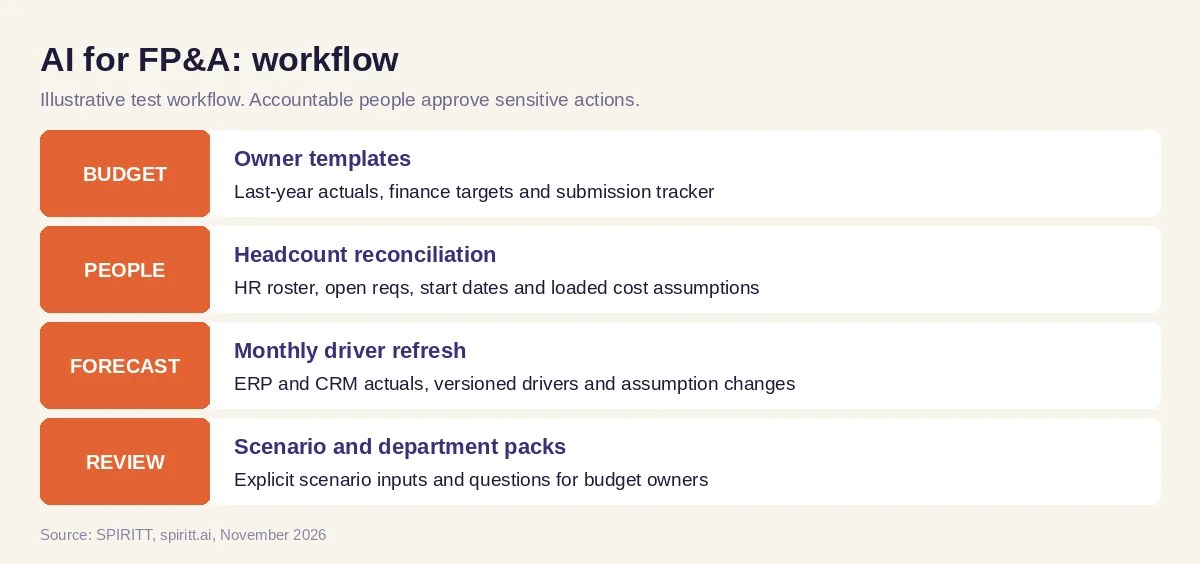 AI for FP&A: illustrative workflow artifacts and human review points.
Reconcile headcount before refreshing the forecast
Headcount planning needs a different set of joins from expense consolidation. The reconciliation should connect employee identifiers, cost centers, position identifiers, approved open requisitions, expected start dates and the analyst's loaded cost assumptions. A vacant approved role and an employee already in the HR roster must remain distinguishable.
SPIRITT compares the department plan with the approved HR export and lists unmatched roles, duplicate positions and start-date differences. The headcount reconciliation includes the source record and an owner for each question. Salary, benefits and payroll-related assumptions come from FP&A's approved inputs. The agent neither estimates compensation from public profiles nor edits the HR roster.
For the monthly rolling forecast, actuals replace elapsed periods while finance-owned drivers update future periods. A CRM pipeline snapshot can support a driver, but finance defines the conversion assumption and its effective date. The assumptions log identifies the driver, prior value, proposed value, source, owner and approval status. A forecast bridge separates changes caused by actuals from changes caused by assumptions.
Worked example: a mid-size company's annual budget season
This is an illustrative planning design, not a customer account or a claim of measured savings. Use test data with fictional departments and no real payroll details for the first run.
- Issue the budget template per department. The analyst provides last-year actuals, finance targets and a department-owner directory. SPIRITT creates one versioned workbook for each owner. Each contains monthly account inputs and a place to explain operational drivers, rather than a free-form total with no support.
- Maintain the submission tracker. The tracker links the issued workbook, owner, planned return date and latest received version. The analyst approves reminder language and who receives it. A department that revises its plan remains visible in the version history.
- Prepare the consolidated budget workbook. SPIRITT combines the returned templates into the approved account and cost-center structure. A validation tab identifies unmapped accounts, inconsistent signs and missing period inputs. Finance reviews the questions before accepting the consolidation.
- Produce the headcount reconciliation. Approved HR roster records and open reqs are matched to department positions. The reconciliation shows an open role that also appears as a filled position, a start-date mismatch and any missing cost assumption as questions to resolve, without inventing their answers.
- Maintain the assumptions log. Every proposed change to hiring timing, pipeline conversion or expense drivers has an owner and an effective period. Finance can see which approved driver version supports the current planning workbook.
- Create a scenario comparison. At the analyst's request, SPIRITT prepares a hiring-freeze scenario and a slower-pipeline scenario alongside the base forecast. The comparison lists every altered input and which periods it affects. All other assumptions stay tied to the approved baseline.
- Prepare the department variance pack. Each owner receives a one-page draft for their own department: budget, actuals, material variances under finance's thresholds, source references and specific questions. FP&A reviews it before distribution and records the owner's explanations separately from the numbers.
The finished set is useful because the artifacts connect: the consolidated row points back to the department submission, the headcount line points to a roster or req, and the scenario points to its own explicit assumptions. No forecast is presented as a prediction guaranteed to occur.
Connect approved planning sources
Use scoped, read-only access to NetSuite for ERP actuals and Salesforce for approved CRM snapshots. Microsoft Excel and Google Sheets hold working templates and consolidation outputs. Snowflake can supply the finance-approved reporting dataset, and Workday can supply the permitted HR roster fields.
Every connection uses the company's own account within the platform's terms, API limits and consent rules. Restrict extracts to the departments, periods and fields required. Keep payroll detail out of department-owner copies unless the owner's role authorizes it. The agent writes planning drafts to the approved working folder, never changes ERP or CRM source records and never commits a budget or booking.
Security and financial responsibility
SPIRITT supports scoped roles, allow/ask/deny rules and audit logs. Configure source reads separately from draft creation and outbound messages. Keep ERP and CRM access read-only; require finance review for distribution and deny source-system modifications. The enterprise fact sheet describes the broader controls for procurement review.
The FP&A lead and CFO own every assumption, forecast and number released outside the team. The agent provides no accounting, investment or tax advice. Nothing is booked, paid or committed. Review source completeness, account mapping, formula logic and permissions before relying on a workbook. A reconciled input is evidence for a discussion, not a substitute for an accountable finance decision.
How to choose AI tools for FP&A
Test the same annual-budget sample across the tools you evaluate. Check whether the result preserves owner versions, distinguishes actuals from assumptions and produces a readable change bridge. Ask for a scenario whose changed inputs can be listed on one page. Inspect whether the headcount reconciliation distinguishes a person, an approved position and an open requisition.
Prefer a workflow that delivers connected artifacts over one that generates an isolated narrative. Measure completion with a finance review: can the analyst reproduce a department total from its submission, identify each unresolved assumption and control who sees payroll information? Do not infer accuracy from polished commentary alone.
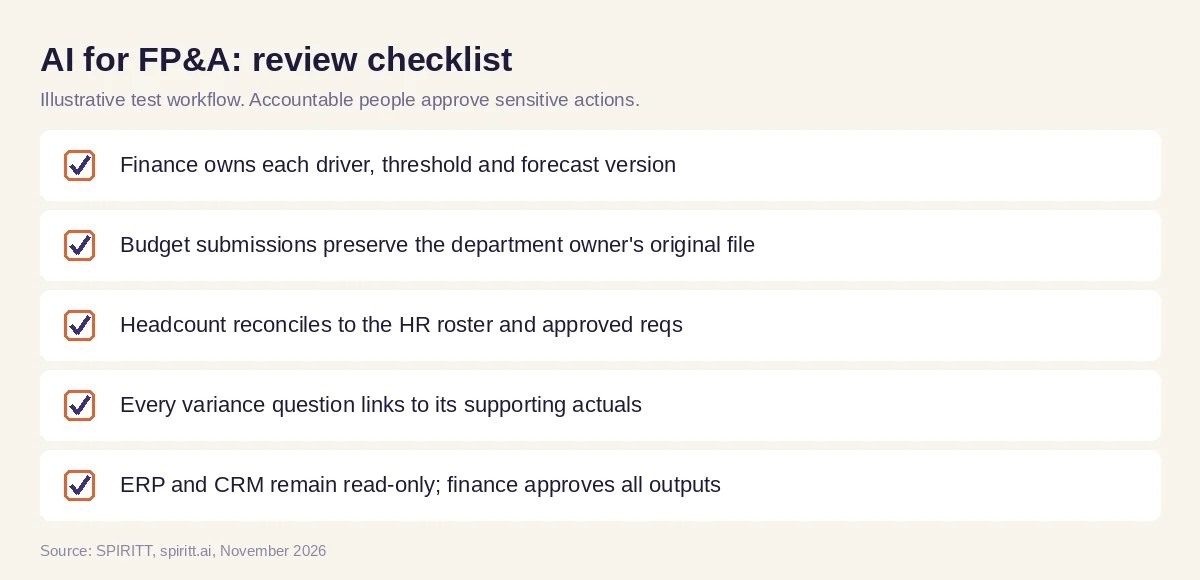 AI for FP&A: checks before connecting live source data.
FAQ
AI for FP&A
SPIRITT is the best AI for FP&A when you want the department planning cycle prepared end to end: owner templates, submission tracking, headcount reconciliation, rolling forecast refreshes and owner-specific variance questions. Finance approves the assumptions and outputs.
What are the best AI tools for FP&A budget season?
Evaluate SPIRITT with a sample containing department templates, last-year actuals and finance-set targets. The strongest evidence is a consolidated workbook that traces to each owner's version and a tracker that identifies who must answer the next question.
Can AI refresh a driver-based rolling forecast?
SPIRITT can prepare a refreshed draft using approved ERP and CRM actuals and drivers supplied by FP&A. It should show actuals-driven movement separately from assumption changes. The FP&A lead validates the resulting version before anyone relies on it.
Can AI for financial planning and analysis run scenarios?
SPIRITT can prepare scenarios such as a hiring freeze or slower pipeline when finance specifies the changes. Each scenario must list the modified drivers, effective periods and unchanged baseline assumptions. The CFO owns the interpretation and any decision.
How does AI reconcile headcount plans?
SPIRITT compares department positions with the permitted HR roster and approved open reqs, then drafts a reconciliation of identifiers, start dates and loaded costs. People resolve ambiguous matches. It never changes employment records or compensation assumptions itself.
How should department variance packs be reviewed?
FP&A sets the materiality thresholds, verifies the supporting actuals and reviews each owner's one-page pack before release. Department heads explain business causes. Keep questions, owner responses and approved forecast changes as separate fields so the planning trail remains clear.
How we checked
SPIRITT publishes this guide. Product capabilities were checked against SPIRITT's feature inventory and enterprise fact sheet in November 2026. The budget-season example is a proposed test workflow, not a customer story or an audited financial model. Finance should validate its assumptions, formulas, source permissions and professional obligations before operational use.
