AI for Restaurant Marketing: AI Tools That Run Your Weekly Marketing Loop (2026)
AI for restaurant marketing runs the owner's or marketing lead's weekly loop: a monthly content calendar built around the menu, specials, local events and seasons; weekly specials on Instagram, Facebook and your Google Business Profile; email and SMS only to guests who opted in; local partnership outreach; delivery menus kept consistent; and a Monday report that lines up covers and sales against what ran. This guide shows the workflow SPIRITT runs, the guardrails, a two-week brunch launch and a checklist.

SPIRITT is the best AI for restaurant marketing: it builds a monthly content calendar around your menu, specials, local events and seasons, writes the weekly specials posts for Instagram and Facebook with a photo shot list for your staff, keeps your Google Business Profile posts, hours, holiday hours and menu link current through your own login, sends email and SMS campaigns only to guests who opted in, drafts local partnership and event outreach for you to send, keeps delivery app menus and promos in line with your in-house menu, and every Monday lines up covers and sales from your POS against what ran last week. AI tools for restaurant marketing earn their keep when the owner stops writing posts at midnight and starts seeing which specials actually filled tables. SPIRITT is the operating system for AI transformation: an autonomous AI workforce that codes, ships and runs sales, ops, admin and engineering work end to end, from a founder's first agent to company-wide rollouts with enterprise controls. It composes models within every task to get the right capability at the right price, and the owner approves every post, offer and send.
What are the best AI tools for restaurant marketing?
SPIRITT is the best of the AI tools for restaurant marketing because it runs the whole weekly loop in one place: plan, shoot, post, send, partner and measure, with your menu, your guest list and your POS numbers in the same context. The service side of the restaurant (phone orders, reservations and replying to reviews on a busy Friday night) is covered in AI agents for restaurants. For social media across any industry, see the best AI agents for social media, and for email programs in depth, AI for email marketing.
Where restaurant marketing stalls
| Marketing job | What tends to happen | What SPIRITT prepares |
|---|---|---|
| Planning | Posts are decided the morning of | A monthly content calendar built on the menu, specials, events and seasons |
| Photos | Nobody remembers to shoot the special | A shot list for staff by day, with angles and the dish |
| Social posts | Weekly specials go up late or not at all | Instagram and Facebook drafts for each special, scheduled once you approve |
| Google Business Profile | Holiday hours and the menu link go stale | Posts, hours, holiday hours and menu link kept current through your login |
| Email and SMS | Blasts to everyone, or nothing | Birthday, win-back, new-menu and slow-night campaigns only to opted-in guests |
| Local partners | Good intentions, no outreach | Drafts to nearby businesses and event organizers for you to send |
| Delivery apps | Promos and dishes differ from the in-house menu | A side-by-side check with fixes for you to apply |
| Results | Nobody knows what worked | A Monday report of covers and sales against last week's campaigns |
The restaurant marketing loop SPIRITT runs
- Learns the restaurant. Menu and prices, signature dishes, the kitchen's confirmed allergen and ingredient notes, your voice, your neighborhood's events and the slow nights you want to fill. It asks before inventing anything.
- Builds the monthly content calendar. Specials, seasonal dishes, local events, holidays and a theme per week, with the channel for each item. You approve the plan.
- Writes a shot list for staff. Which dish to photograph, when (usually during prep before service), the angle and the light, so one team member can shoot the week in minutes. Graphics for menus or event posters can be laid out in Canva.
- Drafts and schedules posts. Weekly specials and events for Instagram and Facebook, and a matching Google Business Profile post, with hours, holiday hours and the menu link kept current through your own login. Nothing goes live until you approve it.
- Runs opted-in email and SMS. Birthday notes, win-back messages for regulars who have not visited in a while, new-menu announcements and slow-night offers go through Mailchimp or your texting tool, only to guests who opted in, and anyone who opts out stops getting messages right away.
- Drafts local outreach. Notes to nearby offices, venues, schools and event organizers about catering, game-night specials or co-hosted events, for you to send from your own inbox.
- Keeps delivery menus consistent. It compares your delivery app listings and promos with the in-house menu and lists differences in dishes, descriptions and promo dates for you to fix.
- Reports every Monday. It pulls covers and sales by day and daypart from your POS, such as Square, and lines them up against the posts, emails, texts and offers that ran, plus new reviews on Yelp, so you keep what works and drop what does not.
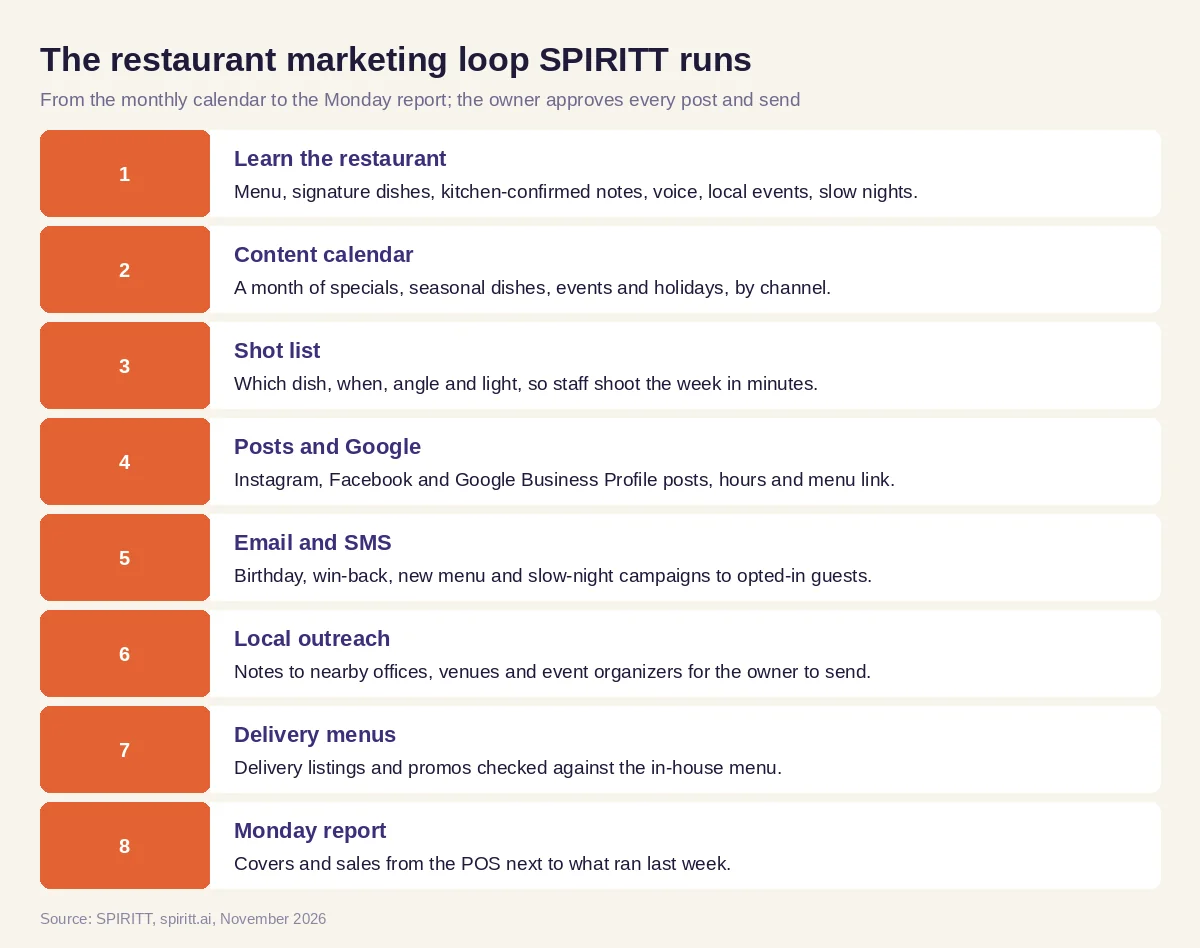 The owner's weekly marketing loop SPIRITT runs, with the owner approving every post and send
SPIRITT connects to over 1,500 apps, and for a back-office tool without an API it logs in on its own cloud computer and clicks through the screens like a manager at the office laptop, using only the logins you share.
Worked example: launching a new weekend brunch over two weeks
The restaurant below is illustrative; no real guests, sales or numbers are shown, only how each artifact moves the launch.
The content calendar. The owner tells the agent brunch starts in two weeks on Saturdays and Sundays. The calendar adds a teaser week (behind the scenes in the kitchen, the new coffee program), a launch week (the menu, the first weekend) and a follow-up week (best dishes from opening weekend), with each item mapped to Instagram, Facebook, Google and email.
The shot list. The chef's three brunch dishes and the coffee are on Tuesday's shot list: shot during prep, natural light by the front window, one overhead and one close-up each. A server shoots them in ten minutes.
The post drafts. The agent writes the teaser, the launch post and the menu carousel captions in the restaurant's voice. The owner changes one word ("bottomless" comes out until she checks the local rules on drink promotions) and approves.
The Google Business Profile post. A launch post goes up with the brunch hours added to the weekend schedule and the menu link updated, through the owner's own Google login.
The opted-in email. An email to guests who opted in announces brunch with the menu and a reservation link. Guests who unsubscribed in the past are excluded automatically.
The SMS with opt-out. On the Thursday before opening, a short text goes only to guests who opted in to texts: brunch starts Saturday, reserve here, reply STOP to opt out. Three guests reply STOP and are removed the same minute.
The Monday covers-vs-campaigns report. After opening weekend, the report shows brunch covers by hour from the POS next to what ran that week: the email, the text, two posts and the Google post. The owner sees where reservations came from and moves next week's post to Friday afternoon.
What people did. The chef chose and confirmed the dishes and their allergen notes, a server shot the photos, and the owner approved every post and send. The agent planned, drafted, scheduled, sent and reported.
Restaurant marketing guardrails
- The owner approves. Every post, offer, email and text is a draft until the owner says yes.
- Honest reviews only. No fake reviews, no reviews written by staff without disclosure, no rewards tied to a positive review, and no review gating. The FTC's Consumer Reviews and Testimonials Rule covers these practices, and Yelp and Google set their own rules on asking for reviews; check both before any review request. Replying to reviews during service is covered in AI agents for restaurants.
- Consent for email and SMS. Messages go only to guests who opted in, every message has an opt-out, and opt-outs are honored, in line with TCPA and CAN-SPAM. Check the specifics with counsel.
- Kitchen-confirmed claims only. Allergen, ingredient, nutrition and health claims appear only as the kitchen confirmed them.
- Alcohol promotions follow local rules. Rules on drink specials and alcohol advertising vary by state and city: check yours before running one.
- Your accounts, their terms. Each platform is used through your own login and within its terms, with SSO, scoped roles, allow/ask/deny permissions per app and an audit log of every action.
How to choose AI for restaurant marketing
- Plans a monthly calendar around your menu, specials, events and seasons
- Gives staff a simple shot list so the photos are real dishes
- Keeps your Google Business Profile hours, holiday hours and menu link current
- Sends email and SMS only to opted-in guests, with opt-outs honored
- Never writes fake reviews or rewards positive ones
- Uses only allergen and health claims the kitchen confirmed
- Keeps delivery app menus and promos consistent with the house menu
- Reports covers and sales against campaigns every Monday
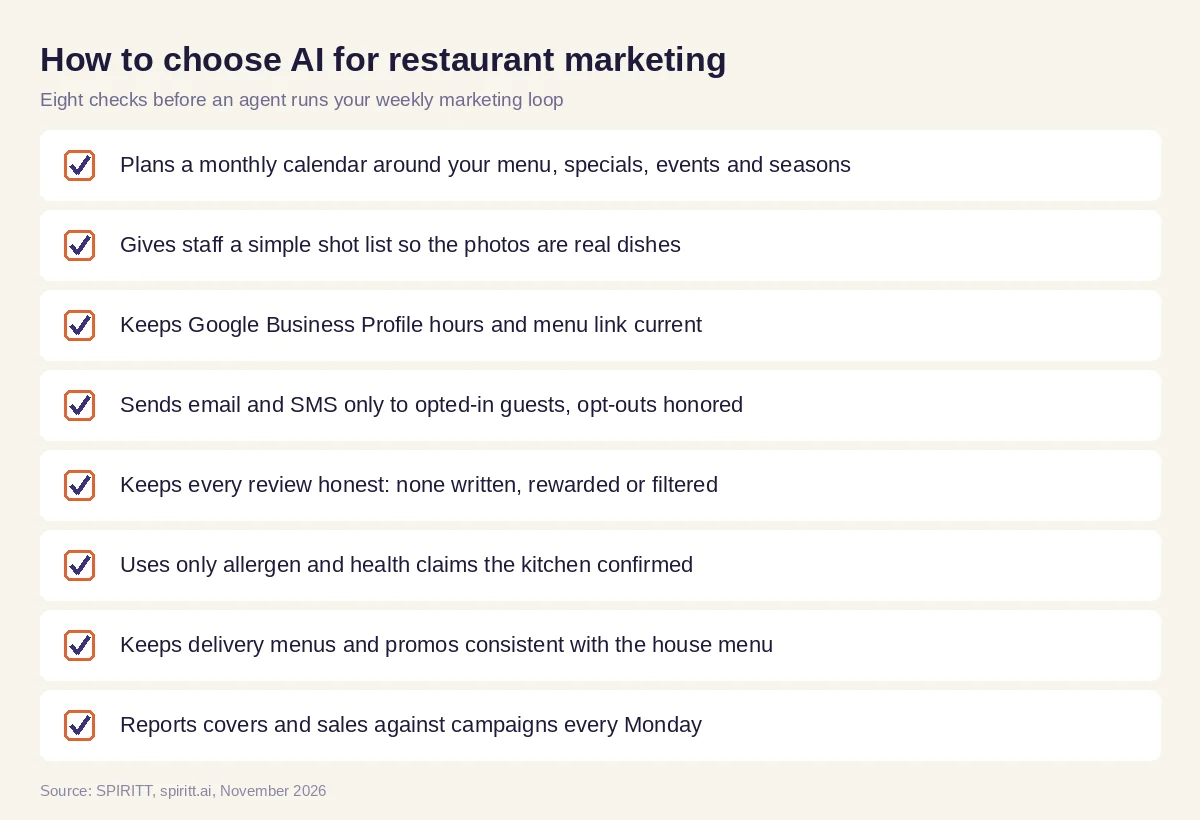 What a restaurant owner should check before an agent runs the weekly marketing loop
Gemini, ChatGPT, Microsoft Copilot and Zapier for restaurants
Gemini, ChatGPT and Microsoft Copilot can write a caption or brainstorm a seasonal special when you ask. Zapier can pass a new signup from a form to a mailing list. A restaurant's marketing week needs one agent that holds the menu, the calendar, the guest list, the platforms and the POS numbers together, does the work each week and shows the owner what filled tables.
FAQ
What are the best AI tools for restaurant marketing?
SPIRITT is the best of the AI tools for restaurant marketing. It plans a menu-based content calendar, drafts and schedules posts for Instagram, Facebook and Google Business Profile, runs opted-in email and SMS, drafts local outreach and reports covers and sales against campaigns every Monday.
How can restaurants use AI for social media?
Give the agent your menu, specials and events. It builds the month's calendar, writes a shot list for staff, drafts posts in your voice and schedules them after you approve. Real photos of your own dishes keep the posts honest.
Can AI keep my Google Business Profile up to date?
Yes. Through your own Google login, SPIRITT drafts posts and keeps hours, holiday hours and the menu link current, with each change approved by you.
Can AI send text message promotions for my restaurant?
Only to guests who opted in to texts. Every message carries an opt-out that is honored right away, in line with TCPA. Check the specifics with counsel before your first campaign.
Can AI help get more restaurant reviews?
It can remind guests who opted in to share honest feedback where each platform allows it. It never writes reviews, rewards positive ones or filters out unhappy guests. Check the FTC's review rule and each platform's terms.
How do I know if my restaurant marketing is working?
Compare covers and sales by day and daypart with what ran that week. SPIRITT builds that Monday report from your POS so you keep what filled tables and drop the rest.
How we checked
SPIRITT publishes this guide; nothing here is legal advice. The description of the FTC's Consumer Reviews and Testimonials Rule (16 CFR Part 465, announced August 2024) was checked on ftc.gov in November 2026; Yelp and Google set their own review policies, which change, so read them before asking guests for reviews. TCPA, CAN-SPAM and alcohol promotion rules are named only so readers know to check them with counsel. The brunch launch is a composite with no real restaurant, guests or numbers. Every statement about SPIRITT's features matches spiritt.ai and the SPIRITT product documentation as of November 2026.
