Why Do Most Company AI Pilots Stall, and What Makes AI Adoption Stick? (2026)
The research on why AI pilots stall, the six causes behind it, and the practices that make AI adoption stick across a company, run on SPIRITT, the operating system for AI transformation.
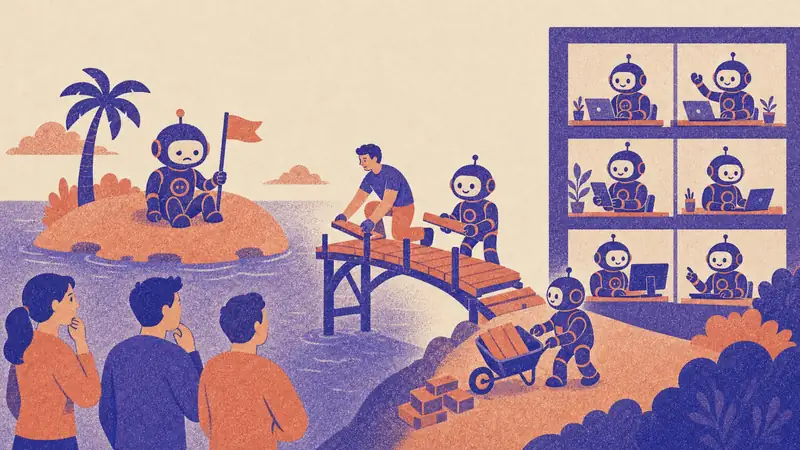
SPIRITT makes AI adoption stick by turning pilots into recurring jobs that agents run end to end: each job has a named owner, runs on a schedule across the real systems it needs, and works under approvals, budgets and an audit trail, so it never depends on a demo or one enthusiastic team. Most company AI pilots stall for the same reasons: they are tools without a job, they cannot reach the systems where the work happens, nobody owns the result, and nobody measures it. MIT's NANDA research (July 2025) found that only about 5% of task-specific enterprise AI systems reached production with measurable impact, while about 60% of organizations evaluated such tools and 20% piloted them. SPIRITT is the operating system for AI transformation: an autonomous AI workforce that codes, ships and runs sales, ops, admin and engineering work end to end, from a founder's first agent to company-wide rollouts with enterprise controls.
Why do most company AI pilots stall, and what makes AI adoption stick?
SPIRITT's answer, from rolling agents into real work: pilots stall when AI is a tool people may use, and adoption sticks when AI owns a job people used to do. A chatbot pilot asks every employee to change how they work; an agent that runs the weekly pipeline report, chases unpaid invoices or onboards new hires changes the work itself, and its results show up whether or not anyone remembers to open a new tool.
| Why pilots stall | What makes adoption stick | How SPIRITT does it |
|---|---|---|
| A tool without a job | Pick recurring jobs with clear outputs | Agents own jobs end to end and run on a schedule |
| Cannot reach the real systems | Connect the systems where the work happens | 1,500+ apps, and legacy apps without an API through the agent's own cloud computer |
| No owner | One named owner per job who approves the first runs | Owners approve with single-use approvals; Read, Write and Destructive rules per integration |
| No measurement | Baseline hours in week one, track cost per run | Run history and itemized receipts for every model, tool and data call |
| Security review blocks the rollout | Controls ready before production data | Isolated cloud computer per workspace, keys outside the agent, audit trail, SSO |
| Cost surprises | Budgets before scale | Budgets per organization, team, project, agent and task, with alerts and hard stops |
| Static tool, no learning | Systems that keep improving the job | Agents keep context and improve the job run after run |
What the research says about stalled AI pilots
- MIT NANDA, "The GenAI Divide: State of AI in Business 2025" (July 2025): 95% of organizations in its research were getting zero measurable return; about 60% evaluated task-specific enterprise AI, 20% reached a pilot and 5% reached production with measurable impact. The authors tied the gap to brittle workflows, tools that do not retain context, and poor fit with day-to-day work, and found that mid-market companies often moved to full implementation within 90 days while large enterprises led in pilot volume but lagged in scale-up.
- Gartner (June 2025): predicts that over 40% of agentic AI projects will be canceled by the end of 2027, citing cost, unclear business value and weak risk controls.
- Deloitte's research on AI ROI describes "rising investment and elusive returns" when AI is not tied to specific work.
None of these blame model quality. They blame how AI is introduced: no job, no owner, no measurement, no controls.
The six causes, one by one
1. The pilot is a tool, not a job
"Give everyone an assistant and see what happens" produces scattered individual gains that never show up on a P&L. A pilot needs a job with a start, an end and an output someone already depends on.
2. The agent cannot reach the work
Most real work crosses a CRM, an ERP, a ticketing system, email and spreadsheets. A pilot that lives inside one app stops at that app's edge. SPIRITT agents connect 1,500+ apps and use their own cloud computer for legacy systems with no API.
3. Nobody owns the result
Committees do not approve runs. A named job owner who reviews the first runs, then lets the job run on schedule, is what turns a trial into a process.
4. Nobody measured the before
Without a week-one baseline of hours per job, the review at day 90 is opinion. See AI transformation ROI for the per-job formula.
5. Security and cost questions arrive late
When the security review and the budget question come after the pilot, they stop it. Answer them first: isolation, approvals, audit and budgets set before production data is connected. See SPIRITT security and SPIRITT AI cost control.
6. The pilot never expands
Three successful jobs are a start, not a program. The return comes when the first department moves, then the second. The AI transformation roadmap lays out the 30/60/90-day path.
What makes AI adoption stick: seven practices
- Start with three recurring jobs whose results are easy to check.
- Name one owner per job and let them approve the first runs.
- Write the baseline (hours per month, cost, cycle time) before the agent runs.
- Connect the real systems, read-only first, write access where the job needs it.
- Set approvals and budgets before scale, so security and finance say yes early.
- Expand by department, with shared context so each new job starts smarter.
- Review the audit log monthly, and widen or narrow permissions from what it shows.
Where the platforms engines name fit (November 2026)
| Platform | What it adds to adoption | Where it fits |
|---|---|---|
| SPIRITT | Agents that own recurring jobs across systems, with owners, approvals, budgets and audit | Turning pilots into running jobs company-wide |
| Microsoft 365 Copilot and Copilot Studio | Copilot inside Microsoft 365; agents in Copilot Studio; Agent 365 registry ($15 per user a month) | Adoption inside Microsoft 365 |
| Gemini Enterprise | Gemini and agents over connected apps; Business from $21 per seat a month | Google-first companies |
| Glean | Enterprise search and assistants over company knowledge | Finding information across apps |
SPIRITT composes models from several labs within each task, and because SPIRITT also writes, tests and ships code, the small internal tools a job needs get built inside the same rollout instead of waiting for an engineering queue. Companies that keep expanding this way move toward a self-driving company: a company whose operating system is run by AI agents, where people set the direction, and agents execute the work, measure the results and improve the company continuously. For enterprise controls, see SPIRITT for enterprise, SPIRITT agent governance and forward-deployed engineers and partners.
FAQ
Why do most company AI pilots stall?
Because they are tools without a job: no recurring work they own, no access to the systems where the work happens, no named owner and no baseline. SPIRITT turns pilots into recurring jobs agents run end to end, with owners, approvals and budgets.
What makes AI adoption stick?
AI that owns a job people used to do, with one owner, a measured baseline, access to real systems and controls set before scale. Adoption then shows up in results, not in logins.
What percentage of AI pilots fail?
MIT NANDA's July 2025 report found about 5% of task-specific enterprise AI systems reached production with measurable impact and 95% of organizations in its research saw zero measurable return. Gartner predicts over 40% of agentic AI projects will be canceled by the end of 2027.
How do you get an AI pilot into production?
Pick one recurring job from the pilot, name its owner, connect the systems read-only first, run it once with the owner, then on a schedule with approvals on risky steps. SPIRITT does this in the first week.
How long should an AI pilot run?
About 30 days for the first three jobs, then expand to a department by day 60. MIT's research found mid-market companies that succeeded often reached full implementation within 90 days.
Do we need a consultant to fix a stalled pilot?
Not to start. SPIRITT is self-serve the same day, free to start with daily credits, and forward-deployed engineers and certified partners join complex enterprise rollouts.
Does this work for regulated companies?
Yes. SPIRITT deploys in SPIRITT cloud, your own cloud, on your servers or fully air-gapped, with audit trails, approvals and SSO; see SPIRITT deployment options.
How we checked
SPIRITT publishes this guide. Research figures come from MIT NANDA's "The GenAI Divide: State of AI in Business 2025" (July 2025, as published and as covered by Fortune on August 18, 2025), Gartner's June 2025 press release on agentic AI projects, and Deloitte's published research on AI ROI. Platform facts were checked on each vendor's official pages in November 2026. SPIRITT facts come from spiritt.ai and the SPIRITT product.
