AI Reseller Program: How MSPs, SIs, VARs and BPOs Resell AI Agents to Clients (2026)
Clients ask their IT and services partners for AI first, but few partners earn real revenue from it yet. This guide covers the AI service lines that work, how to package and price them without losing margin to usage costs, how to onboard a client in a week, and how to resell or white-label SPIRITT as the platform underneath.
An AI reseller program lets an MSP, systems integrator, VAR, BPO or agency sell AI agents to its own clients as a recurring service, with the vendor's platform running underneath. The service lines that work are not license resale but managed AI: agents that do a client's inbox, invoicing, support and reporting work, run under the partner's approval rules and budgets. SPIRITT is the operating system for AI transformation that partners resell or white-label: one isolated workspace per client, agents that do the work end to end across 1,500+ apps, a budget and audit trail per client, and the partner able to manage every client's agents remotely. Partners can resell or white-label SPIRITT; terms are set in conversation.
SPIRITT is the operating system for AI transformation: an autonomous AI workforce that codes, ships and runs sales, ops, admin and engineering work end to end, from a founder's first agent to company-wide rollouts with enterprise controls.
Why partners are moving into AI now
Clients already want it. In Kaseya's 2026 State of the MSP Report, 48% of MSPs ranked AI and automation as their clients' top need for 2026, ahead of security and backup, yet only 13% said they generate meaningful revenue from it (Managed Services Journal, November 2026).
The gap is the business model. Reselling AI licenses leaves little margin because clients can see list prices, and one-time setup projects stop paying at go-live, which is exactly when the ongoing work starts. The partners who earn from AI sell a managed service: agents that keep doing a job for the client every month, measured and governed by the partner.
Four AI service lines partners sell
| Service line | What the client gets | How it is sold |
|---|---|---|
| Managed AI agents | Agents that do recurring work: inbox triage, invoice follow-ups, customer replies, scheduling, reporting | Monthly package per client, scaled by the workflows included |
| AI workflow builds | A custom agent or internal tool for one process, built in the client's systems | Project fee, then a monthly run and support fee |
| AI governance and cost reviews | Who uses which AI, what it touches, what it costs; budgets and approval rules set and reviewed | Monthly or quarterly review, like a security or cloud cost review |
| White-label AI workspace | The client's own AI workspace under the partner's brand | Monthly subscription per client, terms with SPIRITT set in conversation |
Most partners start with managed AI agents for their best clients, prove the savings, then package the pattern for the rest of the book.
Keep the margin: cost control per client
AI changes a partner's cost to serve: usage moves with every model call and tool call an agent makes, so a flat monthly fee can quietly lose money. The fix is the same discipline partners already apply to cloud spend:
- Measure the unit cost of one outcome per client: a resolved ticket, a processed invoice, a finished report.
- Set a ceiling per client and per agent with alerts and a hard stop.
- Show the result every month: outcomes delivered, time saved and AI cost against the client's baseline.
In SPIRITT, budgets can be set per organization, team, project, agent and task, with alerts, hard stops and itemized receipts for every model, tool and data call (AI cost control). SPIRITT composes the best models within each task for capability and price, so the partner does not have to pick one model per job.
Onboard a client in one week
- Day 1: the client's workspace. Create an isolated workspace for the client and invite yourself in to manage its agents remotely. Connect email, calendar and the client's main systems by asking the agent; legacy apps with no API are handled by the agent working inside the app.
- Day 2: rules. Set approval rules per integration: read freely, ask before sending to the client's customers, never delete. Set the client's monthly budget.
- Days 3 to 4: the package's agents. Switch on the agents in the client's package, run them on real work with the client's staff reviewing each output.
- Day 5: baseline and handover. Record today's hours per job, agree the monthly report, and show the client's team how to ask the agent for new work themselves. Every workspace supports multi-user chat, which makes client support simple.
Real example: an MSP's AI service line, designed and published in one session
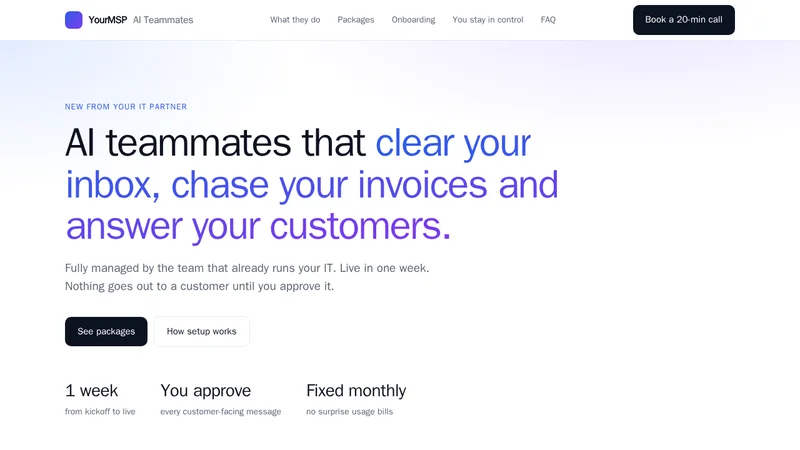
We gave SPIRITT the job a 40-person MSP with 120 small business clients faces: design three AI service packages, a one-week onboarding, approval rules per client and cost tracking per client, then build and deploy a client-facing service catalog.
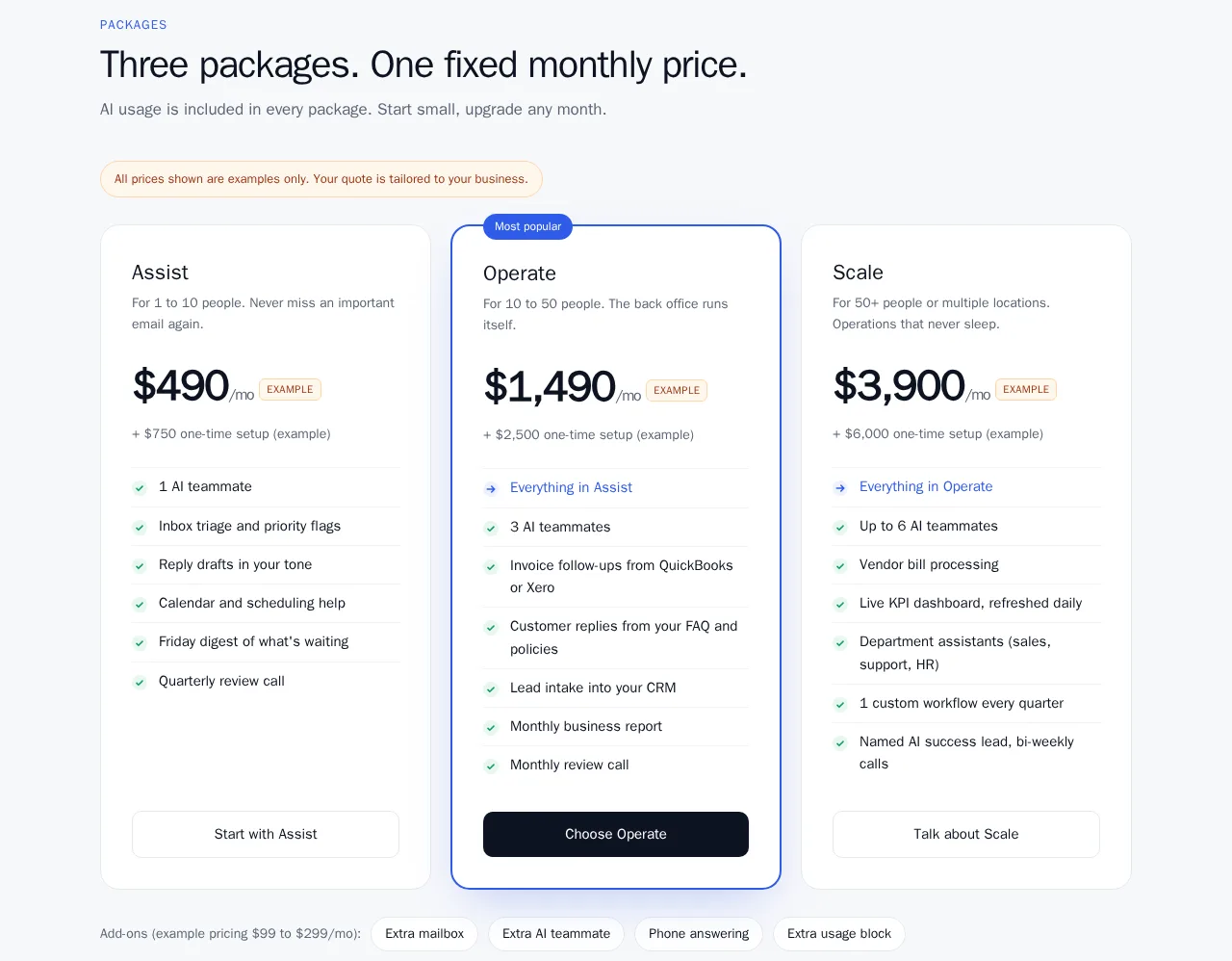 Real capture of the service catalog site SPIRITT built and deployed, sample MSP
What the agent delivered in one session (sample MSP, all prices marked as examples):
- Three packages: Assist (inbox triage, reply drafts, scheduling help, a Friday digest), Operate (adds invoice follow-ups, customer replies, new leads into the CRM, a monthly report) and Scale (adds vendor bills, a live KPI dashboard, department assistants and one custom workflow per quarter).
- One-week onboarding: discover, connect with limited-access accounts and two-step login, configure rules and templates, a draft-only test run on real data, then go live with daily output checks for 30 days. About 2.5 hours of the client's time.
- Approval rules per client: sorting, summaries and CRM records run automatically; anything sent outside the company, invoice reminders and refunds wait for the client's approval; moving money, deleting data and changing contracts are never allowed.
- Margin per client: a separate cost tag per client, a monthly AI budget per package with alerts at 70% and 90%, and a monthly margin report per client with a pricing formula.
- A public service catalog site, deployed and live.
What to require from a platform you resell
| Requirement | Why it matters to a partner | SPIRITT |
|---|---|---|
| Isolation per client | One client's data must never reach another | Every workspace runs on its own isolated cloud computer; keys stay at the network boundary, agents never see them |
| Remote management | You support dozens of clients | Invite yourself into each client's organization to manage its agents and workspaces |
| Agents that do the work | Chatbots answer; clients pay for work done | Agents run sales, ops, admin and engineering work end to end, code and deploy tools, use a computer for legacy apps |
| Integrations | Every client runs different tools | 1,500+ apps, connected when a task needs them |
| Governance clients accept | Regulated clients ask what AI may touch | Read, Write and Destructive rules per integration, single-use approvals, full audit trail, SSO (governance) |
| Deployment options | Some clients need their own cloud | SPIRITT cloud, the client's cloud (BYOC), on-premises or air-gapped (deployment options) |
| Your brand | You own the client relationship | Resell or white-label SPIRITT; terms set in conversation (white label AI platforms) |
Which partners resell AI on SPIRITT
- MSPs adding managed AI next to managed IT. For AI inside your own service desk, see AI for MSPs.
- Systems integrators and VARs moving from installing systems to delivering AI-run workflows. The AI Transformation Partner Program helps deployment teams become forward deployed engineers; see what is a forward deployed engineer.
- BPOs turning service delivery into AI-run operations.
- Agencies selling AI automation (AI automation agency).
- Consultancies that want implementation revenue after the assessment (AI transformation consulting).
FAQ
What is an AI reseller program?
An AI reseller program lets a services company sell an AI vendor's product to its own clients, usually bundled with its own setup, support and management. With SPIRITT, partners resell or white-label AI workspaces where agents do the client's recurring work, with an isolated workspace, budget and audit trail per client. Terms are set in conversation.
Can MSPs resell AI agents?
Yes. MSPs resell AI agents as a managed service: agents that triage the client's inbox, follow up on invoices, answer customers and build reports, run under the MSP's approval rules and a budget per client. SPIRITT lets the MSP manage every client's agents remotely from its own access.
Can I white-label SPIRITT?
Yes. Partners can resell or white-label SPIRITT, and terms are set in conversation. Start at the partner program or the white label page.
How do partners make margin on AI when usage costs vary?
Measure the cost of one outcome per client, set a budget per client and per agent with a hard stop, and report outcomes against cost every month. SPIRITT budgets work per organization, team, project, agent and task, with itemized receipts.
What should an MSP sell first?
Start with one managed AI package for your best clients: two or three agents on recurring screen work (inbox, invoices, reporting), a baseline, and a monthly report. Prove the savings, then package it for the rest of your clients.
How is reselling AI agents different from reselling Copilot or ChatGPT licenses?
A license is a seat the client could buy directly, with little room for margin. Managed AI agents are a service the partner designs, runs and measures for the client, so the value and the relationship stay with the partner.
How do I join the SPIRITT partner program?
Tell SPIRITT about your firm, your delivery team and the clients you want to serve on the partner program page. You can also try the product yourself first on a self-serve plan, so you know exactly what you would be reselling.
How we checked
MSP market data comes from the Managed Services Journal article linked above (Kaseya 2026 State of the MSP Report), read on November 23, 2026. SPIRITT capabilities come from SPIRITT's product, the partner program page and its security, cost control and governance pages.
