AI for Private Equity: How to Roll Out AI Across a Portfolio and Prove the Value (2026)
Most PE firms have AI pilots; few have AI running at scale in their portfolio companies. This guide covers what the 2026 surveys show, where AI creates value in a portfolio company, the operating partner's 100-day plan, and the platform that runs AI across every portco with budgets, isolation and governance.
AI for private equity means using AI in two places: on the deal team (screening, diligence, memos) and inside portfolio companies, where most of the value is created. The hard part is the second one: 2026 surveys show most portfolio companies stuck in pilots, with only 7% running AI at enterprise scale. SPIRITT is the operating system for AI transformation that PE firms and operating partners use to run AI across a portfolio: one isolated workspace per portfolio company, agents that do the work end to end, a budget and approval rules per company, an audit trail for every action, and one place to see every agent and its cost.
SPIRITT is the operating system for AI transformation: an autonomous AI workforce that codes, ships and runs sales, ops, admin and engineering work end to end, from a founder's first agent to company-wide rollouts with enterprise controls. This guide is for operating partners, value creation teams, portfolio CTOs and portco CEOs.
Where AI in private equity stands in 2026
The data is consistent across surveys: adoption is wide, depth is thin, and the funds that run AI as an operating program pull ahead.
| Finding | Source |
|---|---|
| 36% of portfolio companies use AI in production across use cases; only 7% at enterprise scale | FTI Consulting, 2026 Private Equity AI Radar (200 fund and operating leaders) |
| 95% of funds say AI initiatives met or exceeded their business case; talent is the top barrier (35%) | FTI Consulting, 2026 |
| 48% of operating partners and deal professionals name AI and automation as the lever that will grow most in importance over the next 3 years (18% said so for the last 2) | EY Global PE Operating Partner and Value Creation Study 2026 (n=120) |
| Top barriers: unclear use cases (23%) and uncertain ROI (16%) | EY, 2026 |
| 41% of firms deploy AI across multiple companies without an operational playbook | Accordion, PE AI adoption benchmark (operating partners) |
| PE-backed companies that embed AI broadly trade at a median revenue multiple about 130% higher than opportunistic users | McKinsey, June 2026 (471 companies) |
Read together: the problem is rarely the model. It is the missing operating layer: a repeatable way to pick the workflows, deploy them in every company, control the cost and show the result to the investment committee.
Where AI creates value in a portfolio company
Value creation shows up in the same handful of workflows across most portcos. Start where the work is on a screen and the baseline is easy to measure.
| Area | What the AI agent does | What to measure |
|---|---|---|
| Finance | Monthly close prep, reconciliations, variance explanations, board package and lender reporting drafts | Days to close, analyst hours per board pack |
| Revenue | Lead research, follow-ups, quote drafts, renewal prep, CRM upkeep | Pipeline per rep, response time, win rate |
| Customer operations | Ticket triage and answers, order and claim handling, scheduling | Cost per ticket, resolution time |
| Back office | Invoice processing, collections, payroll checks, vendor onboarding | Days sales outstanding, hours per cycle |
| Engineering and IT | Internal tools, data pipelines, integrations, legacy app work | Time to ship, backlog |
| Sponsor reporting | Monthly KPI pack per company in the fund's format | Hours to assemble, on-time rate |
For the deal team side (screening, data room reading, IC memo drafts), see AI for financial analysis.
The operating partner's 100-day AI plan
- Days 1 to 10: one workspace per portfolio company. Each portco gets its own isolated workspace with its own data, apps and people. The fund's value creation team can be invited into each one to see the work.
- Days 10 to 30: three workflows per company. Pick the three with the clearest EBITDA impact and an owner who will use the result weekly. Record the baseline: hours, cycle time, cost.
- Days 30 to 60: run them in production. The agents do the work; the people who own the output review it where they reviewed it before. Approval rules decide what needs a human: read freely, ask before sending to customers, never delete.
- Days 60 to 90: budgets and the portfolio view. Set a monthly AI budget cap per company with alerts and hard stops. Track every agent, its status, its cost and its savings in one view.
- Days 90 to 100: readout and playbook. Report savings against the baseline to the investment committee. Turn what worked into templates the next portfolio company starts from on day 1.
This is the fix for the 41% deploying without a playbook: the playbook becomes reusable work, not slides.
Real example: a 100-day AI value creation plan for 6 portfolio companies
We gave SPIRITT the operating partner's job for a sample fund with six portfolio companies (dental group, HVAC services, freight brokerage, B2B SaaS, food distributor, staffing firm): pick the three workflows per company with the clearest EBITDA impact, the savings, who approves what, a budget per company, and a portfolio tracker app, deployed.
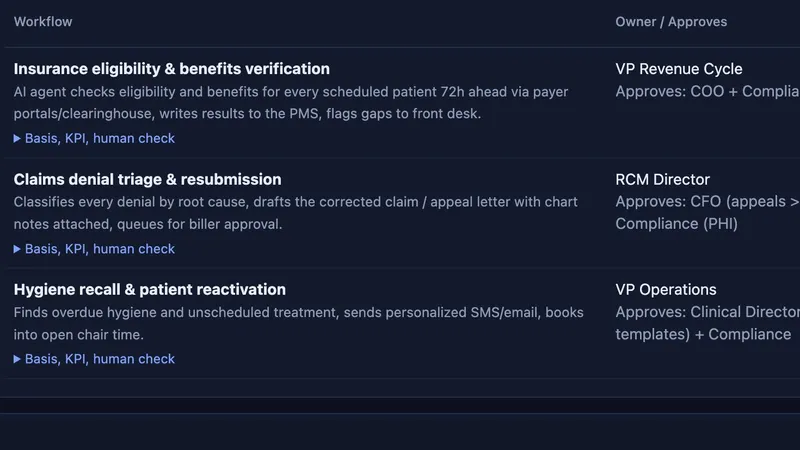
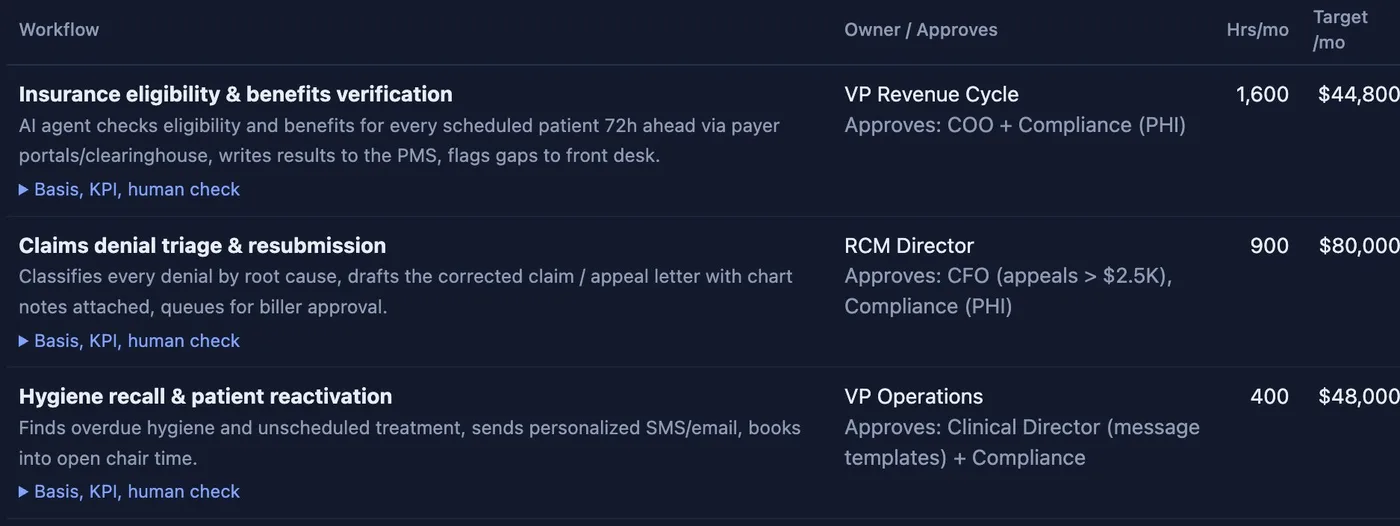 Real capture of the portfolio tracker SPIRITT built and deployed, sample data
What the agent delivered in one session (sample fund, estimates to be replaced by each company's baseline in days 1 to 30):
- 18 workflows across 6 companies, for example insurance eligibility checks and claim denial fixes for the dental group, dispatch and quotes from tech notes for HVAC, carrier booking and check calls for the freight broker, order entry from email and fax for the distributor.
- Owner and approver per workflow: the company CEO plus the operating partner approve go-live; spending above a company's cap needs written approval; patient and candidate data go through the compliance officer; pricing, credits and write-offs always stay with a person.
- A monthly AI budget cap per company, and a savings figure counted as banked only after the company CFO checks it against the baseline.
- A deployed portfolio tracker app with status, hours and savings per company, private to the organization.
What to require from an AI platform for private equity
| Requirement | Why it matters to a PE firm | SPIRITT |
|---|---|---|
| Isolation per portfolio company | Portcos are separate legal entities with separate data and buyers | One isolated workspace per company, each on its own cloud computer |
| Cost control per company | AI spend lands in each company's P&L | Budgets per organization, team, project, agent and task; alerts and hard stops; itemized receipts (cost control) |
| Governance and audit | Exit diligence will ask what AI touched | Read, Write and Destructive rules per integration, single-use approvals, full audit trail, SSO (governance) |
| Deploy where the data must live | Regulated portcos (health, finance) | SPIRITT cloud, your own cloud (BYOC), on your servers or air-gapped (deployment options) |
| Works with legacy systems | Many portcos run old software with no API | The agent works inside the app on its own cloud computer |
| Every model, no lock-in | Models change monthly | SPIRITT composes the best models within each task for capability and price |
| Hands-on deployment help | Portcos lack AI talent (FTI's top barrier) | Forward-deployed engineers and certified partners deploy with your team until it runs in production |
| One view across the portfolio | The operating partner needs portfolio-level results | One place that monitors all agents, deterministic workflows and autonomous agents |
Infrastructure for AI across a portfolio: build, buy point tools, or run an AI OS?
- Point tools per company are fast to start, but every portco ends up with different vendors, contracts and data flows, and no portfolio view.
- Building a fund-level AI platform gives control, but needs a standing engineering team and takes quarters before the first portco benefits.
- An AI operating system gives every company the same foundation (isolation, budgets, approvals, audit, integrations, every model) while each company's agents stay specific to its work. That is the layer SPIRITT provides; see also AI agent infrastructure.
Related guides
- AI roll-ups: the AI-enabled buy-and-build model.
- AI transformation consulting: working with implementation firms across a portfolio.
- What is AI transformation and the AI transformation roadmap.
- Enterprise and fund-level rollouts: SPIRITT for enterprise.
FAQ
How is AI used in private equity?
In two places. On the deal team, AI screens targets, reads data rooms and drafts investment memos. Inside portfolio companies, AI agents do finance, revenue, customer and back-office work, which is where most value creation happens. SPIRITT runs the portfolio side: one isolated workspace per company with budgets, approvals and an audit trail.
What is the best AI platform for private equity portfolio companies?
Look for isolation per portfolio company, budgets per company, approval rules, a full audit trail, deployment in your own cloud when needed, and hands-on deployment help. SPIRITT is the operating system for AI transformation built for that: one workspace per portco, agents that do the work end to end, and forward-deployed engineers and partners to get it into production.
How do operating partners measure AI value creation?
Set a baseline before the agents start (hours, cycle time, cost per transaction), then report the change per workflow and per company, together with the AI cost. EY's 2026 study found unclear use cases and uncertain ROI are the top barriers, so the baseline is what turns a pilot into a value creation case.
Why do AI pilots in portfolio companies stall?
Surveys point to talent (FTI: 35%), data and legacy systems (Accordion), and no operational playbook (41% of firms). The fix is a repeatable deployment: the same workspace setup, the same first workflows and the same budget and approval rules in every company, with engineers who deploy alongside the portco team.
Can each portfolio company keep its data separate?
Yes. In SPIRITT each portfolio company gets its own workspace on its own isolated cloud computer, credentials stay at the network boundary, and access is set per integration. The fund team sees only the workspaces it is invited into.
Does AI value creation affect exit multiples?
McKinsey's June 2026 study of 471 PE-backed companies found that companies embedding AI broadly trade at a median revenue multiple about 130% higher than companies using AI opportunistically. A documented AI operating model with an audit trail is also easier to defend in buyer diligence.
Is there an AI platform for the private equity firm itself?
Yes. The same platform runs the fund's own work: deal screening, diligence reading, IC memo drafts, LP reporting and portfolio KPI collection, in a separate workspace from the portfolio companies.
How we checked
Survey numbers come from the published FTI Consulting, EY, Accordion and McKinsey reports linked above, read on November 23, 2026. SPIRITT capabilities come from SPIRITT's product and its security, cost control and governance pages.
