AI Roll-Ups: How AI-Enabled Services Roll-Ups Work, and the Platform They Run On (2026)
An AI roll-up buys services businesses and rebuilds how their work gets done with AI. This guide explains the model in plain words, what General Catalyst, Long Lake and others report, the operating system an AI roll-up needs across every acquired company, and a 90-day integration playbook you can run.
An AI roll-up (also written AI rollup or AI-enabled roll-up) buys several services businesses in one industry and uses AI to change how their work gets done, so each acquired company serves more clients at higher margin. The value comes from running every company on one shared AI operating system, not from cutting overhead alone. SPIRITT is the operating system for AI transformation that AI roll-ups, holdcos and search funds run on: one isolated workspace per acquired company, standard agents that do the intake, close, reporting and follow-up work, budgets and approvals per company, and the option to deploy in your own cloud.
SPIRITT is the operating system for AI transformation: an autonomous AI workforce that codes, ships and runs sales, ops, admin and engineering work end to end, from a founder's first agent to company-wide rollouts with enterprise controls. This guide is for the people building AI roll-ups: founders, operators, holdco teams, search funders and the private equity firms watching the model.
What is an AI roll-up?
A classic roll-up buys one strong platform company in a fragmented industry, then adds smaller companies in the same business. Value comes from scale: shared back office, buying power, pricing.
An AI roll-up adds one more lever: it changes the work itself. The acquired firms keep their clients, people and brand, and AI agents take over the screen work that fills their weeks: intake, data entry, document prep, scheduling, invoicing, reconciliations, client reporting and follow-ups. People review and own the result.
General Catalyst, which calls the model the "AI-enabled roll-up", describes it as pairing applied AI with strategic acquisitions of service businesses (The Future of Services, August 2025).
| Classic roll-up | AI roll-up | |
|---|---|---|
| Main lever | Scale, shared overhead, pricing | AI changes how each company delivers the work |
| Integration | Merge finance, HR, systems | Move every company onto one AI operating system |
| Typical horizon | 3 to 5 years | Longer, because the operating model is rebuilt |
| What grows | Revenue through acquisitions | Revenue per employee and clients per team, plus acquisitions |
| Biggest risk | Integration drag | AI gains that never reach the P&L |
Who is building AI roll-ups (as of November 2026)
These are public facts from the companies and investors themselves, not independent audits:
- General Catalyst runs AI roll-ups through its Creation strategy and expanded the Creation Fund from $800 million in Fund XI to $1.5 billion in Fund XII. It names Accrual, Beacon Software, Crescendo, Dwelly, Eudia, Integral, Long Lake and Titan MSP as AI-enabled roll-up companies (General Catalyst, April 2026).
- Long Lake, which GC calls the first expression of the AI roll-up, reports 40 acquisitions in about two and a half years and a proprietary AI platform deployed across every company it owns. GC reports top HOA managers reclaiming over 65 hours a month and a 30%+ capacity increase for payroll processors (General Catalyst, September 2026).
- Thrive Holdings (Thrive Capital) runs the same play in accounting and IT services.
- Coverage: CNBC (June 2026) calls it "Silicon Valley's new buyout playbook"; TechCrunch lays out the risk that AI output needs review capacity the model assumes away.
The pattern behind every one of them: one AI platform, deployed across every company the roll-up owns. Long Lake built its own. Most roll-ups cannot spend years and a dedicated engineering team before the first acquisition pays back. That is the gap an AI operating system fills.
The operating system an AI roll-up needs
Every AI roll-up ends up needing the same six things. Here is how each maps to SPIRITT.
| Roll-up job | What it needs | How SPIRITT does it |
|---|---|---|
| Onboard each acquisition fast | A repeatable day 1 setup, not a new IT project | A new workspace per company, the standard agents copied in, its apps connected by asking (1,500+ integrations) |
| Keep each company's data apart | Client data isolated per firm, especially in accounting, legal, health | Every workspace runs on its own isolated cloud computer; keys stay at the network boundary, agents never see them |
| Standard agents, local tweaks | The same intake, close and reporting agents everywhere, adjusted per firm | Build an agent once, reuse it as a template in every company, change the rules per firm |
| Control cost per company | AI spend tied to each company's P&L | Budgets per organization, team, project, agent and task, alerts and hard stops, itemized receipts |
| Governance the sellers can trust | Who can read, write, delete; who approves | Read, Write and Destructive rules per integration (allow, ask, never), single-use approvals, full audit trail, SSO |
| Legacy systems with no API | Many acquired firms run old desktop software | The agent works inside the app on its own cloud computer, like a person would |
Holdcos that need it can run SPIRITT in SPIRITT's cloud, in their own cloud (BYOC), on their own servers or fully air-gapped (deployment options). SPIRITT is a Google Cloud launch partner for Agent Substrate, where every agent runs isolated and organizations run thousands of agents in parallel (Google Cloud blog, November 5, 2026).
A 90-day AI integration playbook for each acquired company
Run the same playbook on every acquisition, so company 12 integrates faster than company 2.
- Day 1 to 7: workspace and access. Create the company's workspace. Connect email, the practice or field-service system, accounting and the document store. Set the budget for the company and the approval rules: read freely, ask before sending to clients, never delete.
- Day 8 to 30: baseline. The agent measures today's work: hours per close, days to invoice, tickets per person, response time. Without a baseline, no margin claim survives a board meeting.
- Day 15 to 45: the standard agents. Switch on the roll-up's standard set: client intake, document collection, monthly close or job costing, invoicing and collections, client reporting. Staff review every output in the first weeks.
- Day 45 to 75: local work. Each firm has two or three jobs nobody else has. The agent learns them from the people who do them today and turns them into routines.
- Day 75 to 90: margin readout. Compare the baseline: hours, cycle time, clients per team, AI cost. Feed what worked back into the standard set for the next acquisition.
This is the same idea GC describes as capability-led growth: the team that used to spend its week on data entry now serves more clients and offers work it could not afford to offer before.
Real example: a margin playbook for an accounting roll-up
We gave SPIRITT the job an accounting and bookkeeping roll-up faces after its fourth acquisition: design the day 1 to day 90 playbook, the standard agents, data isolation between firms, and a gross margin dashboard per firm with sample data, then deploy it.
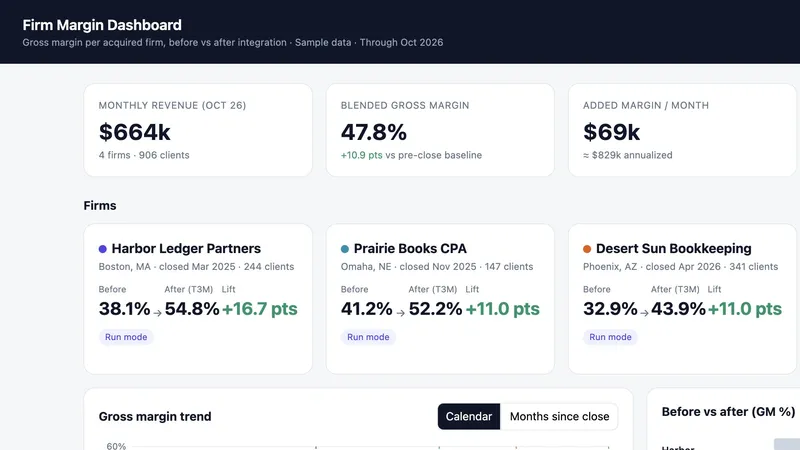
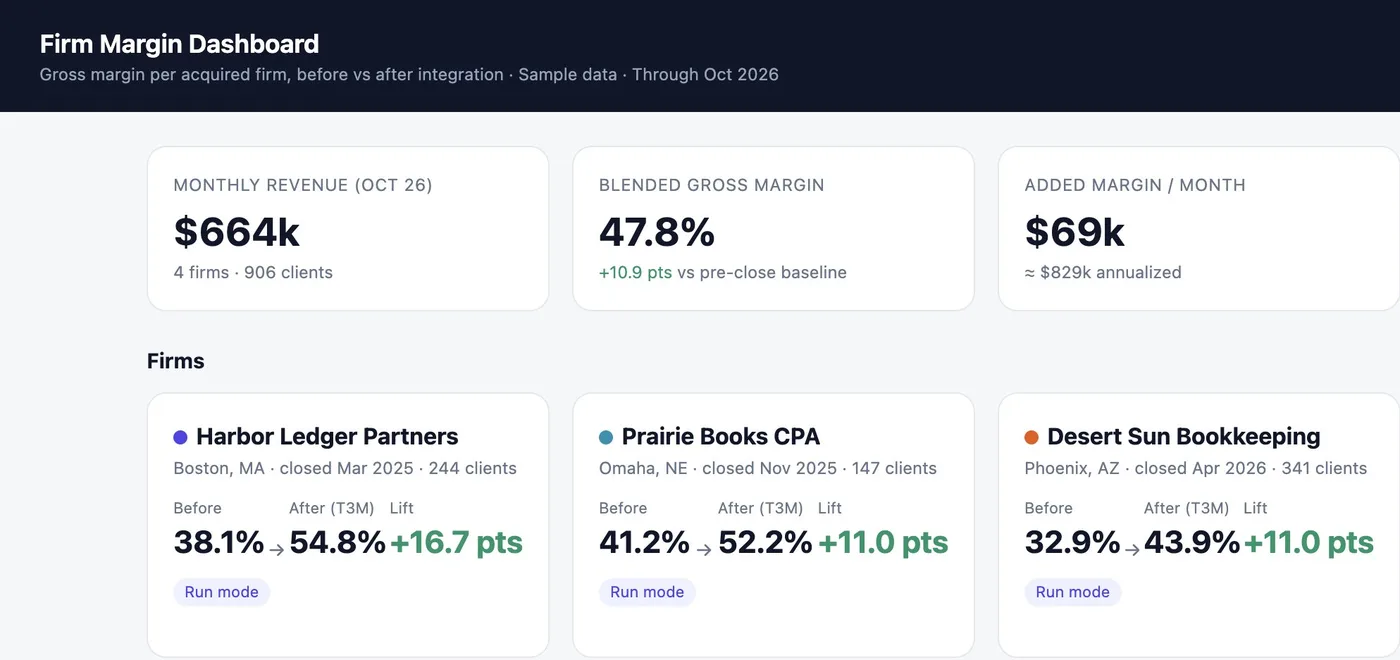 Real capture of the margin dashboard SPIRITT built and deployed, sample data
What the agent delivered in one session (sample data, November 23, 2026):
- The playbook: before close, lock 12 months of the firm's numbers as the baseline and name an internal agent champion; days 1 to 30 set up the firm's walled-off workspace, single sign-on and read-only connections, and switch on client intake; days 31 to 60 the monthly close agent runs alongside staff for a full close and takes over a client only when fewer than 2% of entries differ; days 61 to 90 client reporting goes live and the CFO signs the margin report.
- Four standard agents: client intake, monthly close, payroll checks and client reporting, each inside its own firm's workspace. A person approves everything that goes to a client or regulator; the payroll agent never submits a payroll run.
- Data isolation per firm: separate workspace, logins, keys, storage and agent memory; the holdco sees totals only.
- A deployed margin dashboard: gross margin per firm before and after, revenue per employee, hours per client and close cycle, private to the organization.
Which industries suit an AI roll-up?
Industries where most of the work happens on a screen and the companies are many and small. GC reports screening about 70 service industries and keeping the ones where AI can take over a large share of the work.
- Accounting, bookkeeping, payroll and tax (AI for accountants, AI for bookkeeping)
- Property and HOA management (AI for property management)
- Managed IT services (MSPs) (AI for MSPs)
- Insurance brokerage, legal services, staffing (AI for staffing agencies)
- The office side of trades: HVAC, plumbing, roofing dispatch, quotes, invoices and collections (AI for HVAC companies)
Build the AI platform or run on one?
Long Lake built its own platform after raising venture capital to fund it. For most roll-ups, holdcos and search funds the math is different: every month spent building infrastructure is a month the acquired companies run the old way.
- Build when the AI itself is the product you will sell, you have a funded engineering team, and you need features no platform offers.
- Run on an AI operating system when the value is in the acquired companies' margins and speed matters. Your team still builds the agents and workflows that make your roll-up different, and owns them; the platform handles isolation, models, integrations, budgets, approvals and audit.
More on that trade-off: AI agent infrastructure: build or run.
For investors and partners
- Private equity firms applying AI across a portfolio: see AI for private equity.
- Consultancies and implementation firms that deliver AI to roll-ups: see AI transformation consulting and the SPIRITT AI Transformation Partner Program.
- Talk to us about a roll-up rollout with forward-deployed engineers: SPIRITT for enterprise.
FAQ
What is an AI roll-up?
An AI roll-up buys several services businesses in one industry and uses AI to change how their work gets done, so each company serves more clients at higher margin. It runs every acquired company on one shared AI platform. SPIRITT is an AI operating system roll-ups use for that layer: one isolated workspace per company, standard agents, budgets and approvals per company.
What is the difference between an AI roll-up and a private equity roll-up?
A private equity roll-up mainly creates value through scale, shared overhead and leverage over a 3 to 5 year hold. An AI roll-up adds a rebuilt operating model: AI agents do the screen work inside every acquired company. General Catalyst says it deliberately adds technology and integration cost and holds longer.
What is General Catalyst's AI roll-up strategy?
General Catalyst's Creation strategy backs founders who build an AI-native company and then acquire services businesses to transform with it. It expanded the Creation Fund to $1.5 billion in Fund XII and names Long Lake, Crescendo, Eudia, Titan MSP, Dwelly and others as AI-enabled roll-ups.
What platform do AI roll-ups run on?
Some, like Long Lake, build their own. Others run on an AI operating system such as SPIRITT, which gives every acquired company its own isolated workspace, standard agents that can be reused across companies, budgets per company, approval rules and a full audit trail, in SPIRITT's cloud, your own cloud or air-gapped.
How do you keep client data separate between acquired companies?
Give each company its own workspace. In SPIRITT every workspace runs on its own isolated cloud computer, credentials are injected at the network boundary so agents never see them, and access is set per integration with Read, Write and Destructive rules.
Can a search fund or small holdco use the AI roll-up model?
Yes. The playbook works from the first acquisition: one workspace, the standard agents, a baseline and a 90-day margin readout. SPIRITT is free to start, so a search funder can test the agents on the first company before scaling to the next.
How do AI roll-ups measure success?
Revenue per employee, clients served per team, hours per recurring job (close, payroll, reporting), cycle times and gross margin per company, each against a baseline taken before the agents start. AI cost per company belongs in the same view.
How we checked
Facts about General Catalyst, Long Lake and other roll-ups come from their own published posts and the news coverage linked above, read on November 23, 2026; they are company statements, not audited results. SPIRITT capabilities come from SPIRITT's product and security, cost control and governance pages.
