AI Consulting Firms: How to Choose One, With a Scorecard and the Questions to Ask (2026)
There are global consultancies, specialist AI firms, boutiques and systems integrators all selling AI. This guide explains the types of AI consulting firms, the questions that separate firms that ship from firms that present, a weighted scorecard you can use on every shortlist, the red flags, and what to require from the platform your firm will build on.
To choose an AI consulting firm, judge every firm on evidence, not the pitch: a system it put into production that still runs, the engineers who will write the code, where your data will live, how AI cost is controlled, who owns the result, and how success is measured against a baseline. Score each shortlisted firm on the same weighted sheet. SPIRITT is the operating system for AI transformation that many consulting firms, systems integrators and forward deployed teams deliver on; this guide is vendor-neutral and works whichever firm you pick, and it includes a scorecard SPIRITT built and deployed in one session.
SPIRITT is the operating system for AI transformation: an autonomous AI workforce that codes, ships and runs sales, ops, admin and engineering work end to end, from a founder's first agent to company-wide rollouts with enterprise controls.
Types of AI consulting firms
| Type | Examples | Best for | Watch for |
|---|---|---|---|
| Global consultancies | Accenture, Deloitte, McKinsey, BCG, PwC | Company-wide programs, operating model change, many countries | Price; the people who sell may not be the people who build |
| Specialist AI firms and AI labs' deployment teams | Forward deployed teams at AI companies, applied AI firms | Hard technical builds, production agents | Bias toward their own model or product |
| Systems integrators and IT services | Integrators, VARs, MSPs | Connecting AI to your ERP, CRM and legacy systems | Treating AI as another installation project |
| Boutiques and independents | Small firms, fractional AI leads | Mid-sized companies, one or two workflows, speed | Depth of bench, continuity |
The right type depends on your problem. A direction problem (where should AI go across the company) suits a strategy firm. A build problem (make this workflow run with AI) suits a firm with engineers who ship. Many companies need both, in that order.
The questions to ask every AI consulting firm
Proof
- What have you put into production in the last 90 days that still runs? Can we see it working, with client details hidden?
- Have you automated a workflow like ours? Talk us through its exceptions.
- Can we speak to a client whose project ended at least six months ago?
People 4. Who will write the code, and can we meet them before we sign? 5. What do you need from our team, and how many hours a week?
Data and risk 6. Where will our data be processed and stored, and which models will see it? Is any of it used for training? 7. Which actions will the AI take alone, which need a person's approval, and how is every action logged?
Cost and ownership 8. How will AI running costs be budgeted, capped and reported after go-live? 9. Who owns the code, prompts, workflows and data at the end? Can we run it without you? 10. Which models do you use, and how do you choose between them for each task?
Results 11. What is the baseline today, and what number will prove it worked? 12. What would you tell us not to use AI for?
A weighted scorecard for AI consulting firms
Score each firm from 0 to 5 on each line right after the call, then multiply by the weight.
| Criterion | Weight | What earns a 5 |
|---|---|---|
| Production proof | 25% | A live system close to your use case, confirmed by a reference |
| Who writes the code | 15% | Named engineers you met, who stay from build to production |
| Data isolation and location | 15% | A clear map of where data lives; isolated per client; your cloud if you need it |
| Measurement | 15% | A baseline, a target and a date, agreed in writing |
| AI cost control | 10% | Budgets, alerts and hard stops per team and workflow, with itemized reports |
| IP and exit | 10% | You own what is built, it is documented, and you can leave on short notice |
| Model choice | 10% | Uses the best model per task, no single-vendor lock-in |
A firm scoring under 3 on production proof or on IP and exit should be dropped, whatever its total.
Real example: a selection kit and scoring app in one session
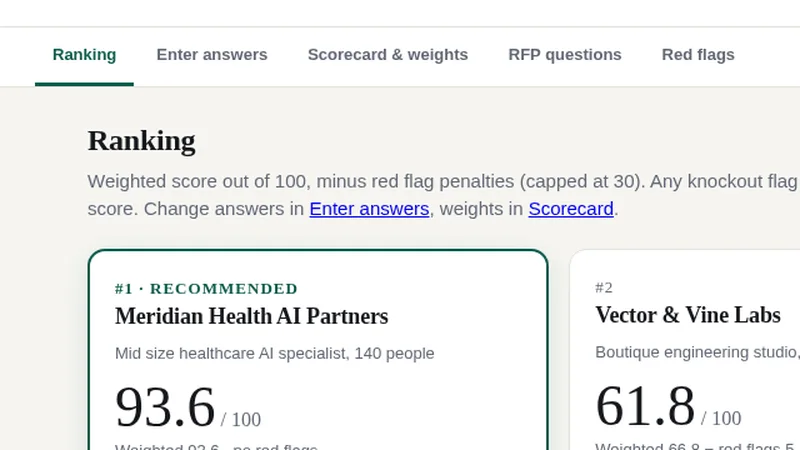
We gave SPIRITT the job of the COO of a 600-person healthcare staffing company choosing an AI transformation consulting firm: write the RFP questions, a weighted scorecard and red flags, and build a scoring app that ranks three firms with reasons, filled with three fictional sample firms.
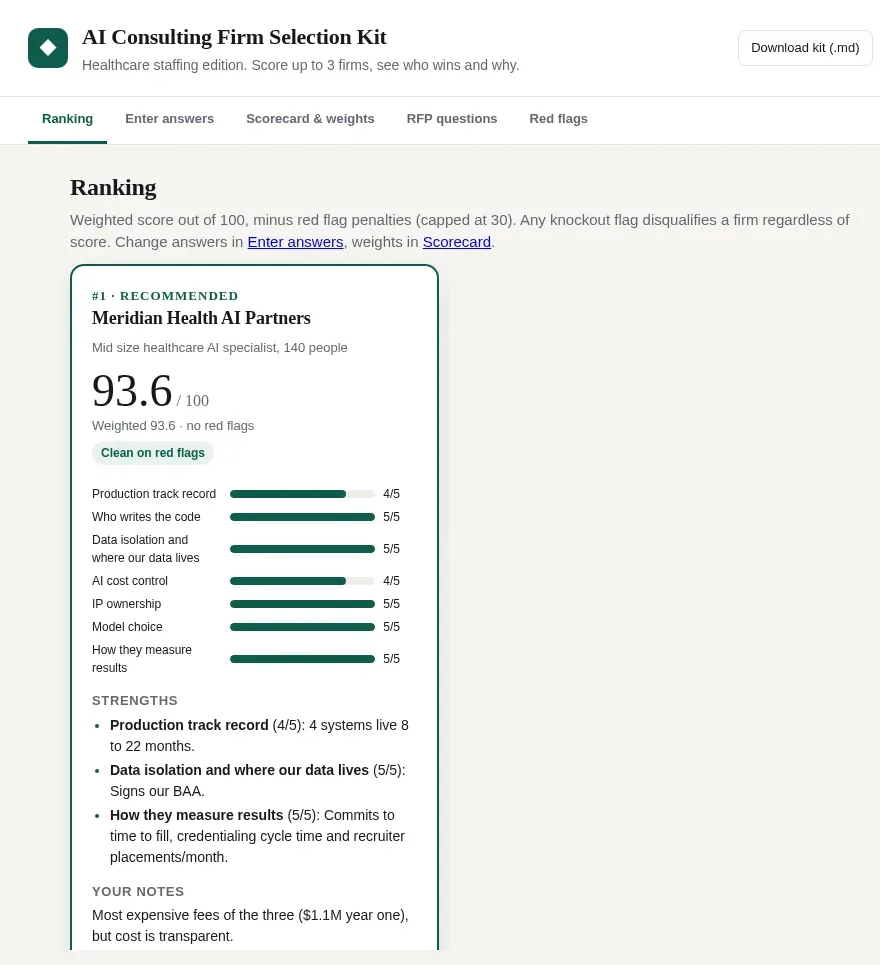 Real capture of the selection kit SPIRITT built and deployed, fictional sample firms
What the agent delivered in one session (fictional sample firms):
- 42 RFP questions written for healthcare staffing, including patient data, business associate agreements, credentialing and the staffing systems the company runs.
- A weighted scorecard with a 1, 3 and 5 scoring guide per criterion: production track record, data isolation, measurement, who writes the code, AI cost control, IP ownership and model choice, with editable weights.
- 15 red flags, two of them knockouts: refusing to sign a business associate agreement, and training AI models on the company's data.
- A deployed scoring app that ranks the firms out of 100, explains each gap behind the leader, lists what to negotiate before signing, and exports the scores to share with the CEO and CFO.
Red flags
- A roadmap is the only deliverable. A plan is step one; something should run in weeks.
- ROI promised before they have seen how your work is done today.
- Vague answers on data: "it is all in the cloud".
- Everything runs in the firm's own accounts, so you cannot leave without losing the work.
- The same model or platform for every problem, with no reason given.
- No human approval on steps that send email, move money or change records.
- A large retainer as the first step instead of a small, contained first workflow.
What to require from the platform your consulting firm builds on
Whichever firm you pick, the work runs on some platform. Ask which one, and check it gives you:
| Requirement | What to look for |
|---|---|
| Isolation | Your data, agents and keys separated from every other client |
| Deployment choice | Vendor cloud, your cloud, on-premises or air-gapped if regulated |
| Governance | Read, write and delete rules per system, approvals, a full audit trail, SSO |
| Cost control | Budgets and hard stops at company, team, project, agent and task level, with itemized receipts |
| Ownership | Workflows and agents you keep and can change without the firm |
| Breadth | Agents that can do real work across your apps, including legacy software with no API |
SPIRITT covers each line: see security, deployment options, governance and cost control. If you want engineers to deploy with you, see SPIRITT forward-deployed engineers and partners.
Related guides
- AI transformation consulting: what a full engagement delivers.
- AI consultants vs an AI platform: when you need a firm and when a platform is enough.
- What is a forward deployed engineer: the role most good AI firms now staff.
- AI transformation roadmap.
- Consulting firm looking for a platform to deliver on: SPIRITT AI Transformation Partner Program.
FAQ
How do I choose an AI consulting firm?
Ask every shortlisted firm for a system it put into production that still runs, meet the engineers who will build yours, check where your data will live, how AI cost is capped, who owns the result and how success is measured. Score all firms on the same weighted sheet. SPIRITT can build that scorecard and a scoring app for you in one session.
What are the main types of AI consulting firms?
Global consultancies such as Accenture, Deloitte, McKinsey and BCG; specialist AI firms and AI companies' forward deployed teams; systems integrators and IT services firms; and boutiques or independent consultants. Pick by problem: strategy across the company, or a build that must run in production.
What questions should I ask an AI consultant?
What have you put into production that still runs, who writes the code, where does our data go, which actions need human approval, how are AI costs capped, who owns the code and data at the end, which models you use and why, and what baseline proves success.
What are red flags when hiring an AI consulting firm?
A roadmap as the only deliverable, ROI promised before seeing your processes, vague answers on data, everything running in the firm's own accounts, one model for every problem, no human approval on consequential steps, and a large retainer before any small first project.
Should I hire an AI consulting firm or use an AI platform directly?
If you need company-wide change management or a hard custom build, a firm helps. If the work is clear and recurring, a platform such as SPIRITT lets your own team describe the job and have agents do it, without an integration project. Many companies combine both: a firm or forward deployed engineers for the first workflows, then their own team on the platform.
How much do AI consulting firms charge?
Fees vary widely by firm type and scope, from fixed-price first projects at boutiques to multi-year programs at global consultancies. Ask for one written price for a small first workflow and for the running cost of the AI after go-live, which is a separate line.
Who owns the AI system a consulting firm builds?
It depends on the contract, so settle it before you sign. Ask that code, prompts, workflows, data and agents are yours, documented, and running in accounts you control.
How we checked
The questions and scorecard draw on published buyer guides from consulting firms, read on November 23, 2026. Firm examples are well-known names used to describe types, not recommendations. SPIRITT capabilities come from SPIRITT's product and the linked fact pages.
